
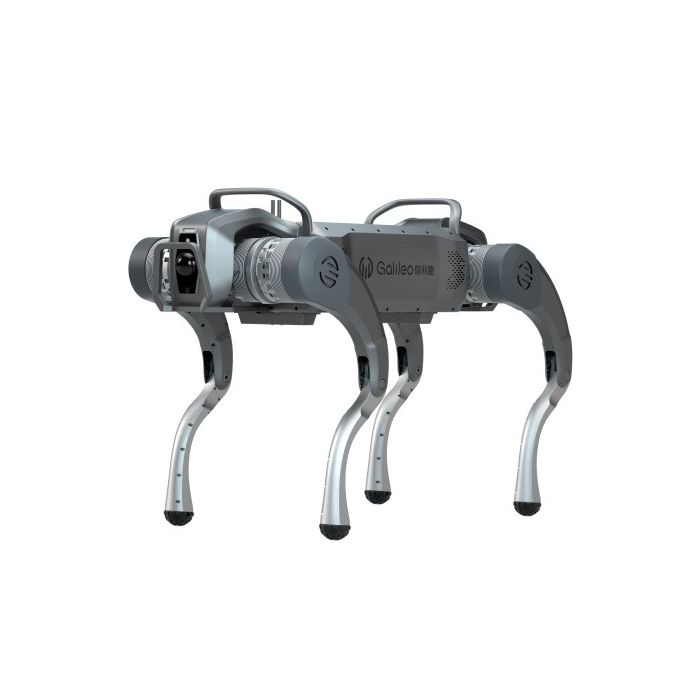
Galileo S1 Large Industrial Grade Quadruped Robot Dog
In stock
- BRAND:
- GALILEO
- MODEL:
- S1
- ORIGIN:
- China
- Warranty:
- 12 MONTHS
- AVAILABILITY:
- SUBJECT TO AVAILABILITY
- SKU:
- GALILEO-S1
Galileo S1 Large Industrial Grade Quadruped Robot Dog
Most walking robots are built to impress in a hall; the Galileo S1 Large Industrial Grade Quadruped Robot Dog is built for the places where a wheeled cart gives up, such as a steep slope, a stack of steps, a dusty plant floor or a collapsed corridor. It is a heavy machine with a working purpose, and the specification sheet reads like it.
The product is available through this page, by quotation.
Background
The Galileo S1 Series and its lineage
The Galileo S1 Series sits at the large end of the Galileo family of bionic quadruped robots. The manufacturer describes it as a heavy-duty, large-scale bionic robot designed for demanding professional scenarios: industrial inspection, plateau material transportation, large-equipment mounted inspection and emergency rescue. Smaller members of the family, such as the Galileo E1 Quadruped Robot Dog and the Galileo C1 Small Quadruped Robot Dog, serve lighter duties, while the S1 takes on the work that needs more body, more battery and more carrying strength.
Within the series, the sources name two versions: the S1, a legged model, and the S1-W, its wheeled counterpart. The two share many figures, including the battery, the control system and the protection rating, and they differ in body height, weight, speed, climbing ability and endurance. This page covers the S1 and shows the S1-W alongside it so that the two can be compared honestly.
Positioning and key technology
The S1 is a platform rather than a single-purpose tool. Its body carries two 60Ah batteries rated at 59V, a dual-processor control system and customizable payload interfaces, so that inspection sensors, transport bins or rescue equipment can be fitted according to the job. The control system combines a domestic ARM low-power high-performance CPU (8 cores, 8 threads, 8GB RAM, 64GB SSD) with an X86 low-power high-performance CPU (4 cores, 8 threads, 16GB RAM, 256GB HDD).
Connectivity covers WIFI6 dual-band wireless and an app, and the external interfaces include Ethernet, USB3.0 and RS485, which can be expanded as needed. Power can be taken from external 48V and 24V interfaces, also expandable as needed. For a robot that may sit in a remote location, the low power mode is notable: it lasts at least 365 days and supports remote wake-up. Autonomous charging is supported as well.
Technical Specifications
| Specification | S1 | S1-W |
|---|---|---|
| Standing dimensions (L x W x H) | 1200x550x650mm | 1200x550x760mm |
| Weight | 118kg | 128kg |
| Battery capacity | 60Ah (3540Wh, Dual Batteries) | 60Ah (3540Wh, Dual Batteries) |
| Battery type | Lithium Battery | Lithium Battery |
| Battery rated voltage | 59V | 59V |
| Charger input | 100V~240V | 100V~240V |
| External power interface | 48V; 24V (expandable as needed) | 48V; 24V (expandable as needed) |
| External communication interface | Ethernet; USB3.0; RS485 (expandable as needed) | Ethernet; USB3.0; RS485 (expandable as needed) |
| Low power mode | ≥365 days, supports remote wake-up | ≥365 days, supports remote wake-up |
| Autonomous charging | Supported | Supported |
| Movement speed | 0-3.5m/s (adjustable) | 0-6m/s (adjustable) |
| Maximum climbable slope | ≥30° | ≥30° |
| Climbable height | 30cm high consecutive steps; forward height difference 80cm platform | 30cm high consecutive steps; forward height difference 110cm platform |
| Endurance time | 3.5-5h | 2.5-4h |
| Continuous walking load | 100kg | 100kg |
| Maximum standing load | 170kg | 170kg |
| CPU | Domestic ARM low-power high-performance CPU (8 cores 8 threads / 8GB RAM / 64GB SSD) + X86 low-power high-performance CPU (4 cores 8 threads / 16GB RAM / 256GB HDD) | Same as S1 |
| WIFI6 dual-band wireless | Supported | Supported |
| APP | Supported | Supported |
| Protection rating | IP67 | IP67 |
| Operating environment temperature | -20℃~55℃ | -20℃~55℃ |
Specifications as published by the manufacturer; confirmed against the datasheet at quotation.
The manufacturer has not published the sensors fitted, the camera and lidar specifications, the contents of the box, the joint degrees of freedom, the noise level, the charging time or the software and SDK compatibility; they are confirmed at quotation.
What makes the Galileo S1 different from a wheeled robot?
The question is fair, because the S1 family includes a wheeled sibling, the Large Industrial Grade Wheeled Quadruped Robot Dog. The sheet shows a clear trade. The wheeled S1-W is faster, at 0-6m/s against 0-3.5m/s, and it can reach a 110cm forward platform where the S1 reaches 80cm. The S1 in turn is lighter at 118kg against 128kg, and it runs longer, with 3.5-5h of endurance against 2.5-4h.
Both versions climb 30cm high consecutive steps and a slope of at least 30°, and both carry 100kg while walking. So the choice is less about raw strength and more about the kind of route. A site with long, fairly open runs may favor the faster version, while one that asks for longer shifts between charges may favor the S1.
How does the S1 handle long unattended duty?
Endurance is only part of the picture. The S1 carries two lithium batteries totaling 60Ah (3540Wh), and it supports autonomous charging, so it can return to recharge without an operator walking over to it. When a site goes quiet, the low power mode holds for at least 365 days and the robot can be woken remotely.
The body is rated IP67 and the operating temperature runs from -20℃ to 55℃. WIFI6 dual-band wireless and the app give the operator a way to reach the machine, while Ethernet, USB3.0 and RS485 give the payload a way to talk to the robot. Together these features suit a unit that stays on site and is called on when needed.
Who is the Galileo S1 for?
Plant and utility operators will find the most obvious fit: inspection rounds in facilities where equipment is large and the ground is uneven. Mining, energy and infrastructure teams working at altitude or in rough terrain can use the S1 for carrying material, since the manufacturer names plateau material transportation among its uses and rates continuous walking load at 100kg.
Emergency services and rescue organizations may value the strength to stand under a load of up to 170kg and the ability to climb steps and platforms. Those teams can also look at the Emergency Response category for related machines. Integrators and research groups, finally, can use the customizable payload interfaces and the two-processor control system as a base for their own equipment.
If your routes are long and open and speed matters more than endurance, the wheeled S1-W deserves a look. If your needs are lighter, the Standard Quadrupeds category lists smaller models.
What is the Galileo S1 used for?
- Industrial inspection: regular rounds through plants and yards, carrying inspection sensors on the payload interfaces.
- Plateau material transportation: moving loads over high, uneven ground where vehicles struggle, with a 100kg continuous walking load.
- Large-equipment mounted inspection: working around big machines, climbing steps and platforms to reach what needs checking.
- Emergency rescue: entering ground that is unsafe or hard to reach, carrying rescue equipment fitted to the body.
- Remote site watch: staying on site in low power mode and waking remotely when a task comes up.
- Custom payload development: hosting transport bins or sensor packages through Ethernet, USB3.0, RS485 and 48V or 24V power.
Pricing and Availability
Prices are given by quotation and not listed on the page. Send us your site conditions, the payload you plan to carry and the version you prefer, and we will prepare an offer. Delivery, customs and support are arranged with the quotation. The Galileo S1 Large Industrial Grade Quadruped Robot Dog is available on this page.
Frequently Asked Questions
How much can the Galileo S1 carry?
The continuous walking load is 100kg, and the maximum standing load is 170kg. Both figures are the same for the S1 and the S1-W.
How long does the battery last?
The S1 has an endurance time of 3.5-5h, using dual 60Ah batteries rated at 59V. The wheeled S1-W is listed at 2.5-4h.
Is the S1 protected against dust and water?
Yes, the protection rating is IP67. The operating temperature range is -20℃ to 55℃.
What can it climb?
The S1 climbs slopes of at least 30° and 30cm high consecutive steps, and it manages a forward height difference of an 80cm platform. The S1-W reaches a 110cm platform.
Can I fit my own sensors or equipment?
Customizable payload interfaces allow inspection sensors, transport bins and rescue equipment to be integrated. Ethernet, USB3.0 and RS485 are available, and power is offered at 48V and 24V.
Does it charge itself?
Autonomous charging is supported, and the charger input is 100V~240V. The charging time is confirmed at quotation.
Where can I buy the Galileo S1 and what does it cost?
It is available through this page by quotation. The cost depends on the version and configuration, so request a quotation and we will answer with an offer, including delivery and support.
Summary
The Galileo S1 is a quadruped for places where wheels fall short: a heavy-duty body with two batteries, IP67 protection, a 100kg continuous walking load and a low power mode that can wait a year for a call. Its wheeled sibling trades some endurance for speed and reach, so the choice comes down to your route and your shift. To compare configurations and request an offer, this page is the starting point.


