
Galileo E1-W Wheeled Quadruped Robot Dog
In stock
- BRAND:
- GALILEO
- MODEL:
- E1-W
- ORIGIN:
- China
- Warranty:
- 12 MONTHS
- AVAILABILITY:
- SUBJECT TO AVAILABILITY
- SKU:
- GALILEO-E1-W
Galileo E1-W Wheeled Quadruped Robot Dog
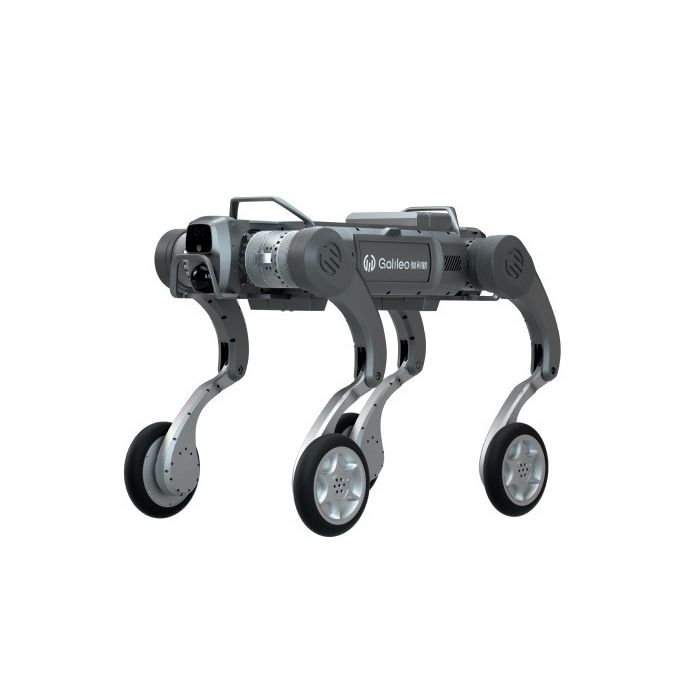
Most robots make you choose: legs that can climb but crawl, or wheels that fly but stall at the first step. The Galileo E1-W Wheeled Quadruped Robot Dog refuses the choice. Its wheel-leg integrated structure lets one machine roll quickly over open ground and then use its legs to take on stairs, gravel and raised platforms.
The product is available through this page, by quotation.
Background
The Galileo line and the E1 family
GALILEO builds quadruped robot dogs for work rather than for show. The range runs from small platforms to large industrial-grade machines, and it comes in both pure legged and wheeled forms. The E1 family sits in the middle of that range. It is a mid-to-heavy platform meant for teams that need to carry sensors and equipment through real sites and bring them back again.
Within the family, the sources name two versions: the E1 and the E1-W. The suffix matters. The E1-W is the wheeled version, and everything on this page about speed, range and endurance belongs to it. If your work does not need wheels, the Galileo E1 Quadruped Robot Dog is the sibling to compare. Buyers who want a larger frame can look at the Large Industrial Grade Wheeled Quadruped Robot Dog, and buyers who want a smaller one can look at the Galileo C1-W Wheeled Quadruped Robot Dog.
Wheel-leg design and key technology
The E1-W has a wheel-leg integrated structural design. The wheels and the legs are not two systems bolted together. They are one body that can switch between rolling and stepping as the ground demands. The body has 16 degrees of freedom, which allows more complex posture adjustments and fine operations. Joint torque reaches 200Nm, which gives the powerful and stable output behind its climbing ability.
Perception is built in as standard. The robot carries 2 LiDARs and 2 HD cameras, mounted front and rear. The two perception devices work together to give 360° all-round environmental perception. Control comes from two processors working side by side: an ARM low-power high-performance CPU with 8 cores, 8 threads, 8GB RAM and a 64GB SSD, and an X86 low-power high-performance CPU with 4 cores, 8 threads, 16GB RAM and a 256GB HDD. The whole series supports secondary development, so engineering teams can build their own behavior on top of the platform.
Technical Specifications
| Specification | Galileo E1-W |
|---|---|
| Structure | Wheel-leg integrated |
| Standing dimensions (L x W x H) | 995*537*630mm |
| Weight | 60kg |
| Degrees of freedom | 16 |
| Joint torque | 200Nm |
| Movement speed | 0-6m/s (Adjustable) |
| Slope climbing capability | ≥30° |
| Climbable height | Forward height difference 100cm platform |
| Continuous walking load | 30kg |
| Maximum load | 100kg (Standing load) |
| Battery capacity | 30Ah (1440Wh) |
| Battery rated voltage | 48V |
| Endurance time | 2.5-4h |
| Range | >15km |
| Protection rating | IP67 |
| Operating temperature | -20℃~55℃ |
| External communication interface | Ethernet; USB; TypeC (Interface expandable as needed) |
| External power interface | 48V; 24V (Expandable as needed) |
| Autonomous charging | Supported |
| Low power mode | ≥365 days, supports remote wake-up |
| Sensors | 2 LiDARs and 2 HD cameras, front and rear |
Specifications as published by the manufacturer; confirmed against the datasheet at quotation.
The manufacturer has not published the package contents, the charger's ingress-protection details, the camera resolution, the LiDAR model, the details of the software platform or the noise level; these are confirmed at quotation.
What makes the E1-W different from the E1?
The answer starts with the wheels. The E1-W is the wheel-legged version, so it can cover ground at an adjustable speed between 0 and 6m/s and reach a range of more than 15km. A purely legged robot spends energy on every step. A wheel-leg machine can roll over flat sections and save its legs for the places that need them. For a patrol route that runs along corridors, yards and access roads before it meets a staircase, that is a practical advantage.
The E1-W also gives up nothing in obstacle work. It climbs a forward height difference of a 100cm platform and handles slopes of ≥30°. Stairs, mountains and gravel roads are the kind of terrain it is built for. Its weight is 60kg, and its standing dimensions are 995*537*630mm. The protection rating is IP67, which suits outdoor deployment in rain and dust. The operating temperature runs from -20℃ to 55℃.
If your sites are mostly stairs, rubble and tight indoor spaces, the plain E1 is the version to quote alongside it. If your routes are long and mostly open, the E1-W is the stronger fit.
How long can the E1-W work on one charge?
The battery is 30Ah (1440Wh) at a rated voltage of 48V. Endurance is 2.5-4h, and range is more than 15km. The span depends on speed, load and terrain, which is why a heavy load on stairs sits at one end and a light run on flat ground at the other.
Two features reduce the downtime that usually limits a patrol robot. Autonomous charging is supported, so the robot can return to its dock without an operator. A low power mode lasts ≥365 days and supports remote wake-up, so a robot can wait at a remote site and be called into service when needed.
Who is the Galileo E1-W for?
Operators of large sites are the clearest buyers. Examples include plants, depots, campuses and utility yards, where a person on foot cannot cover the ground often enough. The speed, the range and the three control modes (remote control, autonomous inspection and accompanying patrol) let one robot serve routine rounds and special tasks. The operator switches between modes according to scenario complexity and operational requirements.
Emergency and rescue teams are a second group. A robot that can enter an area first, climb over obstacles and send back 360° perception reduces the risk to people. Teams in this field can also browse our Emergency Response category.
Research groups and integrators make up the third group. The full series supports secondary development, and the interfaces are Ethernet, USB and TypeC, with 48V and 24V power outputs; both can be expanded as needed. That makes the E1-W a base for payloads and custom software. See also our Research Robots category. Buyers who need a larger frame should compare the larger wheeled model named above.
What is the Galileo E1-W used for?
- Industrial inspection. The robot follows a route autonomously and views equipment through its cameras and LiDARs.
- Security patrol. It makes regular rounds of a site at an adjustable speed, and it can be woken remotely from its low power mode.
- Emergency response. It goes ahead of people into uncertain areas and climbs platforms and slopes on the way.
- Accompanying patrol. It travels alongside staff in the accompanying patrol mode, carrying equipment with a continuous walking load of 30kg.
- Equipment carrying. It carries instruments and tools, with a maximum standing load of 100kg.
- Development and research. Secondary development and expandable interfaces let teams build their own applications on it.
Pricing and Availability
We do not print prices on this page. Every Galileo E1-W is quoted for the project it will serve, because configuration and application decide what you need. Send us your site, your payload and your timeline, and we will respond with a quotation. Delivery, customs and support are arranged with the quotation, so you see the whole picture before you commit. The Galileo E1-W Wheeled Quadruped Robot Dog is available on this page.
Frequently Asked Questions
What is the protection rating of the E1-W?
The E1-W has a protection rating of IP67. It operates in temperatures from -20℃ to 55℃.
How fast is the E1-W?
Its movement speed is adjustable from 0 to 6m/s. The speed can be set to suit the site and the task.
How much can it carry?
The continuous walking load is 30kg, and the maximum load is 100kg as a standing load. Plan your payload against the walking figure for patrol work.
What obstacles can it climb?
It climbs a forward height difference of a 100cm platform and slopes of ≥30°. Stairs, mountains and gravel roads are also terrain it is built to handle.
Can we develop our own software for it?
Yes, the full series supports secondary development. The robot has Ethernet, USB and TypeC communication interfaces, which can be expanded as needed.
What sensors does it have?
It has 2 LiDARs and 2 HD cameras, mounted front and rear, which together give 360° environmental perception.
Where can I buy the Galileo E1-W and what does it cost?
You can request it through this page. The cost is given in a quotation prepared for your project, with delivery, customs and support arranged alongside it.
Summary
The Galileo E1-W answers the old trade-off between wheels and legs with one body that does both. It rolls at up to 6m/s, climbs a 100cm platform, and carries up to 100kg standing load under an IP67 rating. Two LiDARs, two HD cameras, three control modes and a platform open to secondary development make it more than a fast vehicle. Whether you run a patrol, prepare for an emergency or build your own robotic application, this page is the starting point.


