
Galileo EX-1 Intelligent Bionic Explosion-Proof Quadruped Robot
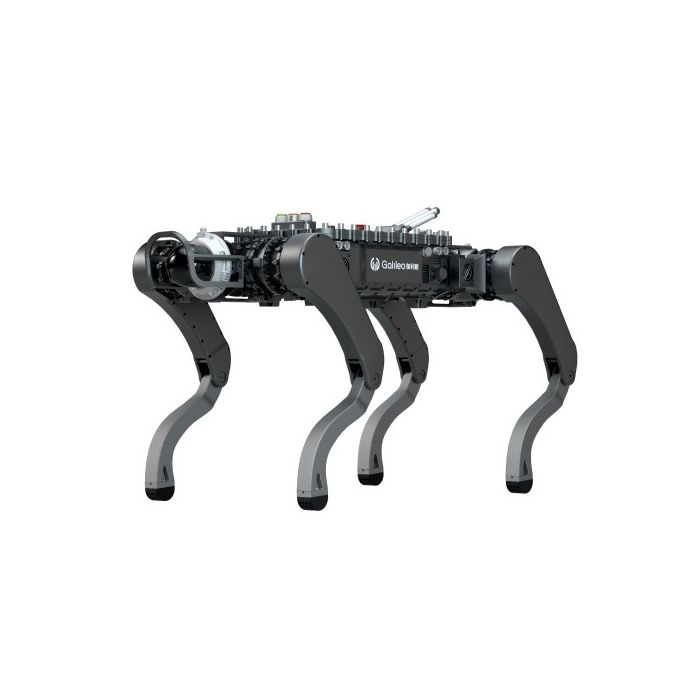
In stock
- BRAND:
- GALILEO
- MODEL:
- EX-1
- ORIGIN:
- China
- Warranty:
- 12 MONTHS
- AVAILABILITY:
- SUBJECT TO AVAILABILITY
- SKU:
- GALILEO-EX-1
Galileo EX-1 Intelligent Bionic Explosion-Proof Quadruped Robot
Some jobs are too dangerous to send a person into, and too demanding for a machine that cannot walk over rubble, steps and ditches. The Galileo EX-1 Intelligent Bionic Explosion-Proof Quadruped Robot is built for exactly that gap: a four-legged walker that carries sensors into places where a spark could be fatal, while its operator stays well clear.
The product is available through this page, by quotation.
Background
The company behind the EX-1
The EX-1 comes from Galileo (Tianjin) Technology Co., Ltd., a robotics company established in 2021 and headquartered in Tianjin. The company builds quadruped robots under the GALILEO brand, and the EX-1 belongs to a family of walking platforms that also includes industrial, wheeled and compact models. Within that family, the EX-1 is the one designed around hazardous atmospheres.
For buyers in the Caribbean, this lineage matters in a practical way. Energy terminals, fuel storage, chemical handling and emergency services all share one problem: some areas cannot be entered casually. A robot developed specifically for those areas, rather than adapted afterward, gives a project team a clearer starting point for planning.
Positioning and key technology
The EX-1 is designed specifically for high-risk environments such as emergency rescue and petrochemical sites. Its explosion-proof rating is Ex ⅡB T4 Gb, and its protection rating is IP66. Together, these two ratings define where the robot is meant to work: in potentially explosive atmospheres and in conditions where dust and water are a fact of daily life.
Underneath, the robot has 12 degrees of freedom in total. Its joints are driven by high stiffness, high power density permanent magnet synchronous motors, with a maximum joint torque of 500Nm. Perception comes from one lidar and dual depth cameras. Autonomous navigation and secondary development are supported, and an Ethernet external interface is provided for integration work. Control runs over 5G or 4G, so the operator and the machine can be in separate places.
Technical Specifications
| Specification | Value |
|---|---|
| Explosion-proof rating | Ex ⅡB T4 Gb |
| Protection rating | IP66 |
| Standing dimensions (L x W x H) | 1300*650*790mm |
| Weight with battery | 120kg |
| Total degrees of freedom | 12 |
| Battery | 48V lithium battery, 45.2Ah (2160Wh) |
| Endurance time | 2h |
| Continuous walking load | 30kg |
| Slope climbing capability | 30° |
| Stair walking capability | 25cm steps |
| Obstacle crossing ability | 25cm |
| Ditch crossing width | 30cm |
| Movement speed | 1.0m/s |
| Maximum joint torque | 500Nm |
| Joint motor type | High Stiffness High Power Density Permanent Magnet Synchronous Motor |
| Perception sensors | Lidar*1; dual depth cameras |
| Remote control | 5G/4G |
| Supported payloads | Dual-light PTZ, methane-only gas detection sensor, voice intercom module, speaker |
| Supplied accessories | Charger and explosion-proof tablet controller |
| Software | Autonomous navigation and secondary development supported; Ethernet external interface |
Specifications as published by the manufacturer; confirmed against the datasheet at quotation.
The manufacturer has not published the dimensions when folded, the battery charging time, the wireless remote control range, the ingress rating of the controller or the certification number; they are confirmed at quotation.
What makes the Galileo EX-1 different from an ordinary quadruped robot?
The first difference is the rating. An ordinary inspection robot is judged on mobility and sensing. The EX-1 is judged first on whether it may enter the area at all, and its Ex ⅡB T4 Gb explosion-proof rating is the answer to that question. The IP66 protection rating adds resistance to the dust and water that outdoor plants and emergency scenes bring with them.
The second difference is how the whole package is assembled around the hazard. The robot ships with an explosion-proof tablet controller, so the device in the operator's hands is also meant for the environment. The payload list follows the same logic: a dual-light PTZ, a methane-only gas detection sensor, a voice intercom module and a speaker. These are the tools of an inspection or rescue task, not general accessories.
The third difference is what the legs can do. The EX-1 walks 25cm steps, crosses 25cm obstacles and 30cm ditches, and climbs 30° slopes while moving at 1.0m/s. Wheels are fast on smooth floors, but a legged machine with 12 degrees of freedom and a maximum joint torque of 500Nm is aimed at broken, cluttered and uneven ground, where industrial sites and disaster scenes often leave a robot with no other choice.
How does the EX-1 keep the operator out of danger?
The design starts from separation. The robot supports 5G and 4G remote control, which enables zero-risk operation in separated human-machine scenarios. The operator works from the explosion-proof tablet controller while the robot enters the hazardous zone alone.
What the operator sees comes from the lidar and the dual depth cameras, and what the robot can measure comes from its payloads. With the methane-only gas detection sensor fitted, it can check an area for methane before anyone walks in. With the voice intercom module and speaker, it can speak with a person who is trapped or give instructions to a crew at a distance. Autonomous navigation is supported, which lets teams plan repeatable routes rather than steering every metre by hand.
Because secondary development is supported and an Ethernet external interface is provided, integrators can connect the robot to their own software and data systems. Any project that depends on a particular control distance should raise it when requesting a quotation.
Who is the Galileo EX-1 for?
The first group is petrochemical and energy operators. Refineries, tank farms, pipelines and processing units contain areas where gas may be present, and routine patrols there carry risk. A robot rated for such areas can take over the walk-through, the gas check and the visual inspection.
The second group is emergency rescue and fire services. Their scenes are unpredictable, with stairs, debris, slopes and gaps, and the atmosphere may be unknown on arrival. The EX-1's stair, slope, obstacle and ditch figures, its 30kg continuous walking load and its intercom and speaker payloads suit that kind of first look into a danger zone.
The third group is system integrators and research teams. With autonomous navigation, secondary development and an Ethernet external interface available, they can build site-specific inspection routines on a platform that already carries the explosion-proof rating.
Buyers whose work is in ordinary, non-hazardous settings may not need the explosion-proof rating at all, and should say so when they ask for a quotation so that the right model can be discussed.
What is the Galileo EX-1 used for?
- Petrochemical inspection. Walks patrol routes through plants and storage areas that people should not enter casually.
- Methane detection. Carries the methane-only gas detection sensor to check an area before a crew goes in.
- Emergency rescue reconnaissance. Climbs steps and crosses obstacles to give responders a first look at a hazardous scene.
- Remote visual inspection. Uses the dual-light PTZ, the lidar and the dual depth cameras to send back what the site looks like.
- Voice contact at a distance. Uses the voice intercom module and speaker to talk with trapped people or direct a crew.
- Custom automation projects. Supports autonomous navigation, secondary development and an Ethernet external interface for integrator-built workflows.
Pricing and Availability
Every EX-1 is quoted for the project it will serve, so no prices are listed here. Quotation is the next step: tell us the site, the payloads you need and the timing, and we will respond with a proposal. Delivery, customs and support are arranged together with the quotation, so that nothing is left to chance once the robot is ordered. The Galileo EX-1 Intelligent Bionic Explosion-Proof Quadruped Robot is available on this page.
Frequently Asked Questions
What explosion-proof rating does the EX-1 have?
The explosion-proof rating is Ex ⅡB T4 Gb, paired with an IP66 protection rating.
How long does the battery last?
The robot carries a 48V lithium battery of 45.2Ah (2160Wh), which provides an endurance time of 2h under standard conditions.
What can the EX-1 carry?
It has a continuous walking load of 30kg. The supported payloads are a dual-light PTZ, a methane-only gas detection sensor, a voice intercom module and a speaker.
What terrain can it handle?
It walks 25cm steps, crosses 25cm obstacles and 30cm ditches, and climbs slopes of 30°. Its movement speed is 1.0m/s.
How is the robot controlled?
It supports 5G and 4G remote control, and an explosion-proof tablet controller is supplied with it.
Can it be integrated with our own systems?
Yes. Autonomous navigation and secondary development are supported, and the robot has an Ethernet external interface.
Where can I buy the Galileo EX-1 and what does it cost?
You can request it through this page, where it is available by quotation. We do not list a price here; the quotation covers the configuration, delivery, customs and support for your project.
Summary
The question behind the EX-1 is simple: how do you look inside a place you cannot safely enter? This robot answers with an Ex ⅡB T4 Gb explosion-proof rating, IP66 protection, a legged body that handles steps, slopes and ditches, and 5G or 4G control from a safe distance. Its 30kg walking load, methane detection, intercom and camera payloads make it a working tool for hazardous sites rather than a demonstration. If your project involves petrochemical, rescue or similar high-risk environments, this page is the starting point.


