
Galileo SH1 Dual Arm Wheeled Humanoid Robot
In stock
- BRAND:
- GALILEO
- MODEL:
- SH1
- ORIGIN:
- China
- Warranty:
- 12 MONTHS
- AVAILABILITY:
- SUBJECT TO AVAILABILITY
- SKU:
- GALILEO-SH1
Galileo SH1 Dual Arm Wheeled Humanoid Robot
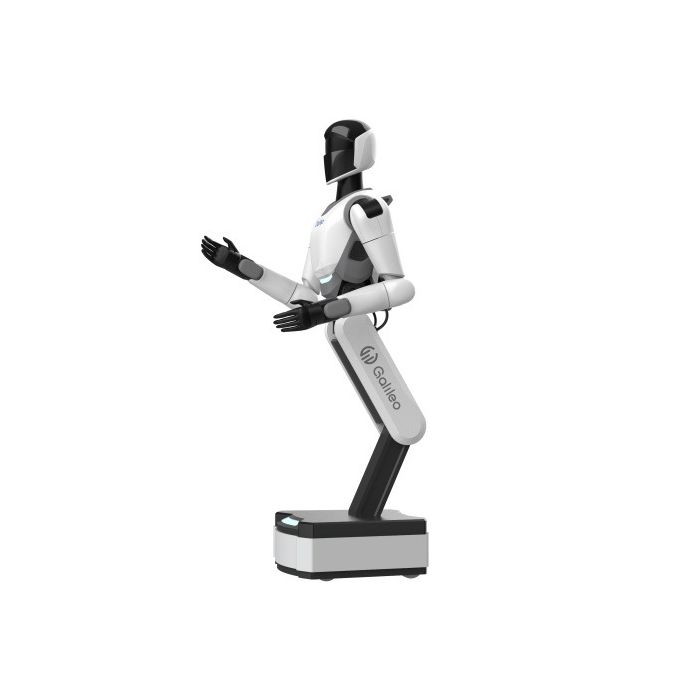
Most robots do one thing well: they roll, or they grip, or they look. The Galileo SH1 Dual Arm Wheeled Humanoid Robot is built on the opposite idea, that a single machine should travel to the job, see it, and use both hands to do it. It puts an omnidirectional wheeled base under a two-armed upper body, so a task that would normally need a vehicle, a camera mast and a pair of operators can be handled by one platform.
The Galileo SH1 is available through this page, by quotation.
Background
Galileo and the wheeled humanoid line
GALILEO is the brand behind the SH1, and the robot sits within a wider range that also includes humanoid and quadruped platforms. The SH1 belongs to the wheeled humanoid family: a human-like upper body, with two arms and a head, mounted on a wheeled chassis instead of legs. Teams that want to compare it with other machines of this kind can browse the Wheeled Humanoids category, and those exploring platforms for laboratories and development projects can look at Research Robots.
The wheeled approach has a practical logic. Floors in plants, hospitals, warehouses and service venues are mostly flat and continuous, and wheels move across them with less complexity than a walking gait. The SH1 puts its effort into what happens once the robot arrives: reaching, grasping and sensing.
Positioning and key technology
The SH1 is positioned as a working platform rather than a demonstration piece. Its computing platform is an AGX Orin 64GB rated at 275TOPS, which handles the perception and control workload on board. Sensing is spread across the whole body: a binocular camera in the head, four RGB cameras and two IMUs in the torso, two depth cameras and two 6-axis force sensors at the wrists, and a 3D LiDAR, eight ultrasonic sensors and an IMU in the chassis.
The complete machine has passed industrial-grade protection tests and reaches the IP66 dustproof and waterproof rating. It supports two modes of operation, remote manual control and fully autonomous intelligent operation, and an operator can switch freely between them according to on-site working conditions. OTA upgrades and secondary development are both supported, so the robot can be updated and extended as projects change.
Technical Specifications
| Specification | Value |
|---|---|
| Standard pose height | 1720mm |
| Body weight | 80kg |
| Endurance | Approx. 4h |
| Charging voltage | 100~240V |
| Total DOF | 24 total |
| Max single-arm payload | 5kg |
| End-effector options | 2-finger gripper / 3-finger dexterous hand (non-tactile) / 3-finger dexterous hand (tactile) / 5-finger dexterous hand |
| Chassis | Speed: 1.5m/s, rotation in place, omnidirectional movement |
| Protection rating | IP66 dustproof and waterproof |
| Head sensor | Binocular camera × 1 |
| Wrist sensors | Depth camera × 2, wrist 6-axis force sensor × 2 |
| Torso sensors | RGB camera × 4, IMU × 2 |
| Chassis sensors | 3D LiDAR, ultrasonic sensor × 8, IMU × 1 |
| Speaker | 8W |
| Microphone | Linear 4-microphone array |
| Communication | Ethernet, WiFi 6, Bluetooth 5.3 |
| Computing platform | AGX Orin 64GB 275TOPS |
| Handheld remote controller | Yes |
| OTA upgrade | Supported |
| Secondary development | Supported |
Specifications as published by the manufacturer; confirmed against the datasheet at quotation.
The manufacturer has not published the battery capacity, the dimensions, the arm reach, the package contents, the operating temperature range or the maximum arm repeat positioning accuracy; they are confirmed at quotation.
What makes the Galileo SH1 different from a fixed robot arm or a plain mobile base?
A fixed industrial arm is precise, but it works only within reach of where it is bolted down. A mobile base can cover a whole site, but it has nothing to work with when it gets there. The SH1 joins the two. Its chassis moves at 1.5m/s, rotates in place and travels omnidirectionally, which helps in tight aisles and crowded rooms where a vehicle that must turn in an arc would struggle. Once it stops, two arms with a maximum single-arm payload of 5kg take over.
The sensor layout matters as much as the mechanics. Force sensors on both wrists let the controller register contact, and depth cameras at the wrists give a close view of the object being handled. The torso and head cameras supply a wider picture, while the chassis LiDAR and ultrasonic sensors cover navigation and obstacle awareness. Together they let one machine perceive at several distances, from the far end of a corridor down to the fingertips.
Which hand should I choose for the Galileo SH1?
The SH1 is offered with four end-effector options: a 2-finger gripper, a 3-finger dexterous hand (non-tactile), a 3-finger dexterous hand (tactile) and a 5-finger dexterous hand. The 2-finger gripper suits repeatable pick-and-place work with objects of regular shape. The dexterous hands suit tasks where object shape varies or where handling resembles a human motion. Choosing the tactile 3-finger variant adds touch feedback at the hand, which is worth considering where grip quality is the heart of the job. The right pairing depends on your objects and your process, and we work it out with you when the quotation is prepared.
Who is the Galileo SH1 for?
Six application areas are listed for the robot, and they point to several kinds of buyer.
- Utilities and industrial operators: teams in State Grid work, industrial inspection and manufacturing who want a machine that can go to the equipment and handle it.
- Logistics teams: operations looking at sorting tasks, where two arms and an omnidirectional base suit work between shelves and stations.
- Healthcare and life-services providers: organizations exploring assistance and service roles in indoor spaces.
- Catering and entertainment venues: businesses wanting a robot that can serve, present and interact with guests, using its speaker and four-microphone array.
- Developers and research groups: teams that value secondary development support and a capable on-board computer.
If your project calls for a different kind of humanoid platform, you can also look at the Galileo GH1 Humanoid Robot and compare it with the SH1 before requesting a quotation.
What is the Galileo SH1 used for?
- Power and utility inspection: travels to equipment and examines it with a full set of cameras, with State Grid named among the listed applications.
- Industrial inspection and manufacturing: carries out checks and handling tasks on the plant floor, supported by IP66 protection.
- Logistics sorting: picks and places items using the gripper or dexterous hand best matched to the goods.
- Healthcare support: works in indoor care settings, switching between remote control and autonomous operation as conditions demand.
- Catering and entertainment: serves and engages guests with speech output and a microphone array for voice input.
- Life services: takes on everyday service duties where a mobile, two-armed machine is more useful than a fixed station.
Pricing and Availability
The Galileo SH1 is supplied by quotation, and the configuration, including the choice of end-effector, is agreed with you at that stage. Delivery, customs and support are arranged together with the quotation. Send us your requirements and we will prepare the offer; the Galileo SH1 Dual Arm Wheeled Humanoid Robot is available on this page.
Frequently Asked Questions
How long does the Galileo SH1 run on one charge?
The endurance is approx. 4h, and the robot charges from a 100~240V supply.
What is the weather and dust protection of the robot?
The complete machine reaches the IP66 dustproof and waterproof rating after industrial-grade protection tests.
How much can each arm lift?
The maximum single-arm payload is 5kg. The robot has 24 degrees of freedom in total.
Can the robot work on its own?
Yes. It supports remote manual control and fully autonomous intelligent operation, and the two can be switched freely according to on-site conditions. A handheld remote controller is part of the specification.
Can we develop our own applications for it?
Secondary development is supported, and the robot accepts intelligent OTA upgrades. It connects over Ethernet, WiFi 6 and Bluetooth 5.3.
Which hands are available?
You can choose a 2-finger gripper, a 3-finger dexterous hand in non-tactile or tactile form, or a 5-finger dexterous hand.
Where can I buy the Galileo SH1 and what does it cost?
The Galileo SH1 is available through this page, by quotation. We do not list a price here; send your requirements and we will prepare an offer that covers configuration, delivery, customs and support.
Summary
The Galileo SH1 answers a simple question: what if the robot could drive to the task and then use both hands? A wheeled omnidirectional base, 24 degrees of freedom, a choice of four hands, a sensor suite from head to chassis, an AGX Orin computing platform and IP66 protection make it a capable single platform for inspection, handling and service work. For a quotation tailored to your site and your tasks, this page is the starting point.


