
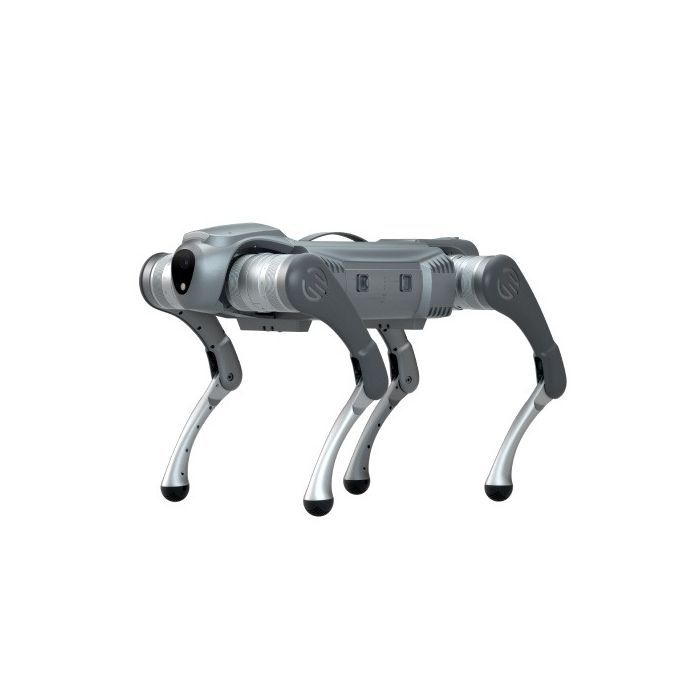
Galileo C1 Small Quadruped Robot Dog
In stock
- BRAND:
- GALILEO
- MODEL:
- C1
- ORIGIN:
- China
- AVAILABILITY:
- SUBJECT TO AVAILABILITY
- SKU:
- GALILEO-C1
Galileo C1 Small Quadruped Robot Dog
A robot that walks like an animal but carries itself like a piece of equipment is a rare thing. Most small robots are toys that cannot work, or tools that cannot climb a step. The Galileo C1 Small Quadruped Robot Dog sets out to be both agile and useful, with four legs for stairs and slopes and a body built for real tasks.
The product is available through this page, by quotation.
Background
Where the C1 sits in the Galileo range
The C1 belongs to the Galileo C1 Series, which the manufacturer describes as a lightweight and versatile bionic robot. It is tailored for consumer-grade scenarios, for scientific research and education, and for inspection tasks on small industrial equipment. That is a wide brief, and it explains the robot's character: it is compact enough to handle without a crane, yet capable enough to be taken seriously in a laboratory or on a plant floor.
The series has two versions, the C1 and the C1-W. This page covers the C1, the legged version. If you are weighing a wheeled alternative, the Galileo C1-W Wheeled Quadruped Robot Dog is the sibling to review.
What the platform is built around
Three ideas run through the C1: endurance, energy management and openness. On endurance, the robot is rated for 3-5h of operation. On energy, it uses dual-mode management: autonomous charging, plus manual battery replacement when you want to keep working without waiting. On openness, secondary development is supported, and the external interfaces include Ethernet, USB and RS485, with the interface set expandable as needed.
For perception, the robot has a front wide-angle camera with a resolution of 1920*1080. For computing, the control system uses a domestic ARM low-power high-performance CPU with 8 cores, 8 threads, 8GB RAM and a 64GB SSD. Wireless connectivity is WIFI6 dual-band.
Technical Specifications
| Specification | Value (C1) |
|---|---|
| Standing dimensions (L x W x H) | 765x410x475mm |
| Weight | 22kg |
| Movement speed | 0-3m/s (adjustable) |
| Maximum climbable slope | ≥30° |
| Stair walking capability | ≥20cm high consecutive steps |
| Endurance time | 3-5h |
| Continuous load | 12kg |
| Battery type | Lithium Battery |
| Battery capacity | 20Ah (960Wh) |
| Battery rated voltage | 48V |
| Charger input | 100V~240V |
| Autonomous charging | Supported |
| Low power mode | ≥365 days, supports remote wake-up |
| External power interface | 48V; 24V (expandable as needed) |
| External communication interface | Ethernet; USB; RS485 (interface expandable as needed) |
| Control system CPU | Domestic ARM low-power high-performance CPU (8 cores 8 threads / 8GB RAM / 64GB SSD) |
| Wi-Fi | WIFI6 dual-band wireless supported |
| Front camera | Front wide-angle camera, resolution 1920*1080 |
| Secondary development | Supported |
| Joint IP rating | IP67 |
| Operating environment temperature | -20℃~55℃ |
Specifications as published by the manufacturer; confirmed against the datasheet at quotation.
The manufacturer has not published the rated payload maximum, the battery charge time, the degrees of freedom, a LiDAR option, the contents of the box, whether a controller is included, the noise level, a mobile app, or the operating system and SDK; they are confirmed at quotation.
What makes the C1 different from a wheeled robot?
A wheeled platform is simple and fast on flat floors. A legged one earns its place where the floor ends. The C1 climbs slopes of ≥30° and walks over ≥20cm high consecutive steps. Those two figures matter to anyone whose site has ramps, raised thresholds or stairwells, because they decide whether a robot can reach the equipment you want inspected.
The trade-off is in the family. The wheeled sibling, the Galileo C1-W Wheeled Quadruped Robot Dog, belongs to the same series and is the one to review when speed over open ground is the priority. The C1 on this page has an adjustable movement speed of 0-3m/s. Ask for the C1-W figures on its own page rather than assuming they match.
How does the C1 stay running between tasks?
Endurance on paper is only half of the story; what counts is what happens when the battery runs low. The C1 carries a 20Ah (960Wh) lithium battery at a rated 48V and runs for 3-5h. It supports autonomous charging, so the robot can return to a dock without an operator. When a job cannot wait, the battery can also be replaced by hand, which is the second half of the dual-mode design.
For long idle stretches, the low power mode lasts ≥365 days and supports remote wake-up. A robot can therefore wait quietly at a remote site and be called into service when needed. The charger accepts 100V~240V input, which suits workshops and classrooms on different supply standards.
Who is the Galileo C1 for?
The first group is universities, technical colleges and laboratories. With secondary development supported, Ethernet, USB and RS485 interfaces, and an 8-core ARM computer on board, the C1 is a solid base for teaching and research. Teams planning a larger programme can browse the Research Robots category for related platforms.
The second group is operators of small industrial equipment: plant rooms, cabinets, utility corridors and similar spaces. The manufacturer names inspection of small industrial equipment as a core scenario. The 12kg continuous load leaves room for sensors or tools, and the IP67 joint rating and the -20℃~55℃ operating range suit working conditions that are not always gentle.
The third group is enthusiasts and demonstration users, since the series is also aimed at consumer-grade scenarios. Anyone who wants a wider range of legged robots can see the Standard Quadrupeds category. If the work involves heavier industrial duty, the Galileo S1 Large Industrial Grade Quadruped Robot Dog is the larger option to compare.
What is the Galileo C1 used for?
- Teaching robotics. Students work with a real legged machine, its interfaces and its development support.
- Research projects. Laboratories build and test their own software on a platform with an 8-core ARM computer.
- Equipment inspection. The robot walks routes around small industrial equipment and views it through the front wide-angle camera.
- Stair and slope access. Legs let it reach areas where a wheeled machine would stop, with climbing of ≥30° and steps of ≥20cm.
- Carrying light equipment. A continuous load of 12kg allows added sensors or accessories.
- Remote standby duty. Low power mode of ≥365 days with remote wake-up keeps the robot ready at distant sites.
Pricing and Availability
Pricing for the Galileo C1 is given by quotation, so that the configuration, quantity and project needs are settled before anything is agreed. Send us your request and we will reply with a quotation. Delivery, customs and support are arranged with the quotation. The Galileo C1 Small Quadruped Robot Dog is available on this page.
Frequently Asked Questions
How fast can the Galileo C1 move?
The movement speed is 0-3m/s and is adjustable, so operators can slow the robot for careful inspection work.
Can the C1 climb stairs and slopes?
Yes. It climbs slopes of ≥30° and walks on ≥20cm high consecutive steps.
How long does the battery last?
Endurance is 3-5h from a 20Ah (960Wh) lithium battery, and the battery can be swapped by hand when you need to keep going.
Can I develop my own software for it?
Yes. Secondary development is supported, and the interfaces are Ethernet, USB and RS485, expandable as needed.
How does the C1 charge itself?
It supports autonomous charging, and the battery can also be replaced manually. This dual-mode energy management keeps the robot working between tasks.
What conditions can it work in?
The joints carry an IP67 rating, and the operating environment temperature is -20℃~55℃. The rating applies to the joints, not to the whole body.
Where can I buy the Galileo C1 and what does it cost?
The Galileo C1 is available through this page by quotation. The cost is given in the quotation after you send your requirements.
Summary
The Galileo C1 answers the question the opening raised: how to make a robot that is agile enough to climb and sturdy enough to work. It brings legs that handle slopes of ≥30° and steps of ≥20cm, a 12kg continuous load, 3-5h of endurance, and an open platform with secondary development support. It suits classrooms, laboratories and small-equipment inspection alike. If the C1 matches your needs, this page is the starting point.