
Galileo C1-W Wheeled Quadruped Robot Dog
In stock
- BRAND:
- GALILEO
- MODEL:
- C1-W
- ORIGIN:
- China
- AVAILABILITY:
- SUBJECT TO AVAILABILITY
- SKU:
- GALILEO-C1-W
Galileo C1-W Wheeled Quadruped Robot Dog
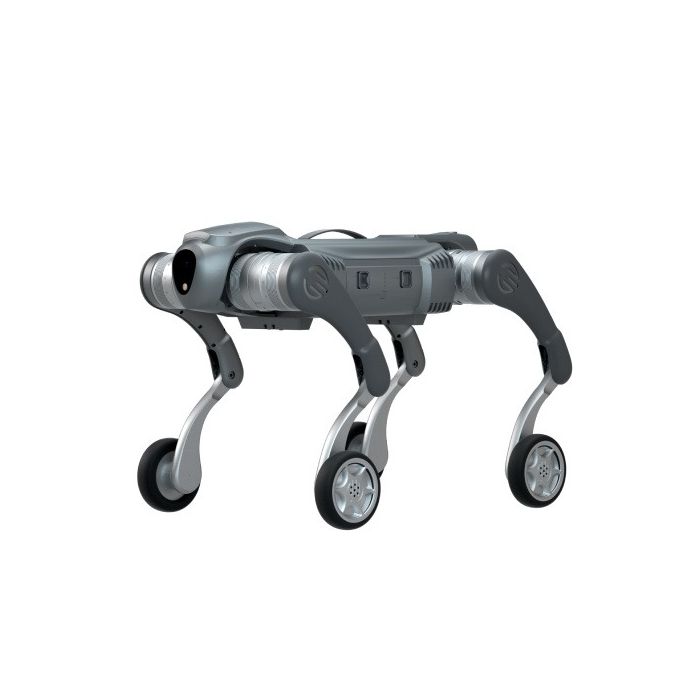
Most robots must choose between the speed of wheels and the reach of legs. The Galileo C1-W Wheeled Quadruped Robot Dog refuses the choice: it rolls across open floor, then steps, climbs and squeezes through places where a plain wheeled cart would stop.
The product is available through this page, by quotation.
Background
The Galileo line and the C1 family
Galileo builds quadruped robot dogs in several sizes and configurations. The range runs from small platforms such as the Galileo C1 Small Quadruped Robot Dog and the Galileo E1 Quadruped Robot Dog to the Galileo S1 Large Industrial Grade Quadruped Robot Dog. Each size comes in a legged form and a wheeled form, so a buyer can match the machine to the job instead of bending the job around the machine.
The C1-W is the wheeled version of the small-sized C1 family. It is a small-sized wheel-legged robot dog, built for consumer-grade scenarios, scientific research education and light-duty industrial inspection. That is a wide span, and it explains why the platform carries both an open development interface and a rugged set of environmental ratings.
Wheel-leg hybrid mobility
The central idea of the C1-W is its compact bionic quadruped structure with wheel-leg hybrid mobility. The robot uses a 16-degree-of-freedom design, and it switches motion modes to suit flat ground, slopes, stairs and narrow spaces. On a smooth corridor it can travel at an adjustable speed of 0-5m/s. Where the surface changes, it adapts its movement rather than waiting for a human to carry it over the obstacle.
Around that mobility sits a perception and control package: autonomous navigation and obstacle avoidance, a 1920 × 1080 front wide-angle camera with a fill light for changing or low-light environments, and a control system built on a domestic ARM low-power high-performance CPU. Together these make the robot a working platform and not only a demonstration piece.
Technical Specifications
| Specification | Value |
|---|---|
| Standing dimensions (L x W x H) | 765x480x540mm |
| Weight | 28.5kg |
| Degrees of freedom | 16-degree-of-freedom design |
| Movement speed | 0-5m/s (adjustable) |
| Maximum climbable slope | ≥30° |
| Stair walking capability | ≥20cm high consecutive steps |
| Continuous load | 12kg |
| Endurance time | 3-5h |
| Battery type | Lithium Battery |
| Battery capacity | 20Ah (960Wh) |
| Battery rated voltage | 48V |
| Charger input | 100V~240V |
| Low power mode | ≥365 days, supports remote wake-up |
| External power interface | 48V; 24V (expandable as needed) |
| External communication interface | Ethernet; USB; RS485 (interface expandable as needed) |
| Wireless | WIFI6 dual-band wireless supported |
| Autonomous charging function | Supported |
| Control system CPU | Domestic ARM low-power high-performance CPU (8 cores 8 threads / 8GB RAM / 64GB SSD) |
| Front camera | 1920 × 1080 front wide-angle camera and fill light |
| Navigation | Autonomous navigation and obstacle avoidance |
| Control modes | Manual remote control, autonomous inspection and intelligent follow |
| Joint IP rating | IP67 |
| Operating temperature | -20℃~55℃ |
| Secondary development | Supported |
Specifications as published by the manufacturer; confirmed against the datasheet at quotation.
The manufacturer has not published the battery recharge time, the maximum payload, any LiDAR option, the contents of the box, the mobile app compatibility or the noise level; they are confirmed at quotation.
What makes the Galileo C1-W different from the Galileo C1?
The difference begins with the letter W. The C1-W is the wheeled version, and its wheel-leg hybrid mobility lets it combine rolling and stepping in a single machine. The Galileo C1 Small Quadruped Robot Dog is the sibling to review if your work is mostly about legged movement. The C1-W is the one to consider when your route includes long, flat stretches that you want to cover quickly, with stairs and slopes only now and then.
That is a practical distinction, not a cosmetic one. An inspection round in a plant, a campus or a warehouse often runs along corridors and yards for most of its length. A robot that can roll through those sections at an adjustable 0-5m/s and then step over to the next level suits that pattern well. Because the figures in this article belong to the C1-W, please ask for the datasheet of any other version when you compare them side by side.
How does the C1-W handle stairs, slopes and tight spaces?
The robot switches motion modes to adapt to flat ground, slopes, stairs and narrow spaces. Its listed capabilities back this up: a maximum climbable slope of ≥30° and the ability to walk consecutive steps that are ≥20cm high. Its compact body, 765x480x540mm when standing, also helps it pass through spaces that larger platforms avoid.
Carrying capacity matters here as well. The robot has a continuous load of 12kg, which allows a sensor head, a communication module or another light accessory. The external power interface offers 48V and 24V, expandable as needed, and the communication interface offers Ethernet, USB and RS485, also expandable as needed. For teams that want to add their own equipment, these connections are the practical starting point, and secondary development is supported.
Environmental protection completes the picture. The joints carry an IP67 rating and the operating temperature range is -20℃~55℃. The front camera and fill light support visual perception in changing or low-light environments, so a round that starts in daylight and ends in a dim corridor remains workable.
Who is the Galileo C1-W for?
Universities and research labs form the first group. The robot supports secondary development, offers several communication interfaces and has a capable onboard computer, so students and researchers can build their own behaviors on a real legged-and-wheeled platform.
Facility and industrial teams are the second group. Light-duty industrial inspection is a named use, and the autonomous inspection mode, autonomous navigation and autonomous charging function suit repeated rounds. Technology enthusiasts and demonstration users make up the third group, since consumer-grade scenarios are also a named use.
If your work needs a much larger machine, look at the Large Industrial Grade Wheeled Quadruped Robot Dog. If you want to compare other wheel-leg models, the Wheeled Quadrupeds category lists them in one place.
What is the Galileo C1-W used for?
- Autonomous inspection: the robot follows inspection rounds with autonomous navigation and obstacle avoidance, then returns to charge itself.
- Scientific research: its open interfaces and secondary development support let labs test their own algorithms on a physical robot.
- Education: classrooms and training programs use a quadruped platform to teach robotics, control and perception.
- Light-duty industrial inspection: the compact body, IP67 joints and wide temperature range suit plants, yards and corridors.
- Intelligent follow tasks: in follow mode the robot trails an operator and carries a continuous load of 12kg.
- Long standby deployment: the low power mode of ≥365 days with remote wake-up keeps the robot ready until it is needed.
Pricing and Availability
Pricing is arranged by quotation, so that the configuration, the interfaces you need and your site requirements are all settled before any commitment. Delivery, customs and support are arranged together with the quotation. Send us your application and the Galileo C1-W Wheeled Quadruped Robot Dog is available on this page.
Frequently Asked Questions
How fast can the Galileo C1-W move?
The movement speed is 0-5m/s and it is adjustable, so you can set a pace that suits the site and the task.
How long does the battery last?
The endurance time is 3-5h from a 48V lithium battery of 20Ah (960Wh).
Can it climb stairs and slopes?
Yes. The listed capability is consecutive steps ≥20cm high and a maximum climbable slope of ≥30°.
Is it protected against water and dust?
The joints carry an IP67 rating, and the robot operates between -20℃~55℃.
Can I develop my own software for it?
Secondary development is supported. The robot also offers Ethernet, USB and RS485 interfaces, expandable as needed, and WIFI6 dual-band wireless.
What control modes does it offer?
It supports manual remote control, autonomous inspection and intelligent follow. It also has autonomous navigation, obstacle avoidance and an autonomous charging function.
Where can I buy the Galileo C1-W and what does it cost?
You can request it through this page, and the cost is given in a written quotation based on your configuration. No price is listed here, and delivery, customs and support are arranged with the quotation.
Summary
The Galileo C1-W answers a simple question: why accept the limits of wheels or the slowness of legs when one compact robot can use both? With 16 degrees of freedom, wheel-leg hybrid mobility, 12kg continuous load, IP67 joints, 3-5h endurance and open interfaces for development, it fits research, education and light-duty inspection. If that fits your plan, this page is the starting point.


