
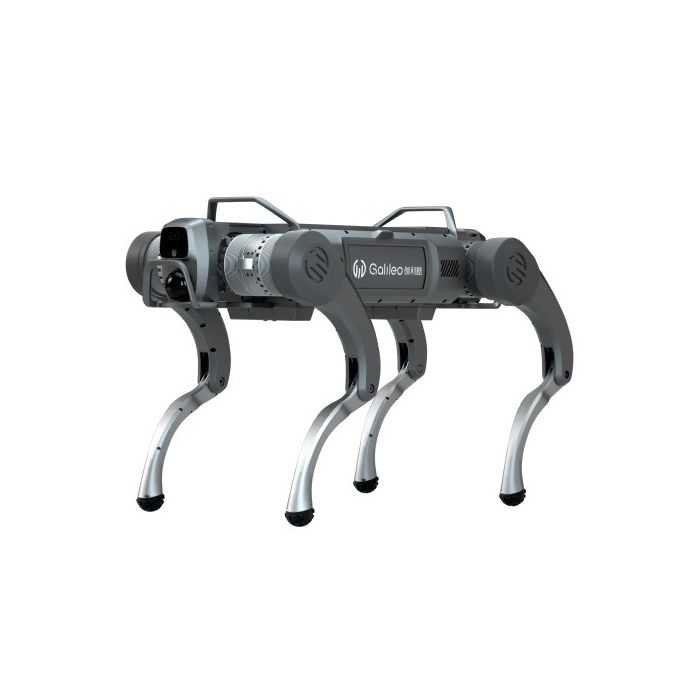
Galileo E1 Quadruped Robot Dog
In stock
- BRAND:
- GALILEO
- MODEL:
- E1
- ORIGIN:
- China
- Warranty:
- 12 MONTHS
- AVAILABILITY:
- SUBJECT TO AVAILABILITY
- SKU:
- GALILEO-E1
Galileo E1 Quadruped Robot Dog
Most robots stop where the floor does. A staircase, a loose gravel bank or a platform at chest height ends the working day for a wheeled machine, and then a person has to walk in. The Galileo E1 Quadruped Robot Dog is built for exactly that moment: four legs, a sealed body and enough battery to keep going when the route stops being friendly. It belongs to the E1 Series, classed by its maker as Medium Industrial Grade.
The Galileo E1 is available through this page, by quotation.
Background
The company and the E1 lineage
Galileo (Tianjin) Technology Co., Ltd. was established in 2021 and is headquartered in Tianjin. In a short time the company has assembled a family of legged platforms that spans small, medium and large frames, with wheeled variants alongside the walking ones.
The E1 sits in the middle of that family. If your work is lighter and indoors, the smaller Galileo C1 Small Quadruped Robot Dog may be the better starting point. If you need the biggest frame in the range, the Galileo S1 Large Industrial Grade Quadruped Robot Dog is the one to compare. The E1 is the balanced choice between them: a medium industrial platform meant to be put to work, not shown on a stand.
Positioning and key technology
The E1 is a working machine, and its design reads that way. Its control system pairs two processors: a domestic ARM low-power high-performance CPU with 8 cores, 8 threads, 8GB RAM and a 64GB SSD, and an X86 low-power high-performance CPU with 4 cores, 8 threads, 16GB RAM and a 256GB HDD. Having two processor families on board gives integrators room to run motion control on one side and heavier application work on the other.
Power is a 48V lithium battery rated at 30Ah (1440Wh). A low power mode lasts at least 365 days and supports remote wake-up, so a robot can wait at a remote site and be called on when needed. Autonomous charging is supported, and an app is supported for operation.
External connections are Ethernet, USB and TypeC, with the interface expandable as needed. The external power interface offers 48V and 24V, also expandable as needed. The robot can be equipped with customized devices for harsh conditions, including toxic-hazardous and high-risk environments.
Technical Specifications
| Specification | Value |
|---|---|
| Product class | E1 Series - Medium Industrial Grade |
| Standing dimensions (L x W x H) | 1000*452*550mm |
| Weight | 52kg |
| Battery capacity | 30Ah(1440Wh) |
| Battery type | Lithium Battery |
| Battery rated voltage | 48V |
| Movement speed | 0-3.5m/s(Adjustable) |
| Slope climbing capability | ≥30° |
| Climbable height | Forward height difference 80cm platform |
| Endurance time | 2.5-4.5h |
| Continuous walking load | 30kg |
| Maximum load | 100kg(Standing load) |
| Range | >16km |
| Protection rating | IP67 |
| Operating temperature | -20℃~55℃ |
| External communication interface | Ethernet; USB; TypeC(Interface expandable as needed) |
| External power interface | 48V;24V(Expandable as needed) |
| Low power mode | ≥365 days, supports remote wake-up |
| Autonomous charging | Supported |
| Control system CPU | Domestic ARM low-power high-performance CPU (8 cores 8 threads / 8GB RAM / 64GB SSD) + X86 low-power high-performance CPU (4 cores 8 threads / 16GB RAM / 256GB HDD) |
| App | Supported |
Specifications as published by the manufacturer; confirmed against the datasheet at quotation.
The manufacturer has not published the sensors and cameras, the dimensions when folded, the charging time, the included accessories, the operating system and SDK, the noise level or the degrees of freedom; they are confirmed at quotation.
What makes the E1 different from a wheeled robot?
A wheeled platform is fast and simple on a smooth surface, and for many sites that is all that is needed. The trouble starts when the route includes a kerb, a step, a cable trench or a rough slope. A legged robot places each foot where it is needed, so the terrain becomes something it walks over, not something it must avoid.
The E1 climbs slopes of at least 30° and can climb a forward height difference of an 80cm platform. Its movement speed is adjustable from 0 to 3.5m/s, so an operator can slow it down for careful inspection work and let it move faster when covering distance. The IP67 protection rating and an operating temperature range of -20℃ to 55℃ also matter, because the ground is rarely the only hazard outdoors: dust, rain and heat all arrive with it.
If your site is mostly flat and you want a wheeled configuration, the Galileo E1-W Wheeled Quadruped Robot Dog is the sibling to review. Its own figures are kept apart from those of the E1 here.
How much can the E1 carry, and how far does it go?
The E1 has a continuous walking load of 30kg and a maximum load of 100kg as a standing load. These are two different numbers, and it pays to treat them separately. The 30kg figure describes what the robot carries while it walks; the 100kg figure describes what it can bear while standing. Plan your equipment mass against the walking figure.
For reach, the endurance time is 2.5-4.5h and the range is more than 16km. Both come from a 30Ah (1440Wh) lithium battery at 48V. Autonomous charging lets the robot return to refuel by itself, and the low power mode of at least 365 days with remote wake-up lets it stay parked between missions without a visit from staff.
Who is the Galileo E1 for?
The first group is industrial operators with plants, substations, tunnels or yards that need regular rounds in places that are tiring, remote or unsafe for people. The E1 gives them a platform that can carry equipment and report back without a person on the route.
The second group is security and site-protection teams that want patrols to run on a schedule, whatever the hour or the weather. The third is emergency services and planners; for them, our Emergency Response range shows how legged robots fit alongside other tools.
The fourth group is universities and development teams. The dual-processor control system and expandable interfaces suit integration work, and our Research Robots category lists related platforms. Buyers who need a lighter, smaller frame should look at the C1, and those who need a larger one should look at the S1.
What is the Galileo E1 used for?
- Industrial inspection. Regular walking rounds of plant, pipework and equipment rooms, carrying the sensing gear a project requires.
- Security patrol. Scheduled or on-demand rounds of a site perimeter, day or night.
- Emergency response. Going ahead of people into places that are hazardous, hot, dusty or unstable.
- High-risk environments. Carrying customized devices for toxic-hazardous conditions where a person should not stand.
- Equipment carrying. Moving instruments or communication gear across uneven ground with a 30kg continuous walking load.
- Research and integration. Developing applications on the dual-processor system through Ethernet, USB and TypeC.
Pricing and Availability
Each Galileo E1 is supplied against a quotation, because the right configuration depends on the equipment, the site and the support you need. Send us your application and we will answer with a quotation. Delivery, customs and support are arranged together with the quotation, so you deal with one party from request to handover. The Galileo E1 Quadruped Robot Dog is available on this page.
Frequently Asked Questions
What is the maximum load of the Galileo E1?
The maximum load is 100kg as a standing load. The continuous walking load is 30kg.
How long does the battery last?
The endurance time is 2.5-4.5h and the range is more than 16km. The battery is a 48V lithium unit rated at 30Ah (1440Wh).
Is the E1 protected against water and dust?
Yes. Its protection rating is IP67, and it operates from -20℃ to 55℃.
What can it climb?
It climbs slopes of at least 30° and can climb a forward height difference of an 80cm platform.
What connections does it offer?
The external communication interface covers Ethernet, USB and TypeC, and the external power interface offers 48V and 24V. Both can be expanded as needed.
Can it charge itself?
Yes, autonomous charging is supported. A low power mode of at least 365 days with remote wake-up is also available.
Where can I buy the Galileo E1 and what does it cost?
The Galileo E1 is available through this page, by quotation. We do not print a price here; request a quotation and the delivery and support terms follow with it.
Summary
The question behind the E1 is simple: what happens when the route stops being flat? A wheeled robot waits for a person, but the E1 keeps walking. It carries 30kg while walking, holds 100kg standing, climbs slopes of at least 30° and is rated IP67. It brings two processors, expandable interfaces, autonomous charging and a year-long low power mode to the job. For a medium industrial legged platform, this page is the starting point.


