
BWSENSING High-Speed Wifi Triaxial Inclinometer (WF-WM400)
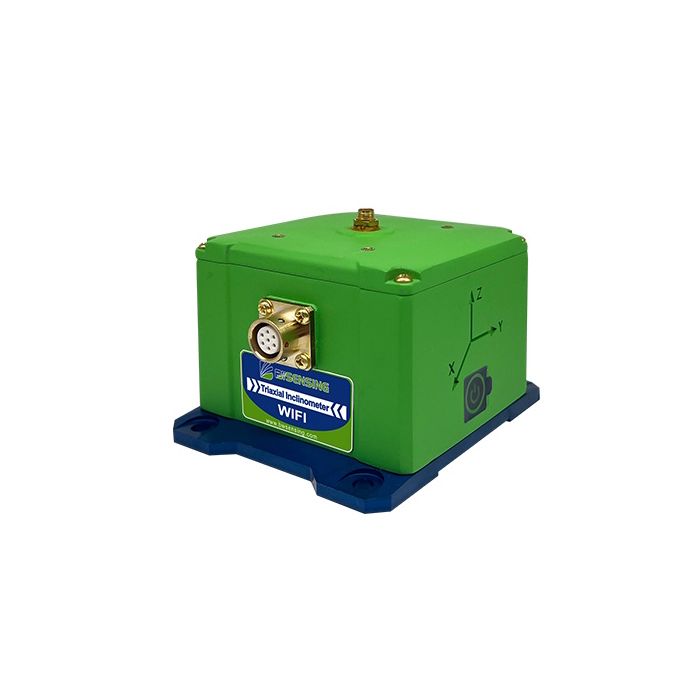
In stock
- BRAND:
- BWSENSING
- PART #:
- WF-WM400
- ORIGIN:
- China
- AVAILABILITY:
- SUBJECT TO AVAILABILITY
- SKU:
- BWSENSING-WF-WM400
BWSENSING High-Speed Wifi Triaxial Inclinometer (WF-WM400)
Most structures do not fail in a day; they lean a little more each season until someone finally notices. The BWSENSING High-Speed Wifi Triaxial Inclinometer (WF-WM400) is built to notice first. It sits on the structure, measures tilt on three axes and sends its readings over WiFi, so no one has to walk a cable run or climb a tower just to read a number.
The product is available through this page, by quotation.
Background
The company behind the sensor
The WF-WM400 is made by Wuxi Bewis Sensing Technology LLC and sold under the BWSENSING brand. The brand's inclinometers are aimed at engineers who need dependable angle data from bridges, slopes, dams and similar assets. You can browse related instruments in the Sensors category and in the BWSensing brand section.
The WF-WM400 belongs to a small family of the same sensor with different radios. The sources name the WF-WM400 for WiFi, the LWHD-WM400 for LoRaWAN and the FG-WM400-EU for 4G LTE Cat-1. This page is about the WiFi version only, and every figure below belongs to it.
Positioning and key technology
The manufacturer describes the WF-WM400 as a compact and intelligent digital inclination sensor designed for structural health monitoring. Its job is to measure angle precisely, report it often enough to follow real movement, and keep running for a long time on its own battery.
Three design choices stand out. First, it measures on three axes over a range of ±60°, so one unit can describe how a surface is tilting in more than one direction. Second, it resolves 0.001° and states an accuracy of 0.005°, which is the scale on which slow structural drift appears. Third, it carries a disposable battery of 19000mAh and supports automatic sleep, timed wake-up and exercise wake, so it spends most of its life drawing very little power.
Technical Specifications
| Specification | Value |
|---|---|
| Measurement | Triaxial |
| Range | ±60° |
| Resolution | 0.001° |
| Accuracy | 0.005° |
| Output frequency | Up to 50 Hz |
| Operating temperature | -40℃ to +85℃ |
| Protection level | IP68 (1 m water depth, 24 hours continuous test) |
| Shell material | ABS+30% glass fiber + magnesium aluminum alloy anodized base |
| Installation | Four M6 screws |
| Connector | Aviation connector |
| Dimensions (antenna not included) | L105.2*W85*H76 (mm); length and width may have 1mm error |
| Standard antenna height | 159mm (WiFi version without radome) |
| Weight | 450 (±10), with battery |
| Power supply voltage | 3.6VDC to 5VDC |
| Disposable battery capacity | 19000mAh |
| Communication distance | Maximum 200m |
| Battery life | More than 3 years when uploading data once an hour |
| Power-saving and wake functions | Automatic sleep mode, timed wake-up and exercise wake |
Specifications as published by the manufacturer; confirmed against the datasheet at quotation.
The manufacturer has not published the wireless standard version, the operating humidity, the software compatibility or the cloud platform details; they are confirmed at quotation.
What makes the WF-WM400 different from a wired inclinometer?
A wired inclinometer needs a cable from the sensor to a logger or a controller, and on a long structure that cable is often the most expensive and most fragile part of the job. The WF-WM400 removes it from the data path. Readings travel over WiFi up to a maximum communication distance of 200m, and the unit runs from its own disposable battery.
That changes where you can place a sensor. A point on a tower, a retaining wall or a slope face that would be awkward to wire becomes a practical measuring position. The unit is fixed with four M6 screws, and its aviation connector gives a robust physical interface for power and setup.
Wireless does not have to mean slow. The sensor outputs at up to 50 Hz, which is useful when you want to see how a structure responds to wind, traffic or construction activity rather than only its slow drift. When the goal is long-term observation instead, the sleep and timed wake-up functions let you report once an hour, and the manufacturer states that the battery then lasts more than 3 years.
How does it cope with harsh sites?
Structural monitoring happens outdoors, often in places that are wet, hot and exposed. The WF-WM400 is rated IP68, proven in a 1 m water depth over 24 hours of continuous testing. Its operating temperature runs from -40℃ to +85℃, which the manufacturer describes as industrial level.
The housing combines ABS with 30% glass fiber and a magnesium aluminum alloy anodized base. The plastic body keeps the unit light, and the metal base gives a firm, corrosion-resistant face to mount against the structure. With the battery, the unit weighs 450 (±10), and its body measures L105.2*W85*H76 (mm) without the antenna. The standard antenna adds up to a height of 159mm on the WiFi version without radome.
Who is the WF-WM400 for?
Bridge and tunnel owners and their consultants are the most obvious buyers. They need repeatable angle data over years, and a battery-powered wireless unit lets them add measuring points without trenching or conduit.
Geotechnical teams monitoring slopes, retaining walls and foundation pits form a second group. For them, the triaxial measurement and the fine resolution help catch early movement, while the high output rate helps during active excavation or after heavy rain.
Dam operators, building monitoring contractors and research groups will also find a use for it. If the site is within WiFi reach, the WF-WM400 is a natural fit. If your project needs a different radio, the sources name the LWHD-WM400 for LoRaWAN and the FG-WM400-EU for 4G LTE Cat-1, so ask us about them when you request your quotation.
Buyers who only need two axes, or a simpler wired output, may prefer a dedicated dual-axis model such as the BWSENSING Cost-Effective Dual-Axis Inclinometer (BWM427) or the BWSENSING Cost-Effective Dual-Axis Digital Output With Modbus Inclinometer (BWN427). For a single axis, see the BWSENSING Cost-Effective Single-Axis Digital Output With Modbus Inclinometer (BWM417).
What is the WF-WM400 used for?
- Bridge and tower monitoring: track slow rotation or tilt of piers, pylons and decks over many years.
- Dam and embankment safety: follow small movements of crest and structure where cabling is impractical.
- Slope disaster prevention: watch hillsides and cuttings for early signs of movement, including after storms.
- Tunnel and foundation pit deformation: record angle changes during excavation and support works.
- Dynamic response checks: use the output rate of up to 50 Hz to see how a structure reacts to loads and vibration.
- Long-term unattended observation: run on a timed wake-up schedule so the battery supports more than 3 years of hourly uploads.
Pricing and Availability
We do not publish prices for this sensor. Quotation is the way to buy: tell us how many units you need, which version suits your site and where it will be installed, and we will respond with a proposal. Delivery, customs and support are arranged together with the quotation. The BWSENSING High-Speed Wifi Triaxial Inclinometer (WF-WM400) is available on this page.
Frequently Asked Questions
What is the measurement range of the WF-WM400?
It measures on three axes over a range of ±60°. Resolution is 0.001° and the stated accuracy is 0.005°.
How fast does the sensor report?
The output frequency is up to 50 Hz. For long-term monitoring, you can instead have it wake on a timed schedule and sleep in between.
How long does the battery last?
When the sensor uploads data once an hour, the battery lasts more than 3 years. The unit uses a disposable battery of 19000mAh.
Is the WF-WM400 waterproof?
Yes. It is rated IP68, based on a test at 1 m water depth for 24 hours of continuous immersion. The operating temperature range is -40℃ to +85℃.
How is it installed and connected?
It is fixed to the structure with four M6 screws and uses an aviation connector. The power supply voltage is 3.6VDC to 5VDC.
Are there versions with other wireless options?
Yes. The sources name the LWHD-WM400 for LoRaWAN and the FG-WM400-EU for 4G LTE Cat-1. This page covers the WiFi WF-WM400, and the other versions can be discussed when you request a quotation.
Where can I buy the WF-WM400 and what does it cost?
You can buy it through this page by requesting a quotation. The cost depends on quantity and delivery, so we give it in the quotation rather than listing a price here.
Summary
A structure rarely announces that it is moving, so the sensor has to be patient, precise and easy to place. The WF-WM400 is all three: triaxial measurement over ±60°, 0.001° resolution, a stated accuracy of 0.005°, an output of up to 50 Hz, IP68 protection and a battery that supports more than 3 years of hourly uploads. For bridges, slopes, dams, tunnels and pits within WiFi reach, it brings wireless convenience without giving up angular detail. If it fits your project, this page is the starting point.


