
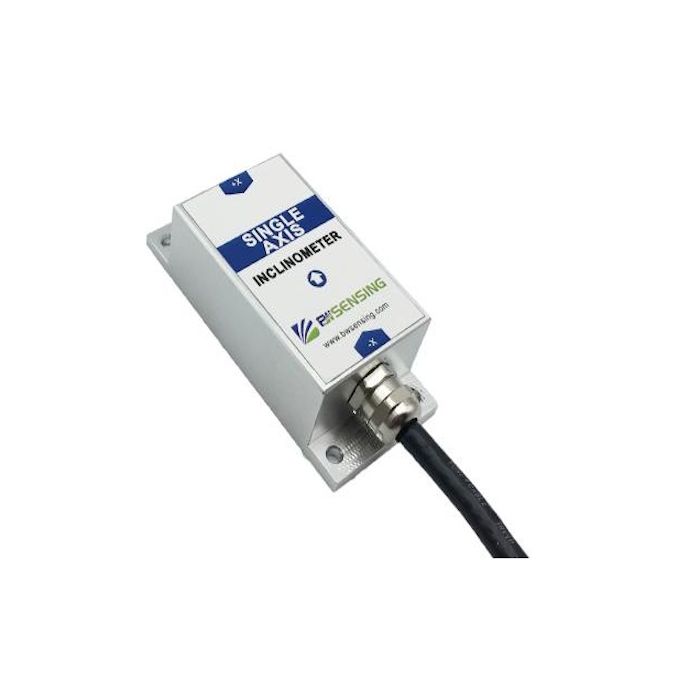
BWSENSING Low Cost Single-Axis Current Output Inclinometer (BWL318)
In stock
- BRAND:
- BWSENSING
- PART #:
- BWL318
- ORIGIN:
- China
- AVAILABILITY:
- SUBJECT TO AVAILABILITY
- SKU:
- BWSENSING-BWL318
BWSENSING Low Cost Single-Axis Current Output Inclinometer (BWL318)
A tower rarely falls over all at once; it leans a little more each season, and the only witness is a sensor that never looks away. The BWSENSING Low Cost Single-Axis Current Output Inclinometer (BWL318) is built for that kind of patient watching, reporting the angle of one axis as a current signal that a PLC or controller can read without fuss.
The product is available through this page, by quotation.
Background
The company behind the BWL318
The BWL318 comes from Wuxi Bewis Sensing Technology LLC, which trades as BWSENSING. The company was established in 2010 and is an innovative, fast-growing business. Its catalog is centered on inclination sensing, and the range includes single-axis and dual-axis models with different output styles, from current output to CAN and Modbus digital interfaces.
That breadth matters to a buyer. A project that begins with a simple analog loop may later need a digital bus, and staying within one manufacturer's family makes that move easier to plan. The BWL318 sits at the plain, economical end of that family: one axis, one analog current signal, and no extra layers to configure.
Positioning and key technology
The BWL318 is a low cost single-axis inclinometer that adopts an industrial level MEMS accelerometer. A MEMS accelerometer senses the pull of gravity along an axis, and the electronics convert that into an angle. Because it has no moving mechanical pendulum, a sensor of this type is compact and suits equipment that vibrates, swings or runs for long hours.
The output is a current signal, selectable between 4-20mA, 0-20mA and 0-24mA. Current outputs are a long-standing choice in industrial plants because they are simple to wire into existing analog input cards. The BWL318 pairs that interface with a wide supply range of 12-36V and an IP67 protection level, so it fits into ordinary industrial power arrangements and outdoor or damp locations.
Technical Specifications
| Specification | Value |
|---|---|
| Type | Current output, single-axis inclinometer with industrial level MEMS accelerometer |
| Measurement range | ±180° |
| Highest accuracy | 0.1° |
| Resolution | 0.01° |
| Power supply | 12-36V |
| Output | 4-20mA / 0-20mA / 0-24mA, optional |
| Protection level | IP67 |
| Dimensions | L90*W40.5*H26 (mm) |
| Weight | 210 g, without outer packaging |
| Zero bias (-40~85℃) | ±0.02 °/℃ |
| Start-up time | <3 s |
| Output frequency | 5-100Hz adjustable, up to 100Hz |
| MTBF | ≥90000 h |
| Impact resistance | 2000g, 0.5ms, 3 times/axis |
Specifications as published by the manufacturer; confirmed against the datasheet at quotation.
The manufacturer has not published the contents of the box, the cable length, the mounting hole spacing or the supply current at full load; they are confirmed at quotation.
Why choose a current output for tilt measurement?
Many modern sensors talk over digital buses, and for good reasons. Yet a large share of industrial equipment still reads its inputs as analog signals, and a current loop is the form that automation engineers know best. A reading carried as current is generally less affected by electrical noise along the wire than one carried as a small voltage, which is why current signals are favored where the sensor sits far from the controller or near motors and drives.
The BWL318 offers three current ranges, so you can match the sensor to the input card already in the cabinet. If your controller expects 4-20mA, you choose that; if it expects 0-20mA or 0-24mA, the option is there. This saves adding converters or changing hardware just to accept one new sensor.
The output frequency is adjustable from 5 to 100Hz. A slowly moving structure such as a tower does not need a fast update, while a lifting arm or a tracking mechanism may benefit from a quicker one. Having that choice in a single model keeps the part list short.
How does the BWL318 compare with the other BWSENSING inclinometers?
The main distinction is the interface and the number of axes. The BWL318 measures one axis and reports it as a current. If your system needs a digital connection, the BWSENSING Cost-Effective Single-Axis CAN Output Inclinometer (BWM415) is a single-axis alternative with a CAN output, and the BWSENSING Cost-Effective Single-Axis Digital Output With Modbus Inclinometer (BWM417) offers a Modbus interface.
If you must monitor tilt in two directions at once, a dual-axis model is the more natural choice, for example the BWSENSING Cost-Effective Dual-Axis Inclinometer (BWM427). Where only one direction of lean matters, the BWL318 avoids paying for a second axis you would not use. Please ask us if you are unsure which interface your controller expects.
Who is the BWL318 for?
Integrators and panel builders who work with PLCs and analog input cards are the clearest fit. They get a sensor that connects the way their other field instruments do, without writing communication code.
Maintenance teams for towers, masts and similar structures will find it useful for watching slow changes in lean over time. Solar installers can use it for tracker angle feedback, and equipment makers can fit it to lifting gear, converters or drilling equipment where one angle drives a safety or control decision.
Medical and laboratory instrument builders who need a compact single-axis angle reference also fall within the listed applications. Buyers who need two axes or a digital bus should look at the sibling models linked above, or browse the Sensors category and the full BWSensing range.
What is the BWL318 used for?
- Industrial automatic leveling: keeps platforms and machines level by feeding the measured angle back to the controller.
- Medical instruments: provides an angle reference inside equipment where position must be known.
- Photovoltaic automatic tracking: reports panel angle so a tracker can follow the sun.
- Tower tilt monitoring: watches for gradual lean in towers and similar tall structures.
- Special valves and oil drilling equipment: gives angle feedback in demanding field installations.
- Industrial converters and lifting equipment: supports inclination control on converters and on cranes or booms.
Pricing and Availability
We do not print prices on this page. Please request a quotation and tell us your quantity, the current range you need and where the sensor will be installed. Delivery, customs and support are arranged together with the quotation, so you know the full picture before you commit. The BWSENSING BWL318 is available on this page.
Frequently Asked Questions
What measurement range does the BWL318 cover?
The range is ±180°, measured about a single axis. Its highest accuracy is 0.1° and its resolution is 0.01°.
Which output signals can I select?
The output is 4-20mA, 0-20mA or 0-24mA, selected as an option. Tell us which one your controller expects when you request a quotation.
What power supply does it need?
The BWL318 runs from a 12-36V supply.
Is the BWL318 suitable for outdoor use?
It carries an IP67 protection level, which is intended for demanding environments. Its zero bias of ±0.02 °/℃ applies across -40~85℃.
How large and how heavy is it?
The dimensions are L90*W40.5*H26 (mm) and the weight is 210 g without outer packaging.
How quickly is it ready after power-up, and how often does it update?
The start-up time is under 3 s. The output frequency is adjustable from 5 to 100Hz.
Where can I buy the BWL318 and what does it cost?
You can request it through this page, by quotation. We do not show a price here; send us your requirements and we will respond with a quotation.
Summary
Like a quiet watchman on a leaning tower, the BWL318 does one job: it tells your controller the angle of one axis, in a current signal that industrial systems already understand. Its ±180° range, 0.1° highest accuracy, 12-36V supply and IP67 protection make it a practical choice for leveling, tracking and tilt monitoring. If one axis and an analog loop match your project, this page is the starting point.


