
BWSENSING Cost-Effective Single-Axis CAN Output Inclinometer (BWM415)
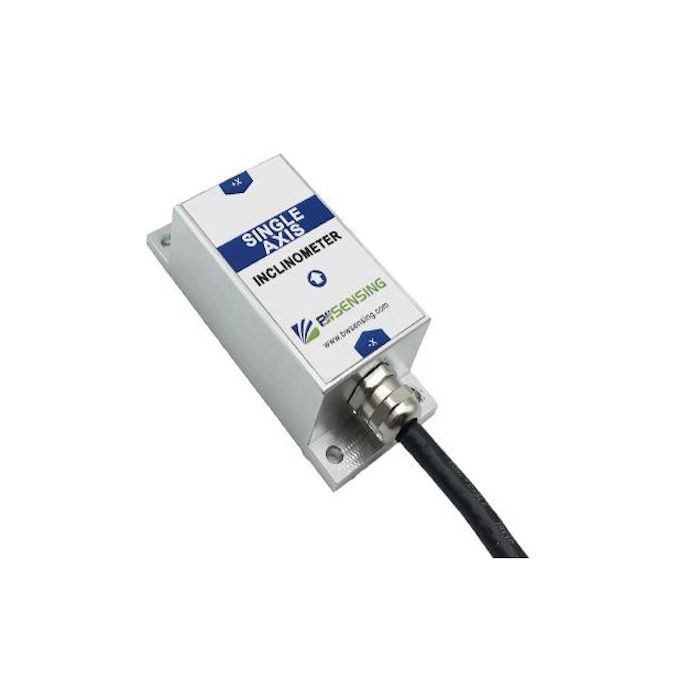
In stock
- BRAND:
- BWSENSING
- PART #:
- BWM415
- ORIGIN:
- China
- AVAILABILITY:
- SUBJECT TO AVAILABILITY
- SKU:
- BWSENSING-BWM415
BWSENSING Cost-Effective Single-Axis CAN Output Inclinometer (BWM415)
A bubble level tells one person one thing at one moment. A machine that must know its own tilt, all day and without anyone watching, needs something quite different: a sensor that reports the angle as numbers, over a network, and keeps doing so in dirt, water and vibration. The BWSENSING Cost-Effective Single-Axis CAN Output Inclinometer (BWM415) is built for that second kind of job, turning one axis of inclination into a CAN signal a controller can read.
This product is available through this page, by quotation.
Background
BWSENSING and its inclinometer family
BWSENSING is the brand behind a broad line of inclination sensors, and the BWM415 sits in its cost-effective range. That range is organized around a simple idea: offer the same kinds of outputs and housings across single-axis and dual-axis models, so a designer can choose the measurement and the interface separately. The BWM415 pairs a single measuring axis with a CAN output. Other family members change one of those two choices, such as the single-axis model with Modbus output (BWM417) or the dual-axis models with digital output.
If you are comparing the whole range, the BWSensing brand page gathers it in one place, and the Sensors category shows how inclinometers sit next to the other sensing products we handle for robotics and field equipment.
Where the BWM415 fits
The BWM415 is positioned as a digital inclinometer with a metal connector, a 1.5 m cable and an IP67 protection level. The manufacturer names one application in particular: it is especially suitable for underground trenchless machines. That tells you a lot about the design priorities. Equipment that works below ground is shaken, knocked and splashed, and it is not easy to reach for service. A compact, sealed sensor with a wide supply range and a bus output suits that setting well.
The CAN output matters just as much. CAN is a long-established bus in mobile and industrial machinery, valued for tolerating electrical noise and for letting several devices share one pair of wires. A tilt sensor that speaks CAN can be wired into an existing network instead of requiring its own analog channel.
Technical Specifications
| Specification | BWM415 |
|---|---|
| Measurement | Single-axis inclination |
| Range | ±180° |
| Resolution | 0.001° |
| Highest accuracy | 0.01° |
| Zero bias (-40~85℃) | ±0.008 °/℃ |
| Output | CAN |
| Output frequency | 5-100Hz adjustable, up to 100Hz |
| Start-up time | <3s |
| Power supply | 9-36V |
| Protection level | IP67 |
| Impact resistance | 2000g, 0.5ms, 3 times/axis |
| Insulation resistance | ≥100 MΩ |
| MTBF | ≥90000h |
| Dimensions | L90*W40.5*H26 (mm) |
| Connector and cable | Metal joint (cable 1.5m) |
Specifications as published by the manufacturer; confirmed against the datasheet at quotation.
The manufacturer has not published the weight, the frequency response, the contents of the box, the cable wiring colors or the baud rate options; they are confirmed at quotation.
What makes the BWM415 different from a dual-axis or Modbus inclinometer?
The first difference is focus. The BWM415 measures inclination about one axis, over a range of ±180°. If your machine pitches or rolls about a single known direction, one axis is all you need, and a single-axis sensor avoids paying for a measurement you will never use. When both directions matter, such as leveling a platform in two planes, the dual-axis models like the BWM427 or the BWM426 are the better place to start.
The second difference is the interface. The BWM415 outputs CAN, while the BWM417 is the single-axis version with Modbus. Neither is better in general; the right one is the one your controller already speaks. If your machine has a CAN network, the BWM415 joins it directly. If your system is built around Modbus, the BWM417 is the natural match. Choosing by interface first saves a gateway, a converter and some commissioning time.
How precise is the BWM415, and how fast does it report?
Resolution and accuracy are different things, and the manufacturer lists both. Resolution is 0.001°, the smallest change the output can express. The highest accuracy is 0.01°, which tells you how close the reading is to the true angle at best. For a drilling or steering application, the practical meaning is that the output moves smoothly with small tilt changes while remaining honest about the true angle.
The output frequency is adjustable from 5 to 100Hz, so you can set a slower rate for a calm, steady task or the full 100Hz where the controller wants frequent updates. The zero bias is ±0.008 °/℃ across -40~85℃, a figure worth checking against the temperature swings your machine will see. The start-up time is under 3 seconds, so the sensor is ready quickly after power is applied.
On the robustness side, the manufacturer lists impact resistance of 2000g for 0.5ms, three times per axis, an insulation resistance of at least 100 MΩ, and an MTBF of at least 90000h. Together with IP67 protection, these describe a sensor intended for rough duty rather than a laboratory bench.
Who is the BWM415 for?
The clearest customer is the builder or operator of underground trenchless machines, the one application the manufacturer names. Those teams need an attitude reading from a sensor that can ride along with the tool, take knocks and keep reporting on a bus.
The second group is machine integrators who already use CAN. For them the BWM415 is a drop-in way to add a tilt reading to an existing network, powered from a 9-36V supply that covers common vehicle and equipment voltages.
The third group is maintenance and retrofit teams who want to add tilt feedback to equipment that lacks it. A compact body of L90*W40.5*H26 (mm) and a 1.5 m cable with a metal joint make that a manageable job.
Buyers who need two axes should look at the dual-axis models such as the BWM466. Those who need Modbus rather than CAN should consider the BWM417 mentioned above.
What is the BWM415 used for?
- Underground trenchless machines. The manufacturer's named application: reporting the tilt of the machine or tool as it works out of sight.
- Drilling and boring equipment. A tilt reading on one axis helps an operator or controller judge the attitude of the rig or the boom.
- Machine leveling. A CAN tilt value lets a controller correct a frame or platform that must stay level about one axis.
- Angle feedback on mobile equipment. Where an arm or a mast moves in a single plane, one axis gives the inclination directly.
- Structure and mast monitoring. Tilt sensors of this class are commonly used to watch for slow lean over time on towers and similar structures.
- Robot and vehicle platforms. A compact CAN sensor can report the slope a platform is working on to the main controller.
Pricing and Availability
We do not publish prices for the BWM415 on this page. Quotation is the next step: tell us the quantity and your application, and we respond with a quote. Delivery, customs and support are arranged with the quotation, so you see the whole picture before you commit. The BWSENSING BWM415 inclinometer is available on this page.
Frequently Asked Questions
What output does the BWM415 use?
It uses a CAN output. The manufacturer does not publish the baud rate options, so confirm them at quotation if your network requires a specific rate.
What is the measuring range?
The range is ±180° on a single axis. The resolution is 0.001° and the highest accuracy is 0.01°.
What power supply does it need?
The power supply is 9-36V. That range covers many common equipment and vehicle supplies.
Is the BWM415 sealed against water and dust?
Yes, its protection level is IP67. It is supplied with a metal joint and a 1.5 m cable.
Can I change how often it reports?
Yes. The output frequency is adjustable from 5 to 100Hz, up to 100Hz. The start-up time is under 3 seconds.
How is it different from the BWM417?
Both are single-axis models, but the BWM415 outputs CAN while the BWM417 is the version with Modbus. Choose the one that matches your controller.
Where can I buy the BWM415 and what does it cost?
You can request it through this page. We do not list a price here; the cost is given in a quotation, with delivery, customs and support arranged alongside it.
Summary
A tilt reading is only useful if it survives the place where it is needed. The BWM415 answers with a single measuring axis over ±180°, 0.001° resolution, a CAN output, a 9-36V supply and IP67 protection, in a compact body with a 1.5 m cable. It suits underground trenchless machines first, and any CAN-based equipment that needs one clear angle. If that matches your project, this page is the starting point.


