
BWSENSING Cost-Effective Single-Axis Digital Output With Modbus Inclinometer (BWM417)
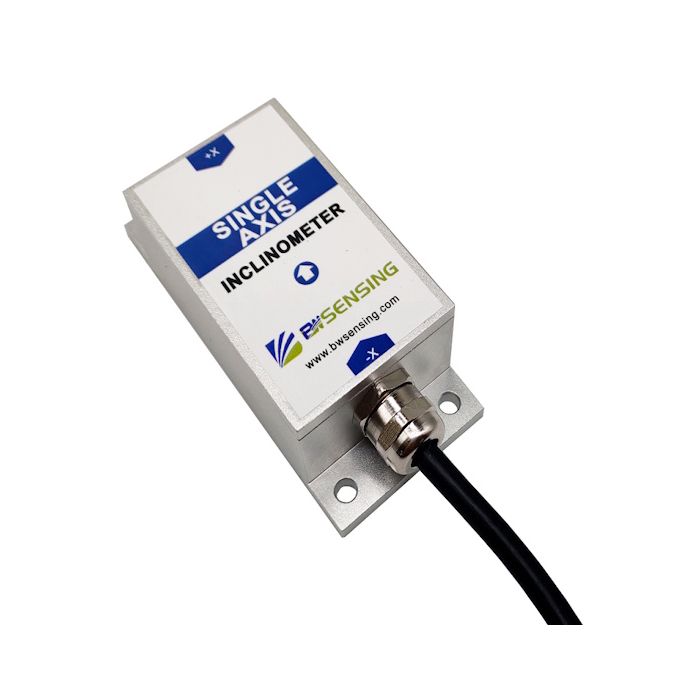
In stock
- BRAND:
- BWSENSING
- PART #:
- BWM417
- ORIGIN:
- China
- AVAILABILITY:
- SUBJECT TO AVAILABILITY
- SKU:
- BWSENSING-BWM417
BWSENSING Cost-Effective Single-Axis Digital Output With Modbus Inclinometer (BWM417)
Most sensors are judged by the data sheet. A tilt sensor is judged by what happens after a year on a tower, a tracker or a boom, when nobody is nearby to look at it. The BWSENSING Cost-Effective Single-Axis Digital Output With Modbus Inclinometer (BWM417) is built around that idea: one axis, a digital signal, a sealed housing and a choice of serial interfaces, so the angle gets to the controller without fuss.
This product is available through this page, by quotation.
Background
The company behind the BWM417
The BWM417 is made by Wuxi Bewis Sensing Technology LLC, based in Wuxi City, Jiangsu Province, China, and sold under the BWSENSING brand. The company works in inclination and tilt measurement, and its catalog covers single-axis and dual-axis inclinometers with different output types. You can browse the wider range in the BWSensing brand listing or in the Sensors category.
For buyers in the Caribbean, a supplier with a clear product family matters. Projects here often mix imported equipment, and it helps when one manufacturer offers the same sensing approach in several output formats. The BWM417 sits in that family as the single-axis digital option.
Where the BWM417 fits
The BWM417 is positioned as a cost-effective digital inclinometer. It measures tilt around a single axis and reports it digitally, rather than as an analog voltage or current that must be scaled and filtered at the receiving end. The product name points to Modbus, the familiar serial convention in industrial automation, and the unit is offered with RS232, RS485 or TTL output.
The BWM417 comes in three versions: BWM417-180-485, BWM417-180-232 and BWM417-180-TTL. The 180 in each code matches the measurement range of ±180°. The measurement figures below apply to the product as a whole; the version you choose is mainly a question of the output interface your controller expects.
Technical Specifications
| Specification | Value |
|---|---|
| Number of axes | Single axis |
| Measurement range | ±180° |
| Highest accuracy | 0.01° |
| Resolution | 0.001° |
| Output frequency | 5-100Hz adjustable, up to 100 |
| Output interface | RS232/RS485/TTL optional |
| Power supply | 9-35V |
| Protection level | IP67 |
| Impact resistance | 2000g, 0.5ms, 3 times/axis |
| Dimensions | L90*W40.5*H26 (mm) |
Specifications as published by the manufacturer; confirmed against the datasheet at quotation.
The manufacturer has not published the weight, the baud rate options, the package contents or the data register map; they are confirmed at quotation.
What makes the BWM417 different from an analog tilt sensor?
An analog tilt sensor gives you a voltage or a current. That is simple on paper, but in the field it brings a chain of small problems: the analog input of the controller has its own error, long cables pick up noise, and the scaling has to be set and documented by someone. A digital inclinometer removes most of that. The angle is converted inside the sensor and sent as data, so the number your controller reads is the number the sensor measured.
The BWM417 goes further than a bare digital output. Its resolution of 0.001° is finer than its highest accuracy of 0.01°, which means the reading changes in very small steps and trends are easy to see. Accuracy and resolution are not the same thing, and it is worth keeping them apart when you write a specification for a project. The accuracy tells you how close the reading is to the true angle. The resolution tells you how small a change you can see.
The output frequency is adjustable from 5Hz to 100Hz. A slow structure, such as a tower leaning over months, does not need a fast stream, and a lower rate keeps the data volume manageable. A moving platform may want the faster end of the range. Having both in one sensor means you do not buy a different model for every job.
Which output version of the BWM417 should I choose?
The output is where the three versions differ. RS485 is common in industrial installations, where several devices share a cable over long runs. RS232 is a simpler point-to-point link, often found on laboratory equipment and older loggers. TTL is the logic-level option, usually chosen when the sensor talks directly to a microcontroller or an embedded board on the same enclosure or machine.
A practical rule: look at what your receiving device already has. If a PLC or gateway has an RS485 port, the BWM417-180-485 is the natural match. If you are wiring to a board with a UART, the BWM417-180-TTL avoids an extra converter. The BWM417-180-232 suits equipment with an RS232 port.
If your application needs a different bus altogether, the BWSENSING Cost-Effective Single-Axis CAN Output Inclinometer (BWM415) is the single-axis model with a CAN output.
Who is the BWM417 for?
The BWM417 is aimed at integrators and maintenance teams who need a dependable angle reading and do not want to pay for features they will not use. Typical buyers include solar installers and operators, structural and tower monitoring teams, machine builders and equipment OEMs, and survey and instrumentation users.
Solar installers work with single-axis trackers that rotate around one line, so one axis of tilt is what the controller needs. The wide ±180° range covers a full swing without ambiguity. Tower and mast monitoring teams watch telecom masts and utility structures for slow lean, and a fine resolution and a sealed housing suit long-term, unattended installation, which is common across island sites exposed to salt air and rain. Machine builders often deal with booms, platforms and levelling systems that move in one plane, and a compact body and a 9-35V supply range make the sensor easy to fit into existing electrical designs. Survey and instrumentation users get a simple digital angle source for a larger instrument.
If your structure can tilt in two directions and you need both, look at a dual-axis model instead, such as the BWSENSING Cost-Effective Dual-Axis Inclinometer (BWM427) or the BWSENSING Cost-Effective Dual-Axis Digital Output Inclinometer (BWM426). A single axis is the better and simpler fit when the motion happens in one plane only.
What is the BWM417 used for?
- Solar tracker positioning. Reports the rotation angle of a single-axis tracker to its controller so the panels can be set and checked.
- Tower and mast tilt monitoring. Watches for slow lean in tall structures and feeds a logger or an alarm.
- Boom and arm angle measurement. Gives equipment controllers the angle of a boom or an arm moving in one plane.
- Platform levelling. Reads pitch on work platforms and mobile equipment so levelling systems can correct it.
- Equipment automation. Supplies an angle input to PLC-based machines that need a digital position signal.
- Surveying and instrumentation. Serves as a compact angle source inside measuring instruments and test setups.
Pricing and Availability
We do not publish prices on this page. A quotation is the way to buy: tell us which version you need and the quantity, and we will prepare it. Delivery, customs and support are arranged with the quotation, so you see the whole picture before you commit. The BWSENSING BWM417 is available on this page.
Frequently Asked Questions
What range does the BWM417 measure?
The measurement range is ±180° on a single axis. The version codes carry the 180 to show it.
How accurate is the BWM417?
The highest accuracy is 0.01°, and the resolution is 0.001°. The two figures describe different things: accuracy is closeness to the true angle, and resolution is the smallest step of the reading.
What output interfaces are available?
RS232, RS485 and TTL are optional. The versions are BWM417-180-485, BWM417-180-232 and BWM417-180-TTL.
What supply voltage does it need?
The power supply range is 9-35V. That covers many common industrial and battery-based systems, so check your own supply against that range.
Is the BWM417 suitable for outdoor use?
It has an IP67 protection level, which suits installations where dust and water are a concern. Its impact resistance is 2000g, 0.5ms, 3 times/axis.
How fast does it output data?
The output frequency is adjustable from 5Hz to 100Hz, up to 100. You set the rate that suits your application.
Where can I buy the BWM417 and what does it cost?
You can buy it through this page by requesting a quotation. The cost depends on the version and quantity, so it is given in the quotation rather than listed here.
Summary
The BWM417 is a sensor you choose so that you can stop thinking about it. It reads one axis over a range of ±180° with 0.001° resolution, sends the result digitally in the serial format you select, runs from 9-35V and sits in an IP67 housing measuring L90*W40.5*H26 (mm). Which version you pick depends on the port your controller has. If you are ready to specify an angle sensor for a tracker, a tower or a machine, this page is the starting point.


