
BWSENSING Cost-Effective Dual-Axis Digital Output Inclinometer (BWM426)
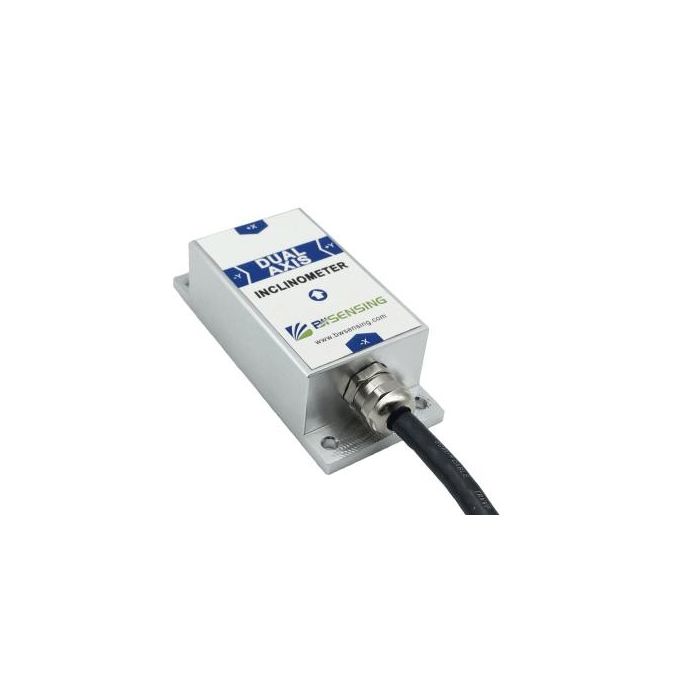
In stock
- BRAND:
- BWSENSING
- PART #:
- BWM426
- ORIGIN:
- China
- AVAILABILITY:
- SUBJECT TO AVAILABILITY
- SKU:
- BWSENSING-BWM426
BWSENSING Cost-Effective Dual-Axis Digital Output Inclinometer (BWM426)
A bubble level shows a technician which way a machine leans, but it tells a controller nothing. The BWSENSING Cost-Effective Dual-Axis Digital Output Inclinometer (BWM426) turns that lean into numbers a PLC, a data logger or a laptop can read. It measures two axes at once, resolves 0.001°, and fits in a housing only 90 mm long.
The product is available through this page, by quotation.
Background
Who designed the BWM426?
The BWM426 was designed by BEWIS Sensing Technology LLC, the maker behind the BWSENSING range. The company's inclinometers cover single-axis and dual-axis models and several digital interfaces. The BWM426 is described by its maker as a low cost, small, double-axes inclinometer with Modbus protocol output. Within the range it sits as the economical, compact choice for jobs that need real digital angle data without a laboratory-grade instrument.
Where does it sit in the range?
Inclinometers come in many forms. Some are built for slow, careful survey work, and others for rugged machinery. The BWM426 is aimed at the practical middle: a sealed, small module with a wide supply range and a choice of serial outputs. Its shell is magnesium alloy with anodizing, and it carries an IP67 protection level. That combination suits equipment that lives outdoors, on vehicles, on frames and on structures, rather than in a clean control cabinet.
The Caribbean has plenty of work of this kind, from solar mounting structures to port equipment to telecom masts. Wherever a surface must stay level, or its movement must be tracked, a compact digital inclinometer earns its place. You can browse related instruments in our Sensors category.
Technical Specifications
| Specification | Value |
|---|---|
| Measurement axes | Dual axis inclination measurement |
| Range (BWM426) | ±90° |
| Measuring range (BWM426-88) | ± 88° |
| Resolution | 0.001° |
| Highest accuracy | 0.01° |
| Power supply | 9-35V |
| Output interface | RS232/RS485/TTL optional |
| Protection level | IP67 |
| Operating temperature (BWM426) | -40℃~+85℃ |
| Shell material (BWM426) | Magnesium alloy anodizing |
| Dimensions | L90*W40.5*H26 (mm) |
| Installation | Horizontal or vertical (vertical installation requires customization) |
Specifications as published by the manufacturer; confirmed against the datasheet at quotation.
The manufacturer has not published the weight, the cable length or the output protocol details; they are confirmed at quotation.
What makes the BWM426 different from a bubble level or a simple tilt switch?
A bubble level and a tilt switch answer a narrow question. The level says roughly whether a surface is flat, and the switch says whether a threshold has been crossed. The BWM426 reports the actual angle on two axes, with a resolution of 0.001° and a highest accuracy of 0.01°. That difference matters when you must log how a structure moves over days, or level a platform to a stated tolerance and prove it afterward.
The digital output is the other half of the story. The sensor offers RS232, RS485 or TTL as options, so it can be matched to the equipment it talks to. RS485 is the usual route when a cable has to run some distance, and TTL suits a direct connection to a microcontroller board. The supply range of 9-35V means one sensor can be powered from the common DC rails found on vehicles, batteries and industrial panels.
Physical toughness is part of the answer too. The IP67 protection level and the anodized magnesium alloy shell make the module suitable for mounting outside a cabinet. The operating temperature runs from -40℃ to +85℃ for the BWM426, which covers a very wide band of working conditions.
Setup is also simple. According to the manual, supporting serial debugging software can be connected to the inclinometer on a computer to display the angle. That lets a technician see readings straight away, before the sensor is wired into a larger system.
What is the difference between BWM426, BWM426-88 and BWM426S?
The sources name three versions. The main difference the fact sheet shows is range. The BWM426 product page gives a range of ±90°, and the BWM426-88 manual gives a measuring range of ± 88°. If your application needs the full ±90° span, ask for the BWM426. If the narrower span is enough, the BWM426-88 is the version the manual describes.
For the BWM426S, the sources we hold give no separate figures, so we do not assign any to it. Tell us which version you need when you request a quotation, and we will confirm its figures against the datasheet.
If your job needs a different axis count or a different interface, the range has neighbors worth a look. The BWM427, the BWN427 and the BWM466 are other dual-axis models in the same family.
Who is the BWM426 for?
Integrators and panel builders are the first group. They need a small angle sensor that speaks a standard serial interface and accepts a wide DC supply, and the BWM426 does both. Maintenance teams are the second. They can use it to check and log the levelness of equipment, and the debugging software gives a fast on-site reading.
Solar and telecom installers are a third segment. They often work outdoors on frames, trackers and masts, where the IP67 protection level and the anodized shell are useful. Developers of mobile machines and robotic platforms are a fourth: a compact two-axis sensor is a convenient way to give a vehicle a sense of its own attitude.
If you only need one axis, a single-axis model may be the better fit. The BWM417 offers single-axis digital output with Modbus, and the BWM415 offers single-axis CAN output. Note that the BWM426 itself is installed horizontally as standard; vertical installation requires customization.
What is the BWM426 used for?
- Platform leveling: Read two axes at once to bring a work platform or frame to level and confirm it stays there.
- Equipment attitude monitoring: Track the tilt of machines, booms and mounted equipment while they work.
- Structural tilt monitoring: Log slow movement of masts, towers, beams and other fixed structures.
- Solar tracker and panel alignment: Provide angle feedback so mounting frames can be set and checked.
- Mobile robot and vehicle orientation: Give a control system a digital pitch and roll reading.
- Laboratory and bench testing: Connect to a computer with the serial debugging software and view the angle directly.
Pricing and Availability
We do not publish prices for the BWM426. Please request a quotation, stating the version, the output interface and the quantity you need. Delivery, customs and support are arranged with the quotation. The BWSENSING Cost-Effective Dual-Axis Digital Output Inclinometer (BWM426) is available on this page.
Frequently Asked Questions
How many axes does the BWM426 measure?
It is a dual-axis inclinometer, so it measures inclination on two axes at the same time.
What output interfaces are available?
The output is RS232, RS485 or TTL, offered as options. Tell us which one you need when you ask for a quotation.
What power supply does it need?
The power supply is 9-35V.
How accurate is it?
The resolution is 0.001° and the highest accuracy is 0.01°.
Can it be used outdoors?
It has an IP67 protection level and an anodized magnesium alloy shell. The BWM426 operating temperature is -40℃~+85℃.
Can it be installed vertically?
It can be installed horizontally or vertically, but vertical installation requires customization.
Where can I buy the BWM426 and what does it cost?
You can buy it through this page by requesting a quotation. We do not list a price here; the cost is given in the quotation, together with delivery and support arrangements.
Summary
The BWM426 takes the simple idea of a level and makes it readable by machines. It measures two axes, resolves 0.001°, accepts 9-35V, offers RS232, RS485 or TTL output, and comes in a compact, IP67-rated housing. The BWM426 and BWM426-88 differ in range, and the BWM426S is confirmed at quotation. If you need to turn tilt into data, this page is the starting point.


