
BWSENSING Cost-Effective Dual-Axis Digital Output With Modbus Inclinometer (BWN427)
In stock
- BRAND:
- BWSENSING
- PART #:
- BWN427
- ORIGIN:
- China
- AVAILABILITY:
- SUBJECT TO AVAILABILITY
- SKU:
- BWSENSING-BWN427
BWSENSING Cost-Effective Dual-Axis Digital Output With Modbus Inclinometer (BWN427)
Most tilt problems do not announce themselves. A tower leans a little more each season, a platform settles on one side, and by the time anyone notices, the correction is expensive. The BWSENSING Cost-Effective Dual-Axis Digital Output With Modbus Inclinometer (BWN427) is built for catching that slow drift early, reading two axes at once and handing the result to your controller over a plain serial line.
The product is available through this page, by quotation.
Background
The company and its lineage
The BWN427 was designed by BEWIS Sensing Technology LLC, the maker behind the BWSENSING range of inclination sensors. The range covers single-axis and dual-axis units, with different output styles such as Modbus and CAN, and it is aimed at buyers who need dependable angle measurement without paying for laboratory-grade instruments. The BWN427 sits in the low-cost, compact end of that family.
For teams in the Caribbean, this kind of sensor fits a practical need. Utility structures, telecom masts, marine platforms and agricultural machinery all face wind, moisture and settling ground. A small digital inclinometer that speaks a common protocol is easier to add to existing monitoring than a bespoke instrument.
Positioning and key technology
The BWN427 is a small, low-cost, Modbus-output, dual-axis inclinometer. It adopts MEMS technology. Inside, a high-precision MEMS accelerometer works together with a high-resolution differential digital-to-analog converter, and built-in automatic compensation and filtering algorithms clean up the signal before it leaves the unit.
That combination matters in practice. A raw accelerometer reading is noisy and sensitive to vibration. Filtering and compensation done inside the sensor means your controller receives an angle it can use directly, rather than a stream it has to condition itself. The output is Modbus, so integration with PLCs, data loggers and industrial gateways follows a familiar pattern.
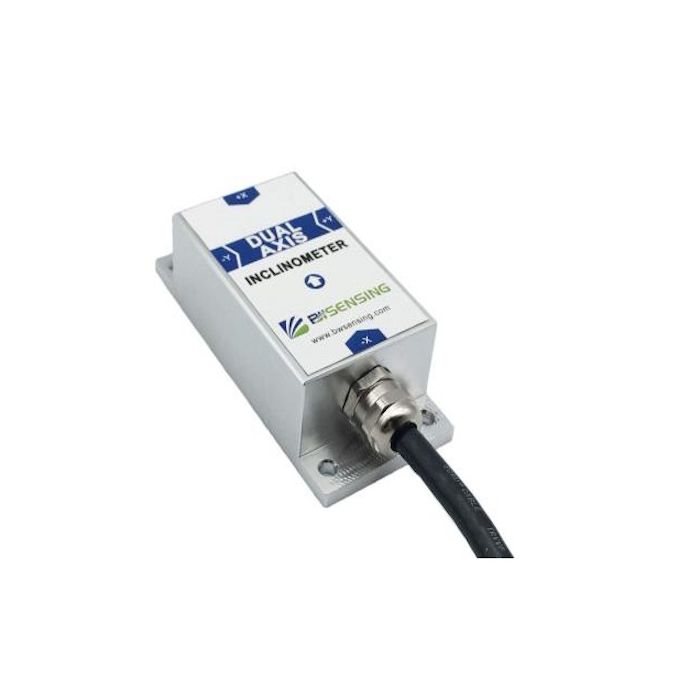
The housing is magnesium aluminum alloy with an oxidation finish, the protection level is IP67, and the unit mounts with four M4 screws. It connects through a metal joint with a 1.5 m cable. In short, it is a compact sensor intended to be bolted to a structure and left to work.
Technical Specifications
| Specification | Value |
|---|---|
| Measurement axes | Dual axis inclination measurement |
| Range | ±90° |
| Resolution | 0.01° |
| Highest accuracy | 0.02° |
| Power supply | 9-36V |
| Output mode | RS232/RS485/TTL optional |
| Output frequency | 5-100Hz adjustable, Up to 100 |
| Protection level | IP67 |
| Technology | MEMS technology and Modbus output |
| Dimensions | L90*W40.5*H26(mm) |
| Shell material | Magnesium aluminum alloy oxidation |
| Installation | Four M4 screws |
| Connector | Metal Joint(Cable 1.5m) |
| Mean time between failures (MTBF) | ≥90000 h |
| Impact resistance | 2000g,0.5ms,3 times/axis |
| Insulation resistance | ≥100 MΩ |
Specifications as published by the manufacturer; confirmed against the datasheet at quotation.
The manufacturer has not published the weight, the cable length options beyond the standard cable, the power consumption in watts or the supported baud rates; they are confirmed at quotation.
Which output version of the BWN427 should I choose?
The sources name three versions: BWN427 RS485, BWN427 RS232 and BWN427 TTL. The listed range, resolution, accuracy, supply voltage and protection level apply to the product as a whole, so the choice is about wiring rather than performance.
RS485 is the usual pick when the sensor sits some distance from the controller, or when several devices share one line. RS232 suits a direct point-to-point link to a computer or a controller with a serial port. TTL is for connecting straight to a microcontroller board on the same device or in the same enclosure. Tell us what your controller offers, and we will recommend the matching version in the quotation.
What makes the BWN427 different from a basic tilt switch?
A tilt switch tells you that a threshold was crossed. The BWN427 tells you where you are. With a range of ±90° and a resolution of 0.01°, it reports a continuous angle on two axes, so you can watch a trend develop over weeks rather than learn only about the final failure.
The output frequency is adjustable from 5 to 100Hz. A slow setting suits a structure that moves gradually, while a faster one suits equipment that tilts during operation, such as a boom or a platform being leveled. The highest accuracy of 0.02° gives a firm basis for deciding when an adjustment is really needed.
Durability is part of the picture too. The MTBF is at least 90000 h and the insulation resistance is at least 100 MΩ, and the unit carries a listed impact resistance rating. For an instrument that may be mounted outdoors and left unattended, those are the figures a maintenance planner looks for.
There is also a practical convenience. Supporting serial port debugging software lets you connect the inclinometer to a computer and display the angle, which makes bench testing and commissioning straightforward before the unit goes into the field.
Who is the BWN427 for?
Integrators and automation engineers are the core buyers. If your system already speaks Modbus, the BWN427 adds angle sensing without a new protocol to learn. The three output options mean it can meet a PLC, a gateway or a microcontroller on their own terms.
Infrastructure and utility teams are a second group. Anyone responsible for masts, poles, towers or platforms that must stay within a tilt limit will value a sensor that is small, sealed to IP67 and fixed with four screws. Maintenance managers can use the angle history to schedule work before a problem becomes urgent.
Equipment builders and machine makers form a third group. Leveling systems, work platforms and mechanical arms all need to know their angle, and a compact unit is easy to place.
If your application needs a different configuration, look at the related models in the range. The BWSENSING Cost-Effective Dual-Axis Inclinometer (BWM427) and the BWSENSING Cost-Effective Dual-Axis Digital Output Inclinometer (BWM426) are other dual-axis options. You can also browse the wider Sensors category or the full BWSensing range.
What is the BWN427 used for?
- Tower and mast monitoring. Track slow lean on structures exposed to wind and changing ground conditions.
- Platform leveling. Read two axes at once so a work platform or mounting frame can be brought level and kept there.
- Mechanical arm and boom angle. Report the inclination of moving equipment to a controller at an adjustable output rate.
- Structural settlement checks. Log angle changes in building elements or support frames over long periods.
- Robot and vehicle attitude. Give a mobile machine a simple tilt reference on two axes.
- Commissioning and bench testing. Connect to a computer with the serial port debugging software and display the angle during setup.
Pricing and Availability
We do not publish prices on this page. Quotation is the way to buy: tell us the output version you need and the quantity, and we will respond with a quotation. Delivery, customs and support are arranged with the quotation. The BWN427 is available on this page.
Frequently Asked Questions
What output options does the BWN427 offer?
The output mode is RS232, RS485 or TTL, selected as an option. The sources name the three versions as BWN427 RS485, BWN427 RS232 and BWN427 TTL.
What is the measurement range and resolution?
The range is ±90° and the resolution is 0.01°. The highest accuracy is 0.02°.
What power supply does it need?
The power supply is 9-36V.
How is the sensor protected against the environment?
It carries an IP67 protection level and a magnesium aluminum alloy shell with an oxidation finish.
How is it installed and connected?
It mounts with four M4 screws and connects through a metal joint with a 1.5 m cable.
Can I test it on a computer before installing it?
Yes. Supporting serial port debugging software connects the inclinometer to a computer and displays the angle.
Where can I buy the BWN427 and what does it cost?
You can buy it through this page by requesting a quotation. Pricing is given in the quotation, and delivery, customs and support are arranged with it.
Summary
Slow tilt is easy to miss and costly to ignore. The BWN427 answers it with a compact, sealed, two-axis sensor that measures ±90° at 0.01° resolution, filters its own signal and speaks Modbus over RS485, RS232 or TTL. It runs from 9-36V, mounts with four screws and has a listed MTBF of at least 90000 h. If it matches your monitoring or leveling task, this page is the starting point.


