
BWSENSING Cost-Effective Dual-Axis Inclinometer (BWM427)
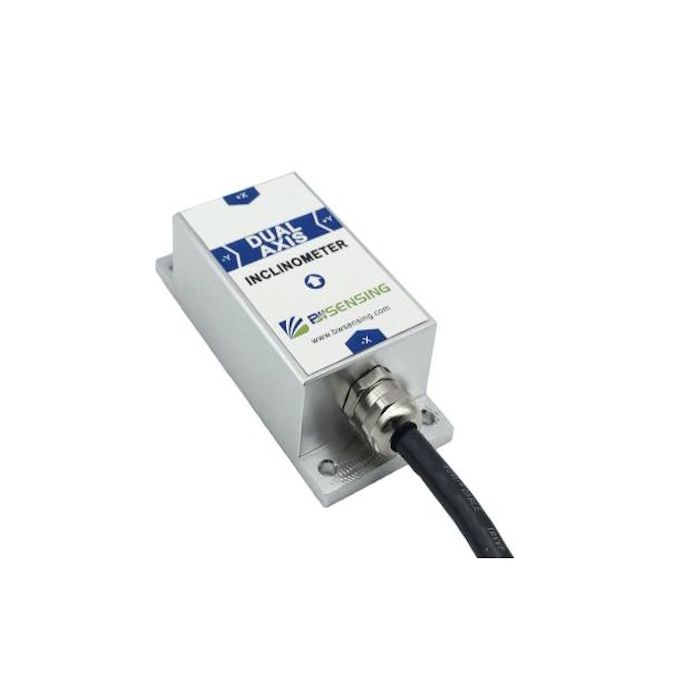
In stock
- BRAND:
- BWSENSING
- PART #:
- BWM427
- ORIGIN:
- China
- AVAILABILITY:
- SUBJECT TO AVAILABILITY
- SKU:
- BWSENSING-BWM427
BWSENSING Cost-Effective Dual-Axis Inclinometer (BWM427)
A bubble level works for a person standing next to it. A machine on a rooftop, a tower or a crane boom needs the same answer as a clean number it can act on. The BWSENSING Cost-Effective Dual-Axis Inclinometer (BWM427) gives a controller that number on two axes at once, in a sealed housing built for the field.
The product is available through this page, by quotation.
Background
BWSENSING and the cost-effective line
BWSENSING is the brand behind a wide family of tilt sensors, and this model sits in its cost-effective group. Within that family the BWM427 is the dual-axis digital unit with a choice of serial outputs. Neighboring models change the number of axes or the communication method. You can browse the full range in the BWSensing category, or look at other devices of this kind in the Sensors category.
The idea behind the line is practical. Many projects need dependable angle feedback but do not need a laboratory instrument. The BWM427 aims at that middle ground: a sensor with fine resolution, a wide supply range and an industrial output, in a compact body.
How the BWM427 reads tilt
The BWM427 is a dual-axis inclination sensor with MEMS technology and digital output. It measures the change of the static gravitational field and converts it into an angle change. Because gravity is always present, the sensor needs no external reference to know which way is down.
The digital output means the angle reaches your controller as data, not as a small analog signal that can pick up noise on a long cable. You choose the interface that suits your system: RS232, RS485 or TTL. These correspond to the three versions named by the manufacturer: BWM427-88-232, BWM427-88-485 and BWM427-88-TTL.
Technical Specifications
| Specification | Value |
|---|---|
| Technology | MEMS, digital output |
| Sensing principle | Measures the change of static gravitational field and converts it into angle change |
| Resolution | 0.001° (completely still) |
| Accuracy | 0.01° (room temperature) |
| Measurement range (manufacturer product page) | ±90° |
| Measuring range (technical manual, BWM427-88) | ±88° |
| Zero bias | ±0.005 °/℃ (-40 to 85℃) |
| Cross axis error | 0.01° (-40 to 85℃) |
| Output frequency | 5-100 Hz adjustable, up to 100 Hz |
| Output interface | RS232 / RS485 / TTL optional |
| Versions | BWM427-88-232; BWM427-88-485; BWM427-88-TTL |
| Power supply voltage (min / typical / max) | 9 / 12 / 35 V |
| Working current, no load (min / typical / max) | 20 / 30 / 40 mA |
| Operating temperature (min / typical / max) | -40 / 25 / 85 ℃ |
| Storage temperature (min / typical / max) | -55 / 25 / 100 ℃ |
| Protection level | IP67 |
| MTBF | ≥90000 h |
| Insulation resistance | ≥100 MΩ |
| Dimensions | L90*W40.5*H26 (mm) |
| Installation | Horizontal or vertical (vertical installation requires customization) |
Specifications as published by the manufacturer; confirmed against the datasheet at quotation.
The manufacturer has not published the package contents, the weight with connector, shock and vibration details beyond impact, or the operating systems supported by the debug software; they are confirmed at quotation.
Why are there two measuring ranges for the BWM427?
Buyers who compare sources will notice two figures. The manufacturer product page lists a measurement range of ±90°, while the technical manual for the BWM427-88 states a measuring range of ±88°. The name of the version carries the 88, so for the BWM427-88-232, BWM427-88-485 and BWM427-88-TTL, plan your design around ±88° unless the quotation says otherwise.
The practical point is that this is a sensor for working around level. It is not meant to follow a full rotation. If your mechanism swings through large angles, check the range against your travel before you order.
What makes the BWM427 suited to outdoor and field work?
Three things stand out in the published figures. The first is the IP67 protection level, which is the rating you look for when a sensor sits on a pole, a frame or a machine that sees rain and dust. The second is the operating temperature range of -40 to 85 ℃, which covers hot rooftops in the sun as well as cold storage areas. The third is the power window: the sensor accepts 9 to 35 V, with 12 V typical. That lets it share a supply with many industrial controllers without a dedicated regulator.
Accuracy holds up as conditions change. Zero bias is ±0.005 °/℃ and cross axis error is 0.01° across -40 to 85℃. For a tracker or a tower that sits in the sun all day, that stability matters as much as the headline accuracy of 0.01° at room temperature. The MTBF of ≥90000 h and the insulation resistance of ≥100 MΩ add to the picture of a unit meant to stay in service.
One more detail: output frequency is adjustable from 5 to 100 Hz. A slow structure can be read gently to keep the data light, while a moving platform can be read quickly.
Who is the BWM427 for?
The first group is integrators and panel builders who need a tilt reading on a serial line. If your controller speaks RS485, the BWM427-88-485 version suits a longer cable run. If the sensor sits next to a microcontroller board, the TTL version fits. For a PC or a device with an RS232 port, choose the 232 version.
The second group is solar installers and maintenance teams who want automatic tracking or position checks on frames. The third is engineers who watch structures: towers, frames and other assets where a slow lean needs to be caught early. Crane and lifting equipment builders can also use it for inclination control.
Medical instrument makers and surveying teams form the fourth group. They benefit from the fine 0.001° resolution when the device is completely still.
If your project needs a single axis or a different communication method, look at related models. The BWSENSING Cost-Effective Dual-Axis Digital Output With Modbus Inclinometer (BWN427) is the one to review if Modbus is a requirement, and the BWSENSING Cost-Effective Dual-Axis Digital Output Inclinometer (BWM426) is another dual-axis option. For one axis with CAN output, see the BWSENSING Cost-Effective Single-Axis CAN Output Inclinometer (BWM415).
What is the BWM427 used for?
- Industrial automatic leveling. Feed two-axis tilt data to a controller so a platform or machine can level itself.
- Medical instruments. Provide an angle reference inside equipment that must know its own orientation.
- Photovoltaic automatic tracking. Report the angle of a solar panel frame so the tracker can adjust.
- Tower tilt monitoring. Watch for slow lean in towers and similar tall structures.
- Structural deformation monitoring. Record small angle changes in a structure over time.
- Surveying and mapping. Supply an angle reading to instruments that need to know whether they are level.
Pricing and Availability
We do not list prices on this page. Quotation is the next step: tell us the version you need, the interface and the quantity, and we prepare an offer. Delivery, customs and support are arranged together with the quotation. The BWM427 and its three interface versions are available on this page.
Frequently Asked Questions
What does the BWM427 measure?
It measures tilt on two axes by sensing the change of the static gravitational field and converting it into an angle change. The output is digital.
Which output interfaces are available?
RS232, RS485 and TTL are optional. They correspond to the versions BWM427-88-232, BWM427-88-485 and BWM427-88-TTL.
How accurate is it?
Accuracy is 0.01° at room temperature, and resolution is 0.001° when the sensor is completely still. Cross axis error is 0.01° from -40 to 85℃.
Is it protected against dust and water?
Yes, the protection level is IP67. The operating temperature range is -40 to 85 ℃.
Can it be mounted vertically?
It can be installed horizontally or vertically, but vertical installation requires customization. Mention it when you request a quotation.
What supply voltage does it need?
The supply range is 9 to 35 V, with 12 V typical. Working current with no load is 20 to 40 mA, with 30 mA typical.
Where can I buy the BWM427 and what does it cost?
You can buy it through this page by requesting a quotation. The cost depends on the version and quantity, so we give it in the quotation rather than on the page.
Summary
Gravity gives every machine a reference, and the BWM427 turns it into a digital reading that a controller can use. It offers fine resolution, a wide supply range, IP67 sealing and a choice of RS232, RS485 or TTL, in a body measuring L90*W40.5*H26 mm. If you are planning a leveling, tracking or monitoring project, this page is the starting point.


