
Unitree R1 Edu Pro D Humanoid Robot with BrainCo Revo 2 Touch Dexterous Hands (R1 EDU U6)
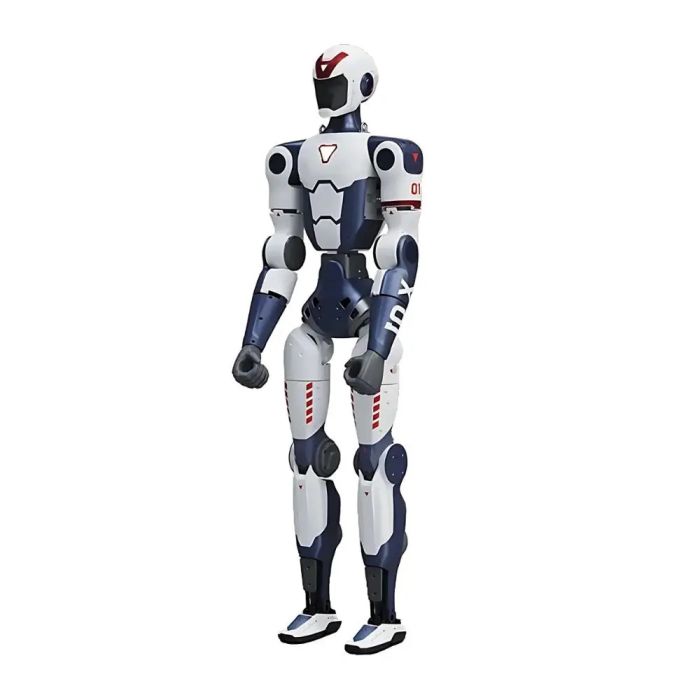
In stock
- BRAND:
- UNITREE ROBOTICS
- MODEL:
- R1 EDU PRO D
- PART #:
- R1 EDU U6
- ORIGIN:
- China
- Warranty:
- 12 MONTHS
- AVAILABILITY:
- ALLOW 2-4 WEEKS FOR DELIVERY
- SKU:
- Unitree Robotics-R1-EDU-U6
Unitree R1 Edu Pro D Humanoid Robot with BrainCo Revo 2 Touch Dexterous Hands (R1 EDU U6)
A humanoid robot is, before anything else, a set of proportions. The length of a leg decides how it steps, the length of an arm decides what it can reach, and the hands decide what it can do once it gets there. The Unitree R1 Edu Pro D Humanoid Robot with BrainCo Revo 2 Touch Dexterous Hands (R1 EDU U6) is built around that idea: a full body with 38 actuated joints, finished with hands that report contact back to the researcher.
This product is available through this page, by quotation.
Background
Unitree and the R1 family
Unitree Robotics is a manufacturer of legged and humanoid robots that are used in laboratories, universities and engineering teams. The R1 line is its compact humanoid family, and it is sold in a ladder of versions: R1 Basic, R1 EDU Standard (U1), R1 EDU Smart (U2), R1 EDU Pro A (U3), R1 EDU Pro B (U4), R1 EDU Pro C (U5) and R1 EDU Pro D (U6). The EDU versions are the ones aimed at teaching and research programs, and the Pro D sits at the end of that list.
Buyers who want to see the whole range side by side can start from the Unitree R1 EDU category or the wider Unitree R1 category. Each version on those pages is quoted separately, and the figures in this article belong to the Pro D (U6) only.
Where the Pro D sits in the lineup
The name tells you what is special about this version. The Pro D carries BrainCo Revo 2 Touch five-finger dexterous hands, with 6 degrees of freedom in each hand and 4-channel tactile sensing. The Pro C, by comparison, is listed with BrainCo Revo 2 Basic dexterous hands, and you can see it on the Unitree R1 Edu Pro C (R1 EDU U5) page. The word Touch on the Pro D is the point: the hand does not only move, it senses.
In practice, the body of the Pro D is a platform for studying how a humanoid uses its hands. A research team can plan reaching, grasping and bimanual tasks around a machine with a leg length, arm length and joint count that are known from the start.
Technical Specifications
| Specification | Value |
|---|---|
| Version | R1 EDU Pro D (U6) |
| Total degrees of freedom | 38 total actuated DOF across legs, arms, waist, and head |
| Dexterous hands | BrainCo Revo 2 Touch five-finger dexterous hands |
| Degrees of freedom per hand | 6 DOF |
| Tactile sensing | 4-channel |
| Calf + thigh length | 675 mm |
| Forearm + upper arm length | 435 mm |
| Battery life | ~ 1 hour |
Specifications as published by the manufacturer; confirmed against the datasheet at quotation.
The manufacturer has not published the IP rating, the battery capacity, the charging time, the walking speed, the power consumption, the operating temperature, the hand grip force or the operating system; they are confirmed at quotation.
What makes the Pro D different from the Pro C?
The difference you can read straight from the model names is the hand. The Pro C is listed with BrainCo Revo 2 Basic dexterous hands. The Pro D is listed with BrainCo Revo 2 Touch hands, which have five fingers, 6 DOF per hand and 4-channel tactile sensing. If your work depends on the robot knowing when and how its fingers are touching an object, that tactile channel is the reason to look at the Pro D first.
Tactile data matters because vision alone cannot tell you everything about a grasp. A camera sees the object and the hand, but it does not feel the contact. A hand that reports touch gives a research team another stream of information to record, to study and to use when training a manipulation method. Both versions share the same family, so the choice between them comes down to whether tactile sensing is part of your research question.
The Pro D is not only about the hands. The 38 actuated joints are spread across the legs, arms, waist and head, so the whole body can take part in a task. A robot that can bend at the waist, turn its head and move both arms is a very different tool from one that only has hands on a fixed torso. For other versions in the same tier, see the Unitree R1 Edu Pro A (R1 EDU U3) and the Unitree R1 Edu Pro B (R1 EDU U4).
How long does the battery of the R1 EDU U6 last?
The Pro D runs for about 1 hour on a battery. That is a useful working window for a lab session: a setup, a round of calibration, a series of trials and a short break. Teams that plan longer experiments should organize them in blocks of that length and plan the battery routine around it.
Who is the R1 EDU U6 for?
The first group is university and research laboratories that study manipulation. A five-finger hand with tactile sensing is a natural fit for projects on grasping, in-hand handling and learning from demonstration. The second group is robotics programs that teach humanoid control. A full body with 38 actuated joints gives students a real machine to work on, not a simplified model.
The third group is development teams that want to test ideas about humanoids before committing to a larger platform. The compact body and the known leg and arm lengths make planning easier. A fourth group is institutions that want one machine for several research lines, from walking and balance to hand work.
If your work does not need tactile sensing, other versions in the family may suit you better. The Pro C carries Revo 2 Basic hands, and the Pro A is another step in the ladder. Ask us for a comparison and we will help you choose.
What is the R1 EDU U6 used for?
- Dexterous manipulation research. Five fingers per hand and 6 DOF per hand allow work on grasping and object handling.
- Tactile sensing studies. The 4-channel tactile sensing gives researchers contact data to record and analyze.
- Whole-body motion research. With 38 actuated DOF across legs, arms, waist and head, the body can be studied as one system.
- Teaching humanoid robotics. Students work on a real humanoid with known leg and arm lengths.
- Learning from demonstration. Human-shaped hands make it natural to compare a human's movements with the robot's.
- Prototype testing. Teams can try out ideas on a compact humanoid before scaling to bigger projects.
Pricing and Availability
We do not list prices on this page. Quotation is the way to buy: tell us how many units you need, how you plan to use them and where they are going, and we will prepare a quotation for the Unitree R1 Edu Pro D (R1 EDU U6). Delivery, customs and support are arranged with the quotation. The R1 EDU U6 is available on this page.
Frequently Asked Questions
How many degrees of freedom does the R1 EDU U6 have?
The robot has 38 total actuated DOF across the legs, arms, waist and head. Each BrainCo Revo 2 Touch hand adds 6 DOF of its own.
What hands does the Pro D use?
It uses BrainCo Revo 2 Touch five-finger dexterous hands. Each hand has 6 DOF and 4-channel tactile sensing.
What are the leg and arm lengths?
The calf plus thigh length is 675 mm, and the forearm plus upper arm length is 435 mm.
How long does the battery last?
The battery life is about 1 hour, which suits a single lab session of setup, calibration and trials.
Why does tactile sensing matter for research?
Touch data shows what a camera cannot, such as whether a finger is in contact with an object. It gives a team another stream of data to record and study.
How does the Pro D differ from the Pro C?
The Pro C is listed with BrainCo Revo 2 Basic hands, while the Pro D has Revo 2 Touch hands with 4-channel tactile sensing.
Where can I buy the R1 EDU U6 and what does it cost?
You can buy it through this page by requesting a quotation. We do not print prices; the cost depends on your quantity and delivery needs and is given in the quotation.
Summary
The Pro D is the R1 family version for teams that care about proportions and touch: a body with 38 actuated joints, known leg and arm lengths, and five-finger hands that feel contact through 4-channel tactile sensing. It gives researchers and teachers a clear tool for manipulation and whole-body work, with a working session of about one hour. If the Unitree R1 Edu Pro D (R1 EDU U6) fits your program, this page is the starting point.


