
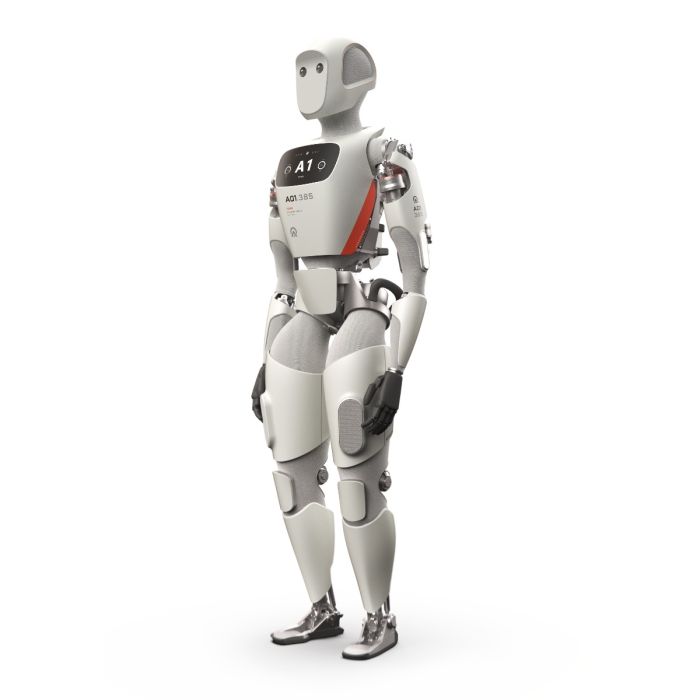
Apptronik APOLLO Humanoid Robot
In stock
- BRAND:
- APPTRONIK
- MODEL:
- APOLLO
- AVAILABILITY:
- SUBJECT TO AVAILABILITY
- SKU:
- Apptronik-APOLLO
Apptronik APOLLO Humanoid Robot
Most robots are built to stay out of the way of people; a humanoid is built to step into their space. The Apptronik APOLLO Humanoid Robot takes that challenge seriously: it stands at roughly human size, wears a face that talks back, and is built so that a person can stand next to it without a cage between them. For teams weighing what a humanoid can do on a real shop floor, it is one of the more thoroughly documented answers on the market.
The product is available through this page, by quotation.
Background
The company and its lineage
Apptronik did not arrive at the humanoid from nowhere. The APOLLO grew out of the company's experience building more than 10 earlier robots, among them NASA's Valkyrie. That history matters to a buyer because a humanoid is a hard machine to get right. Balance, actuation, power and safety all pull against one another, and a team that has already built and debugged many robots carries lessons that a first-time builder does not.
APOLLO is the first commercial humanoid robot designed for friendly interaction, mass manufacturability, performance and safety. Its purpose is to transform the industrial workforce and beyond, in service of improving the human experience. Those four design goals explain much of what follows in this article, from the face and chest panels to the swappable batteries.
Positioning and key technology
APOLLO is aimed at work done around people rather than behind fences. Its force control architecture maintains safe operation near people, in the manner of a collaborative robot rather than a traditional industrial robot. Digital panels on the face and chest support communication, and its human-like countenance sets a new standard for human-robot interaction, approximating an easy face-to-face exchange with a favorite co-worker.
The second generation, Apollo 2, extends the platform. Its modular design lets teams choose the mobility that suits the task, with bipedal and wheeled configurations. Its patented actuator technology is designed for 90%+ energy efficiency, and the actuator platform is also designed for simple maintainability, mass manufacturability and supply chain resiliency. On the software side, Apollo 2 works with Apptronik Artemis, which covers perception, planning, controls, safety and task execution, and with Fleet Connect for managing robots at scale. Apptronik's work with Google DeepMind and Gemini Robotics shows where the company is taking the platform: machines that are more general and more interactive.
Buyers who are still comparing the field can browse the wider Humanoids category, or the narrower Bipedal Humanoids category for legged designs.
Technical Specifications
| Specification | Apollo (2023 unveiling) | Apollo 2 | Alpha version (2023) |
|---|---|---|---|
| Height | 5 foot 8 inches | — | 1.7 meters |
| Weight | 160 pounds | — | 73 kilograms |
| Lift capacity / payload | Lifts 55 pounds | — | Maximum payload of 25 kg |
| Battery | Swappable, four-hour runtime each | Swappable, helps enable 7x22 operation | — |
| Charging | Battery change instead of plug-in charge | Opportunity charging and tethering | — |
| Mobility | — | Modular; bipedal and wheeled configurations | — |
| Actuators | — | Patented technology designed for 90%+ energy efficiency | — |
| Safety | Force control architecture, similar to a collaborative robot | Impact zone pauses movement when an object is detected within its defined radius; configurable perimeter zone | — |
| Human interaction | Digital panels on face and chest | Expressive LED mouth, coordinated lighting, speech and listening, chest display with status, battery level, charging state and task progress | — |
| Software | — | Apptronik Artemis and Fleet Connect | — |
Specifications as published by the manufacturer; confirmed against the datasheet at quotation.
The manufacturer has not published the degrees of freedom, the walking speed, the battery capacity, the compute platform, the sensor suite, the connectivity, the ingress protection rating or what is in the box; they are confirmed at quotation.
What makes APOLLO different from a traditional industrial robot?
A traditional industrial robot is fast, strong and fixed in place, and it earns its safety record by keeping people out of reach. APOLLO starts from a different premise. At 5 foot 8 inches and 160 pounds, with the ability to lift 55 pounds, it is sized for spaces that were laid out for people. Its force control architecture is the part that makes this workable, because it maintains safe operation around people in the way a collaborative robot does.
Apollo 2 adds explicit safety zones. The impact zone pauses movement immediately when an object is detected within its defined radius, and the perimeter zone can be configured to suit the site. For a safety officer, that means the behavior around people is something to define and review.
The communication layer is the other difference. A fenced robot has no need to talk to anyone. APOLLO carries digital panels on its face and chest, and in Apollo 2 an expressive LED mouth, coordinated lighting, speech and listening, and a chest display that shows robot status, battery level, charging state and task progress. A co-worker can see at a glance what the machine is doing and how much power it has left.
How does APOLLO keep working through a shift?
Downtime for charging is a hidden cost of mobile robots. APOLLO's answer is the swappable battery. Each battery in the 2023 unveiling carries a four-hour runtime, and the robot continues working after a simple battery change rather than waiting through a plug-in charge during which it cannot complete tasks.
Apollo 2 builds on this. Its swappable batteries help enable 7x22 operation, letting teams quickly replace power packs and keep the robot moving with minimal interruption. Charging options include opportunity charging and tethering, which makes it easier to adapt the robot to different tasks, facilities and deployment needs.
Who is the Apptronik APOLLO Humanoid Robot for?
The first group is industrial operators who want to trial automation in places built around people, where fixed cells and fences are impractical. The collaborative-style safety approach and the human-scale body speak directly to them.
The second group is integration and engineering teams that value flexibility. Apollo 2's modular design allows a choice between bipedal and wheeled mobility, so a team can match the configuration to the floor, the route and the task. Those who lean toward legged machines may also want to look at the Bipedal Humanoids category.
The third group is research laboratories and AI developers. Apptronik's work with Google DeepMind and Gemini Robotics shows a platform paired with frontier AI, and its software stack of Artemis and Fleet Connect gives a path from a single robot to a managed fleet.
Teams that need the newest features, such as the safety zones, the LED mouth and the fleet software, should ask about Apollo 2 specifically. Buyers whose interest is in the figures of the 2023 unveiling should say so, so the quotation names the right version.
What is the Apptronik APOLLO Humanoid Robot used for?
- Working beside people: the force control architecture lets it operate near staff the way a collaborative robot does.
- Carrying and lifting loads: the 2023 unveiling lists a lift capacity of 55 pounds for handling tasks.
- Running long shifts: swappable batteries keep it working after a quick change instead of a long charge.
- Fleet operations: Fleet Connect is the operational layer for managing robots at scale.
- Human-robot communication: face and chest displays, speech and listening make the robot's state clear to co-workers.
- AI and robotics development: the platform's pairing with Artemis and the Gemini Robotics work supports more general, interactive behavior.
Pricing and Availability
We do not print prices on this page. Quotation is the next step: tell us the version, the configuration and the site, and we prepare an offer. Delivery, customs and support are arranged with the quotation. The Apptronik APOLLO Humanoid Robot is available on this page.
Frequently Asked Questions
How tall and heavy is the APOLLO?
The 2023 unveiling is 5 foot 8 inches tall and 160 pounds in weight. The alpha version from 2023 is listed at 1.7 meters and 73 kilograms.
How much can it lift?
The 2023 unveiling can lift 55 pounds. The alpha version has a maximum payload of 25 kg.
How long does a battery last?
Each swappable battery in the 2023 unveiling has a four-hour runtime. Apollo 2 uses swappable batteries to help enable 7x22 operation.
Is it safe to work around?
It has a force control architecture that maintains safe operation around people, similar to a collaborative robot. Apollo 2 adds an impact zone that pauses movement when an object is detected within its defined radius, plus a configurable perimeter zone.
Can it be wheeled instead of walking?
Apollo 2's modular design offers both bipedal and wheeled configurations, so teams can choose the mobility that suits the task.
What software does it work with?
Apollo 2 works with Apptronik Artemis for perception, planning, controls, safety and task execution, and with Fleet Connect for fleet management.
Where can I buy the Apptronik APOLLO Humanoid Robot and what does it cost?
It is available through this page, by quotation. We do not list a price here; request a quotation with your version and site details, and delivery, customs and support are arranged with it.
Summary
A humanoid earns its place only if people can work next to it, power it through a shift and understand what it is doing. The Apptronik APOLLO Humanoid Robot is built around exactly those points: human scale, force control for safety near people, swappable batteries, and expressive communication, with Apollo 2 adding modular mobility, safety zones and fleet software. For teams ready to evaluate it, this page is the starting point.


