
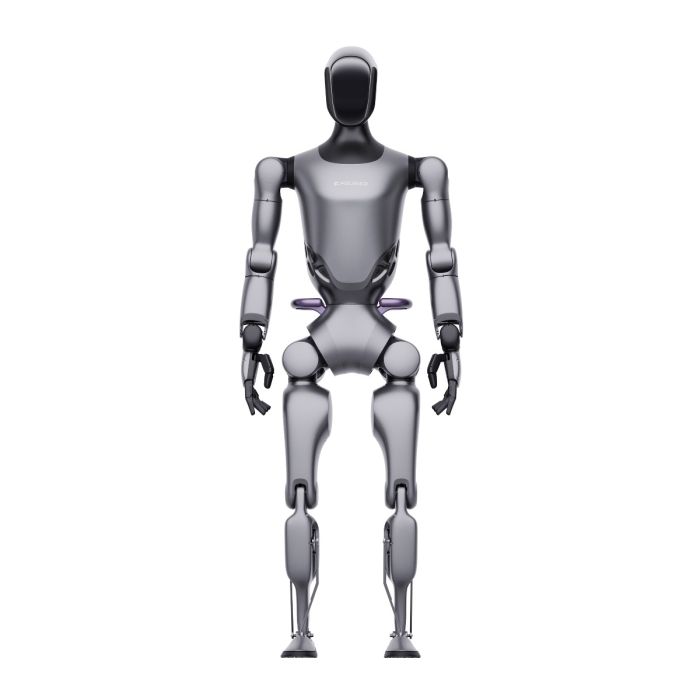
Fourier GR2 Humanoid Robot
In stock
- BRAND:
- FOURIER
- MODEL:
- GR2
- ORIGIN:
- China
- AVAILABILITY:
- SUBJECT TO AVAILABILITY
- SKU:
- Fourier-GR2
Fourier GR2 Humanoid Robot
Most humanoid robots impress from across the room and disappoint up close. The Fourier GR2 Humanoid Robot is built the other way around: its case rests on what happens inside the joints, the hands and the wiring, where a research team spends its working days. Stronger actuators, a rebuilt joint layout, a battery that can be swapped and hands that can feel are the story here, rather than a stage demonstration.
The Fourier GR2 Humanoid Robot is available through this page, by quotation.
Background
Fourier and the road from GR-1
Fourier is a robotics company, and the GR-2 is the second step in its general-purpose humanoid line. It builds on the GR-1, described as the world's first mass-produced humanoid robot. That earlier model is now discontinued, and its page is still available as DISCONTINUED - Fourier GR1 Humanoid Robot (GR-1) for buyers who want to compare the two generations.
Building on a machine that was produced in numbers matters to a buyer. A platform that has already left the laboratory tends to carry lessons about wear, assembly and day-to-day handling, and the GR-2 is the follow-up to that experience.
What changed inside the GR-2
The most visible engineering decision is the joint configuration. Fourier re-designed it, shifting from a parallel to a serial structure. Alongside it sits a new actuator family, the FSA 2.0 series, which includes seven different types of actuators so that each can be tailored to the torque demands of every joint. The actuators reach peak torques exceeding 380 N.m, and a dual-encoder system doubles control accuracy.
Power and communication are carried through an integrated cabling design, which allows concealed wires and more compact packaging. The battery is detachable, with its capacity doubled, which extends runtime by an hour. Taken together, these changes describe a robot refined for daily use instead of one that only looks different from its predecessor.
Technical Specifications
| Specification | Value |
|---|---|
| Height | 175 cm |
| Weight | 63 kg |
| Degrees of freedom | 53 |
| Single-arm load capacity | 3 kg |
| Actuator series | FSA 2.0, seven different types of actuators |
| Actuator peak torque | Exceeding 380 N.m |
| Encoders | Dual-encoder system, doubling control accuracy |
| Joint structure | Serial (shifted from parallel) |
| Cabling | Integrated for power and communication, concealed wires |
| Battery | Detachable, capacity doubled, runtime extended by an hour |
| Upper-limb teaching modes | VR remote control, lead-through programming, direct command |
| Tactile sensing, GR-2 with Enhanced Dexterous Hand (12-DoF, optional) | Six array-type tactile sensors |
Specifications as published by the manufacturer; confirmed against the datasheet at quotation.
The manufacturer has not published the charge time, the IP rating, the Wi-Fi and Bluetooth details, the operating temperature range, the camera resolution, the operating system or the contents of the box; they are confirmed at quotation.
What makes the GR-2 different from the GR-1?
The difference starts with structure. Where the earlier robot used a parallel joint arrangement, the GR-2 uses a serial one, and the whole actuator line has been reworked around it. The FSA 2.0 actuators come in seven types, so a joint that carries a heavy load does not have to share a part with one that only needs light motion. Each joint gets the torque it needs, with peaks exceeding 380 N.m.
Control precision is the second change. The dual-encoder system doubles control accuracy, which matters when a robot is expected to repeat a motion or follow a taught path closely.
Endurance and tidiness are the third. The detachable battery has double the capacity and adds an hour of runtime, and the integrated cabling keeps power and communication lines out of sight and the packaging more compact. For a team that runs a robot through long sessions, those two points are practical rather than cosmetic.
What does the Enhanced Dexterous Hand add?
The GR-2 is offered in two versions: the GR-2 with Basic Dexterous Hand and the GR-2 with Enhanced Dexterous Hand. The enhanced version is a 12-DoF hand and is an option. It carries six array-type tactile sensors, which let the robot sense force, identify object shapes and materials, and adjust its grip in real time.
That feedback is what separates holding an object from handling it. A hand that reads pressure can hold a soft item without crushing it and can correct itself when something starts to slip. The tactile responses are also part of what the GR-2 can record during teaching, alongside motion paths. The tactile sensor figure above belongs to the Enhanced Dexterous Hand version only.
Who is the Fourier GR2 Humanoid Robot for?
University and corporate research groups are the natural first audience. A human-scale body with 53 degrees of freedom gives a manipulation or embodied-intelligence team a platform on which to test ideas about movement and handling without building the robot first.
Developers and integrators form the second group. The teaching modes, VR remote control, lead-through programming and direct command, let a team collect operating data from the arms, including motion paths and tactile responses, and use it for further work.
Educators and demonstration centers can use the robot to show students what a current humanoid does. Organizations that are still comparing options can browse the wider Bipedal Humanoids and Humanoids categories before asking for a quotation. Teams whose project depends on delicate object handling should ask about the Enhanced Dexterous Hand version.
What is the Fourier GR2 Humanoid Robot used for?
- Humanoid research. A 175 cm, 63 kg body with 53 degrees of freedom suits studies of locomotion, balance and whole-body control.
- Manipulation experiments. A single-arm load capacity of 3 kg lets teams work on picking, carrying and placing tasks.
- Teaching by demonstration. VR remote control, lead-through programming and direct command let operators show the robot a task and record it.
- Tactile handling studies. With the Enhanced Dexterous Hand, the six tactile sensors support work on grip adjustment and object recognition.
- Data collection. Motion paths and tactile responses can be recorded for later analysis and training.
- Teaching and demonstration. A human-scale robot gives classrooms and exhibitions a working example of current humanoid engineering.
Pricing and Availability
Pricing depends on the version, the hand option and the project, so we handle it by quotation. Please send us your requirements and we will respond with a quotation. Delivery, customs and support are arranged together with the quotation, so you know the full picture before you commit. The Fourier GR2 Humanoid Robot is available on this page.
Frequently Asked Questions
How tall is the Fourier GR2 Humanoid Robot and how much does it weigh?
The robot stands 175 cm tall and weighs 63 kg. It offers 53 degrees of freedom.
How much can one arm carry?
The single-arm load capacity is 3 kg.
What are the FSA 2.0 actuators?
They are the actuator series used in the GR-2, with seven different types so each joint gets the torque it needs. Peak torques exceed 380 N.m, and a dual-encoder system doubles control accuracy.
Is the battery removable?
Yes, the battery is detachable. Its capacity is doubled, which extends runtime by an hour.
Which hand versions are available?
There are two: the GR-2 with Basic Dexterous Hand and the GR-2 with Enhanced Dexterous Hand. The enhanced hand is a 12-DoF option with six array-type tactile sensors.
How can the robot be taught new tasks?
The upper limbs support VR remote control, lead-through programming and direct command. The robot can record a set of operational data, from motion paths to tactile responses.
Where can I buy the Fourier GR2 Humanoid Robot and what does it cost?
It is available through this page, by quotation. We do not list a price here; send us your requirements and we will prepare a quotation covering the version and hand option you need.
Summary
The Fourier GR2 Humanoid Robot earns its place through what is built into the body rather than how it looks from a distance. A serial joint structure, seven types of FSA 2.0 actuators with peaks above 380 N.m, dual encoders, concealed cabling and a detachable battery with an extra hour of runtime make it a considered step beyond the GR-1. The optional Enhanced Dexterous Hand adds touch to a 53-degree-of-freedom frame. For teams that want to test those ideas with a real machine, this page is the starting point.


