
DISCONTINUED - Fourier GR1 Humanoid Robot (GR-1)
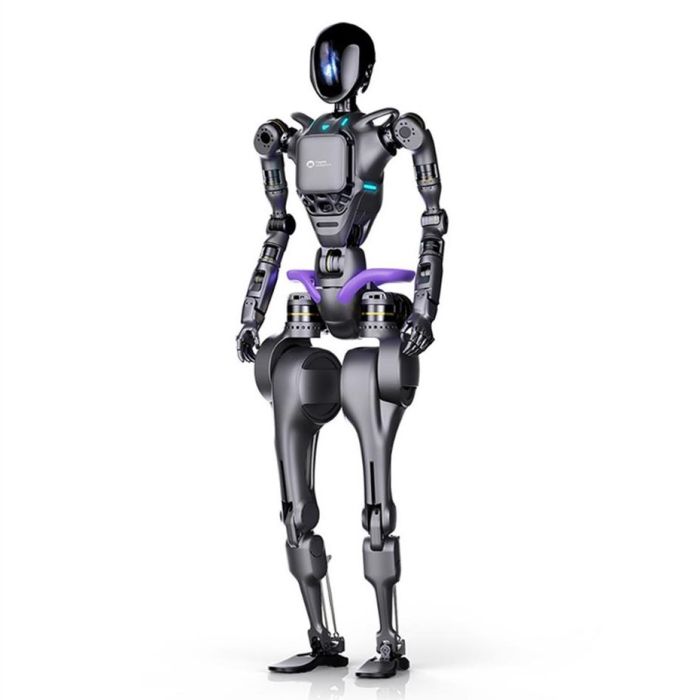
Out of stock
- BRAND:
- FOURIER
- MODEL:
- GR1
- ORIGIN:
- China
- AVAILABILITY:
- SUBJECT TO AVAILABILITY
- SKU:
- Fourier-GR1
DISCONTINUED - Fourier GR1 Humanoid Robot (GR-1)
A humanoid robot is only useful if it fits the rooms people already work in. The DISCONTINUED - Fourier GR1 Humanoid Robot (GR-1) is built around that idea: a machine of human height and reach, carried on 44 joint actuators, that can be programmed with the same open tools many robotics teams already use. This article sets out what the sources say about it, what they leave open, and who is likely to get value from it.
The product is available through this page, by quotation.
Background
Fourier and the GR series
Fourier is the brand behind the GR series of humanoid robots. The GR1 sits in a wider family that the store also lists, alongside rehabilitation equipment such as the AnkleMotus ankle joint device, which shows that the brand works across both robots and human-motion applications.
The fact sheet for this product refers to a single version, the GR series, so every figure below belongs to that one entry. Because the product name carries the word DISCONTINUED, buyers should treat this page as a way to ask about current options, and the quotation is where that is settled.
Positioning and key technology
The GR1 is a bipedal humanoid: it stands upright and walks on two legs instead of rolling on wheels. That choice matters for work in spaces designed for people, such as labs, classrooms, demonstration halls and training facilities, where stairs, thresholds and narrow passages are normal. If you are comparing the field, our categories for Bipedal Humanoids and Humanoids show the wider choice.
Of the 44 joint actuators, 32 are FSA actuators, and the maximum joint torque is 230 N.m. The body is made from aluminum alloy and engineering plastics. For software, the robot runs Ubuntu20.04 with ROS 2, a combination familiar to most university and industrial robotics groups. A Realsense depth camera gives the robot its view of the world.
Technical Specifications
| Specification | Value (GR series) |
|---|---|
| Standing size | 1650 x 515 x 320 mm |
| Arm span | 1680 mm |
| Net weight | ≈ 55 kg |
| Materials | Aluminum alloy, engineering plastics |
| Walk speed | 5 km/h |
| Single hand payload | ≈ 3 kg |
| Total joint actuators | 44 |
| FSA actuators | 32 |
| Max. joint torque | 230 N.m |
| Battery capacity | 483 Wh |
| Battery type | Lithium battery |
| Cruise duration | ≈ 60 min |
| Walk cruise duration | ≈ 45 min |
| Full charge time | 315 min |
| Depth camera | Realsense |
| Operating system | Ubuntu20.04+ROS 2 |
| Wireless connection | Wi-Fi, Bluetooth 4.2 |
| External interfaces | HDMI x 1, Type-C x 3 (fast charge, USB, peripheral extension ports) |
Specifications as published by the manufacturer; confirmed against the datasheet at quotation.
The manufacturer has not published the IP rating, the operating temperature, the maximum incline, the degrees of freedom of the hand, the package contents or the maximum run speed; they are confirmed at quotation.
What does the GR1 offer a research or teaching team?
The first answer is the software stack. Ubuntu20.04 with ROS 2 means a team can bring existing code, simulation tools and habits to the robot instead of learning a closed environment. Three Type-C ports, one of them for fast charge, plus an HDMI port, give a bench engineer ways to connect peripherals, a display or extra sensors. Wi-Fi and Bluetooth 4.2 cover wireless links to a laptop or a network.
The second answer is the body. With 44 joint actuators in total, the robot has many joints to command, and the 230 N.m maximum joint torque describes the strongest joint. A single hand payload of ≈ 3 kg tells you the scale of objects the arms are meant to hold. It is a figure for planning demonstrations and experiments, not for heavy lifting.
The third answer is the human scale. At a standing size of 1650 x 515 x 320 mm and an arm span of 1680 mm, the robot reaches roughly where a person reaches. Doors, tables, shelves and control panels in ordinary buildings then become part of the test environment.
How long can it run on one charge?
The cruise duration is ≈ 60 min and the walk cruise duration is ≈ 45 min, from a lithium battery of 483 Wh. A full charge takes 315 min. In practice that means a session plan: short, focused runs, with the robot charging between blocks. Programs that need long continuous operation should raise this with us when asking for the quotation, so the charging routine can be planned from the start.
Walking speed is 5 km/h, which is a useful reference for indoor locomotion studies and for demonstrations in halls and corridors.
Who is the GR1 for?
Universities and research institutes are the most natural buyers. A bipedal platform on ROS 2 suits work on locomotion, balance, manipulation and human-robot interaction, and a 44-actuator body gives students and researchers a lot to explore.
Technical colleges and training centers in the Caribbean can use a humanoid of this size to bring robotics into the classroom in a way that students remember. Seeing a robot of human height walk across a room does more for interest in engineering than a slide deck.
Companies and developers who prototype for human-built spaces form a third group, such as teams testing how a humanoid might behave in a showroom, a lab or a pilot site. Exhibition and innovation centers may also want a working humanoid as a centerpiece.
If your plans call for a newer platform in the same family, look at the Fourier GR2 Humanoid Robot, or at the Fourier N1 Open-Source Humanoid Robot if open-source work is the priority. For care settings, the Fourier GR-3 Care-Bot Humanoid Robot is named for that purpose. Ask us if you are unsure which suits you better.
What is the GR1 used for?
- Locomotion research: Study bipedal walking, with a walk speed of 5 km/h as a reference point.
- Manipulation experiments: Test grasping and carrying tasks within the ≈ 3 kg single hand payload.
- ROS 2 development: Write, run and refine robotics software on Ubuntu20.04 with ROS 2.
- Vision projects: Use the Realsense depth camera for perception and navigation studies.
- Teaching and training: Give students hands-on contact with a full-size humanoid platform.
- Public demonstrations: Show visitors at events and exhibitions what a humanoid robot can do.
Pricing and Availability
We do not print prices on this page. A quotation is the way to proceed: tell us your application, your site and the quantity, and we will respond with the terms. Delivery, customs and support are arranged with the quotation, so you do not have to coordinate them alone. The GR1 is available on this page.
Frequently Asked Questions
How tall is the GR1?
The standing size is 1650 x 515 x 320 mm, with an arm span of 1680 mm.
How heavy is it?
The net weight is ≈ 55 kg. The body is made of aluminum alloy and engineering plastics.
What software does it run?
It runs Ubuntu20.04 with ROS 2. A Realsense depth camera is fitted for vision work.
How long does the battery last?
The cruise duration is ≈ 60 min and the walk cruise duration is ≈ 45 min, from a 483 Wh lithium battery. A full charge takes 315 min.
What ports and wireless links does it have?
It has one HDMI port and three Type-C ports for fast charge, USB and peripheral extension. Wireless connection is by Wi-Fi and Bluetooth 4.2.
How many joints does it have?
There are 44 joint actuators in total, 32 of them FSA actuators. The maximum joint torque is 230 N.m.
Where can I buy the GR1 and what does it cost?
You can request it through this page, by quotation. We do not list a price here; the quotation sets out the terms, including delivery, customs and support.
Summary
The GR1 asks a simple question: can a robot of human size and reach fit into the spaces people already use? Its answer is a 1650 mm frame, 44 joint actuators, a 230 N.m maximum joint torque and an open ROS 2 software base. The limits are plain too: a runtime measured in tens of minutes and a long charge. For research groups, training centers and prototype teams in the Caribbean who want to work with a real bipedal humanoid, this page is the starting point.


