
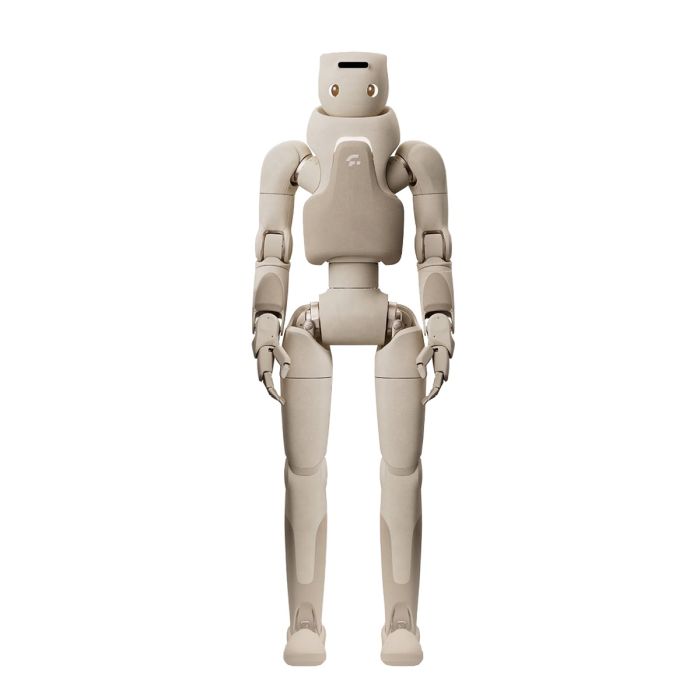
Fourier GR-3 Care-Bot Humanoid Robot
In stock
- BRAND:
- FOURIER
- PART #:
- GR-3
- ORIGIN:
- China
- AVAILABILITY:
- SUBJECT TO AVAILABILITY
- SKU:
- Fourier-GR-3
Fourier GR-3 Care-Bot Humanoid Robot
Most humanoid robots are introduced with a lifting demonstration. The Fourier GR-3 Care-Bot Humanoid Robot is introduced with a different promise: that a machine can be approachable enough to stand beside a person and be welcome there. Fourier calls it its first "Care-bot", and the whole design follows from three ideas: affinity, safety and emotional interaction.
The product is available through this page, by quotation.
Background
Fourier and the GRx lineage
Fourier builds humanoid robots, and the GR-3 belongs to its GRx series. The series began with the GR-1 in 2023 and has since passed through three generations. The latest GR-3 was released in August 2025. Buyers who follow the range will recognize the progression: earlier models such as the Fourier GR1 Humanoid Robot (GR-1) and the Fourier GR2 Humanoid Robot came first, and the GR-3 follows them with a clear change of emphasis.
You can browse the manufacturer's wider range on the Fourier brand page, or compare walking machines of this kind in the Bipedal Humanoids category.
Positioning: a humanoid built for companionship
The GR-3 is described as designed specifically for interactive companionship. That is an unusual brief in a field that often measures progress by payload and speed. Here the hardware serves the interaction. The body is covered with soft materials, tactile sensors are distributed on the head and torso, and a 360° omnidirectional microphone listens for the people around it. The body carries 55 degrees of freedom when the optional 12-DOF dexterous hand is fitted, which gives it room for more human-like body language and expression.
None of this makes the GR-3 a lightweight. It stands 165 cm tall, weighs 71 kg, walks at 6.1 km/h and carries a single-arm payload of up to 3 kg. It is a full-size machine that has been tuned to feel gentle.
Technical Specifications
| Specification | Value |
|---|---|
| Product type | Care-bot humanoid robot for interactive companionship |
| Height | 165 cm |
| Weight | 71 kg |
| Dimensions | 1642 mm × 552 mm × 292 mm |
| Arm span | 1395 mm |
| Materials | Aluminum alloy + Engineering plastic + Soft covering materials |
| Total actuator count | Up to 55 (with optional 12-DOF dexterous hand) |
| Maximum joint peak torque | 440 N·m |
| Walking speed | 6.1 km/h |
| Single arm payload | ≈3 kg |
| Battery capacity | 702 Wh + 234 Wh |
| Runtime | ≈3 h |
| Hot-swappable battery | Supports hot-swappable battery replacement |
| Wireless connection | Wi-Fi 6 |
| I/O | Type-C, USB3.0, RJ45 |
| Microphone | 360° omnidirectional sound pickup |
| Tactile sensors | Distributed on head and torso, supports tactile perception |
| Teleoperation | Supports immersive remote control (VR headset / exoskeleton teleoperation) |
| Operating temperature | 0 to 45°C |
Specifications as published by the manufacturer; confirmed against the datasheet at quotation.
The manufacturer has not published the ingress protection rating, the maximum obstacle clearance height, the contents of the box or the camera resolution; they are confirmed at quotation.
What makes the GR-3 different from a task-focused humanoid?
A task-focused humanoid is judged on what it can move, lift or repeat. The GR-3 is judged on how it behaves in a room with people. Its covering is soft, its sensing includes touch on the head and torso, and its microphone picks up sound from every direction. Together these let it respond to a person who approaches, speaks or reaches out, rather than simply carry out a programmed routine.
The mechanical figures show that the engineering underneath is serious. A maximum joint peak torque of 440 N·m, a walking speed of 6.1 km/h and an arm payload of about 3 kg describe a machine that can move with purpose, and the aluminum alloy and engineering plastic structure sits beneath the soft covering. The result is a robot that can gesture, walk and hold light objects while keeping a friendly outward character.
Power and handling follow the same practical thinking. Two batteries, 702 Wh and 234 Wh, give a runtime of about 3 h, and hot-swappable battery replacement means the robot need not be shut down to change power. Wi-Fi 6 handles wireless connection, while Type-C, USB3.0 and RJ45 ports give your engineers wired access for development and integration.
Which hand version should I choose?
The sources name two versions: the GR-3 with the 12-DOF dexterous hand, and the GR-3 with the single hand base of 6 DOF. The figure of up to 55 actuators applies to the version with the optional 12-DOF dexterous hand, so it should not be read as the count for the base hand version.
The choice follows the work. If expressive, detailed hand gestures or finer manipulation matter to your project, the dexterous hand version is the one the 55-actuator figure describes. If the robot's role is mostly presence, conversation and body language, you may want to discuss the single hand base (6 DOF) with us. Tell us how the robot will be used and we will confirm the configuration, along with any version-specific figures, in the quotation.
Teleoperation is also part of the picture. The GR-3 supports immersive remote control through a VR headset or exoskeleton, which suits teams who want to guide the robot by hand while they study how people respond to it.
Who is the Fourier GR-3 for?
The GR-3 suits organizations that want a humanoid to meet people, not to work behind a fence. Hospitality operators, education providers, research groups and care-focused institutions are natural audiences. In these settings a robot has to be safe to stand near and pleasant to talk to, and that is the stated focus of the design.
Universities and laboratories in the Caribbean and beyond can use it to study human-robot interaction, with the wired ports, Wi-Fi 6 and teleoperation support giving room to build on. Venues that welcome visitors, such as showrooms, exhibitions and reception areas, can use it as a memorable guide.
Buyers comparing the range may also look at the Fourier GR-3C Cosmo Humanoid Robot and discuss with us which model fits the project. Operating temperature is stated as 0 to 45°C, which is worth checking against the conditions at your site.
What is the Fourier GR-3 used for?
- Companionship and social interaction. The robot is designed for interactive companionship, with emotional interaction at its core.
- Reception and guidance. It can greet visitors in public venues and hotels, using voice pickup and a friendly look.
- Education and demonstration. Schools and training centers can use a full-size humanoid to make robotics tangible for students.
- Human-robot interaction research. Wired ports, Wi-Fi 6 and a hot-swappable battery support long experimental sessions.
- Remote-guided presence. VR headset or exoskeleton teleoperation lets an operator act through the robot.
- Light carrying tasks. Each arm handles a payload of about 3 kg for simple handing and carrying movements.
Pricing and Availability
We do not publish prices on this page. Quotation is the way to proceed: tell us the version you want, the number of units and the site where the robot will work. Delivery, customs and support are arranged with the quotation, so you receive one clear plan instead of several loose ends. The Fourier GR-3 Care-Bot Humanoid Robot is available on this page.
Frequently Asked Questions
How tall is the Fourier GR-3 and how much does it weigh?
It stands 165 cm tall and weighs 71 kg. Its dimensions are 1642 mm × 552 mm × 292 mm, with an arm span of 1395 mm.
How long does the battery last?
The runtime is about 3 h, from a battery capacity of 702 Wh + 234 Wh. The battery supports hot-swappable replacement.
What can the robot carry?
The single arm payload is about 3 kg. That suits light handing and carrying tasks rather than heavy loads.
Does it have dexterous hands?
A 12-DOF dexterous hand is available as an option, and the figure of up to 55 actuators refers to that version. The other version uses a single hand base with 6 DOF.
How does it sense people?
It has tactile sensors distributed on the head and torso and a 360° omnidirectional microphone for sound pickup. Camera resolution has not been published by the manufacturer.
Can it be controlled remotely?
Yes. It supports immersive remote control with a VR headset or exoskeleton teleoperation.
Where can I buy the Fourier GR-3 and what does it cost?
You can buy it through this page by requesting a quotation. We do not list a price here; the cost depends on the version and the delivery plan, and we confirm it in the quotation.
Summary
The Fourier GR-3 starts from a different question than most humanoids. Instead of asking how much a robot can lift, it asks how welcome a robot can be. A soft covering, tactile sensing on the head and torso and an omnidirectional microphone answer that, while 440 N·m of peak joint torque, a 6.1 km/h walk and a hot-swappable battery show that the machine beneath is built for real use. If a humanoid that can stand among people suits your project, this page is the starting point.


