
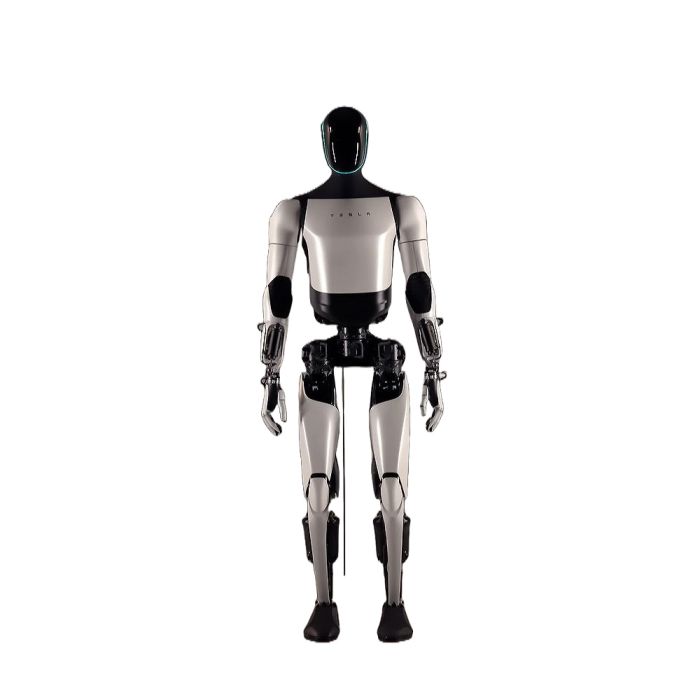
Tesla Optimus Humanoid Robot
In stock
- BRAND:
- TESLA
- MODEL:
- OPTIMUS
- ORIGIN:
- United States
- AVAILABILITY:
- SUBJECT TO AVAILABILITY
- SKU:
- Tesla-Optimus
Tesla Optimus Humanoid Robot
Almost everything people build is made to fit a human body: the doorway, the stair, the tool handle, the workbench. The Tesla Optimus Humanoid Robot starts from that simple observation. Rather than asking a workplace to rearrange itself around a machine, Tesla designed a machine to stand in the places people already stand and to work with the objects people already use.
The product is available through this page, by quotation.
Background
Tesla and the road to a humanoid
Optimus, also known as Tesla Bot, is a general-purpose robotic humanoid under development by Tesla, Inc., a United States manufacturer. It was announced at the company's Artificial Intelligence (AI) Day event on August 19, 2021. For a company known mainly for cars, the announcement was a surprise, but the logic was easy to follow. Tesla already builds electric drive systems, trains large neural networks and manufactures at scale, and a walking robot draws on all three.
The robot will be controlled by the same AI system Tesla is developing for the advanced driver-assistance system used in its cars. In practical terms, that means the software that learns to interpret roads, obstacles and moving people is the same family of technology meant to guide a humanoid through a building. Buyers who follow robotics will recognize this as a distinctive approach, since many humanoid programs begin with a research platform and add intelligence later.
Positioning and key technology
Optimus is planned to measure 5 ft 8 in (173 cm) tall and weigh 125 lb (57 kg). At the 2021 AI Day presentation, Tesla gave its carrying capacity as 45 lb (20 kg). Those proportions put it close to an average adult, which is the point: a robot of that scale can reach the same shelves, handles and controls as a person.
One engineering detail is worth noting. To manage the high force density required for dynamic movement, the robot's linear actuators use planetary roller screw technology rather than traditional ball screws, which gives higher shock load resistance during walking motions. Walking sends repeated impacts through the legs, so an actuator that tolerates shock matters more here than it would in a fixed industrial arm.
The hands show how quickly the design has moved. In 2023, the hands of the Generation 2 Optimus had 11 degrees of freedom. In 2024, the Generation 3 hands had 22 degrees of freedom. More degrees of freedom in a hand generally means finer finger movement and a better chance of handling the varied objects found in a workplace or a home.
For wider context on this class of machine, see our Bipedal Humanoids category and the broader Humanoids range.
Technical Specifications
| Specification | Value |
|---|---|
| Product type | General-purpose robotic humanoid |
| Manufacturer | Tesla, Inc., United States |
| Announced | August 19, 2021, at Tesla AI Day |
| Planned height | 5 ft 8 in (173 cm) |
| Planned weight | 125 lb (57 kg) |
| Carrying capacity (2021 AI Day presentation) | 45 lb (20 kg) |
| AI system | Same AI system Tesla is developing for the advanced driver-assistance system used in its cars |
| Linear actuators | Planetary roller screw technology |
| Hand degrees of freedom, Generation 2 | 11 |
| Hand degrees of freedom, Generation 3 | 22 |
Specifications as published by the manufacturer; confirmed against the datasheet at quotation.
The manufacturer has not published the battery capacity, the battery runtime, the walking speed, the ingress protection rating, the connectivity options, the contents of the box, the charging method or the operating temperature range; they are confirmed at quotation.
What makes Optimus different from a conventional industrial robot?
A conventional industrial robot is usually bolted to a floor or rides a fixed track, and it does one job very well. The cell around it is built to suit it. Optimus takes the opposite approach. It is a walking, two-handed machine meant to enter spaces designed for people, so the building does not have to change first.
That flexibility is the central promise, and it is also why the intended tasks are ones that are "dangerous, repetitive and boring", such as providing manufacturing assistance. A single platform that can be pointed at several such tasks is a different proposition from a series of single-purpose machines.
The shared AI system adds to the contrast. Because the robot is meant to run on the same AI Tesla is developing for its cars, its perception and decision-making are not a separate, bolted-on product. We would encourage buyers to weigh that against the fact that the robot remains under development, so planning should allow for change.
What changed between Generation 2 and Generation 3?
The clearest difference is the hand. The Generation 2 hands had 11 degrees of freedom in 2023, and the Generation 3 hands had 22 degrees of freedom in 2024. The count doubled in a single step.
For a buyer, that matters because hands decide what a humanoid can actually do. Carrying a box needs little dexterity; sorting small parts, turning a knob or holding a tool needs a great deal. We have no other figures split by generation, so we do not attribute any further specification to either version. Ask us which generation is on offer when you request your quotation.
Who is the Tesla Optimus Humanoid Robot for?
Optimus is aimed at organizations that are evaluating general-purpose humanoids rather than buying a finished, proven product off the shelf. Manufacturers with repetitive or hazardous tasks are the group the sources name most directly, and they are the natural starting point.
Research groups and universities in the region may also have an interest, since a humanoid built around a production-minded AI stack is a useful subject for study. Technology-forward logistics operators and hospitality or resort businesses that want to follow the field closely belong in the same conversation, as do government and training bodies exploring the future of work.
If your needs are narrower, such as a walking platform without the general-purpose claim, browse the Bipedal Humanoids category, or compare other designs in Humanoids. Our team will tell you plainly if another machine fits your task better.
What is the Tesla Optimus Humanoid Robot used for?
- Manufacturing assistance. The sources name this as a proposed task, covering work that is dangerous, repetitive and boring.
- Carrying loads. The 2021 AI Day presentation gave a carrying capacity of 45 lb (20 kg), suited to moving parts and containers.
- Hand-based handling. Generation 3 hands with 22 degrees of freedom are meant for work that needs finer finger control.
- Working in human spaces. At 5 ft 8 in (173 cm) tall, it is sized for doorways, shelves and workstations built for people.
- Repetitive routines. Tasks that repeat all day are where a tireless machine can relieve staff.
- AI development and training. Teams studying how car-derived AI behaves in a walking body can use it as a reference platform.
Pricing and Availability
We do not publish prices on this page. Quotation is the way to proceed: tell us your application, your site and the quantity you have in mind, and we will respond with a proposal. Delivery, customs and support are arranged with the quotation, so you are not left to sort them out alone. The Tesla Optimus Humanoid Robot is available on this page.
Frequently Asked Questions
Who makes the Tesla Optimus Humanoid Robot?
It is made by Tesla, Inc., a company based in the United States. It is also known as Tesla Bot.
How tall is Optimus and how much does it weigh?
Optimus is planned to measure 5 ft 8 in (173 cm) tall and weigh 125 lb (57 kg).
How much can it carry?
The 2021 AI Day presentation gave a carrying capacity of 45 lb (20 kg).
What is the difference between Generation 2 and Generation 3?
The difference we can state is in the hands: 11 degrees of freedom for Generation 2 in 2023 and 22 for Generation 3 in 2024.
What AI does it use?
It is controlled by the same AI system Tesla is developing for the advanced driver-assistance system used in its cars.
What about battery life, speed and IP rating?
None of these figures is available yet; the specifications section above lists what is open.
Where can I buy the Tesla Optimus Humanoid Robot and what does it cost?
You can request it through this page, and the cost is provided in a written quotation based on your requirements. We do not list prices here.
Summary
The idea behind Optimus is that the world was built for people, so a robot shaped like a person can fit into it without remodeling. The facts support that picture: a 5 ft 8 in (173 cm) frame, a 45 lb (20 kg) carrying capacity from the 2021 presentation, shock-tolerant roller screw actuators and hands that grew from 11 to 22 degrees of freedom between generations. What remains open, such as battery, speed and protection rating, is listed in the specifications section. If you are weighing a humanoid for your operation, this page is the starting point.
Specifications
General
Related Products
Out of stock


