
UBTECH Walker S Industrial Humanoid Robot
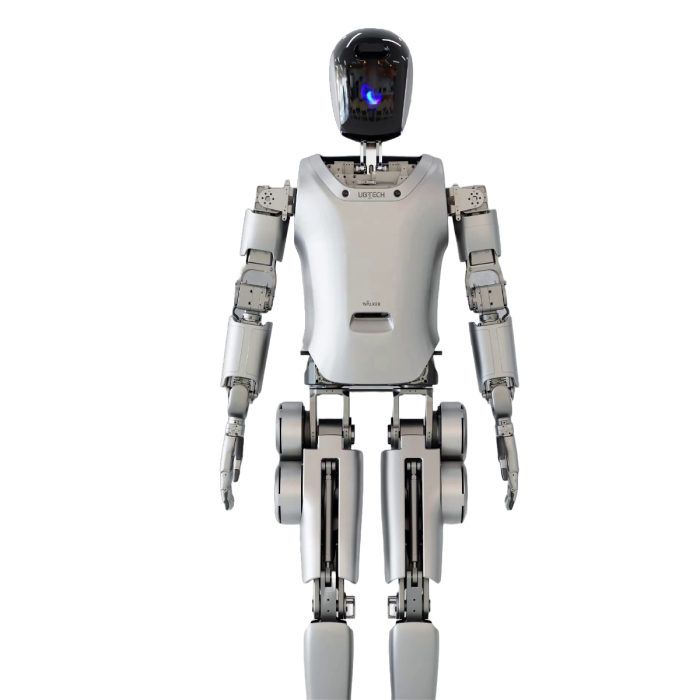
In stock
- BRAND:
- UBTECH
- PART #:
- Walker S
- ORIGIN:
- China
- AVAILABILITY:
- SUBJECT TO AVAILABILITY
- SKU:
- UBTECH-Walker-S
UBTECH Walker S Industrial Humanoid Robot
A robot that walks onto a moving production line has to read the room the way a new hire reads a shift board: who is where, what is moving, and what comes next. The UBTECH Walker S Industrial Humanoid Robot is built around that skill. It is designed for smart manufacturing and enterprise automation, and it pairs a human-shaped body with perception, planning and a link to the factory's own data.
The product is available through this page, by quotation.
Background
UBTECH Robotics and the road to Walker S
UBTECH Robotics was established in 2012 and has kept its research focus on the core technology of humanoid robots ever since. The company, UBTECH ROBOTICS CORP LTD (stock code 9880.HK), listed on the main board of the Hong Kong Stock Exchange on 29 December 2023. That same year, UBTECH developed Walker S as a humanoid robot designed for industrial applications. It worked with several leading new energy vehicle companies to plan the phased introduction of humanoid robots into manufacturing scenarios.
The most visible result of that work is a deployment at NIO. Walker S was placed in the final assembly workstation of NIO's advanced manufacturing base F2. It collaborated with human workers on automotive assembly and quality inspection tasks on a factory production line, the first time a humanoid robot had done so.
Positioning and key technology
Walker S is an industrial machine, not a reception robot. Its stated purpose is work on the factory floor, in spaces and workflows that were laid out for people. Several technologies support that purpose.
The body carries 41 servo joints with force feedback. Force-compliant drive joints and rigid-flexible coupling hybrid structures let the robot walk stably on mobile production lines. Built-in high-resolution RGBD visual sensors, together with multiple visual, audio and distance sensors, feed a multi-modal sensor fusion approach and dynamic environment exploration. With these, the robot can perceive its surroundings, the people around it and the objects it handles.
On top of this sits deep integration with a large language model. It adds intent understanding and fine-grained planning to the robot's existing multimodal perception and motion control, so it can perform a variety of tasks in different environments. The robot runs the Robot Operating System ROSA 2.0.
Technical Specifications
| Specification | Value |
|---|---|
| Product type | Industrial humanoid robot for smart manufacturing and enterprise automation |
| Height | 1.7 meters |
| Servo joints | 41 servo joints with force feedback |
| Sensors | Built-in high-resolution RGBD visual sensors; multiple visual, audio and distance sensors |
| Joints and structure | Force-compliant drive joints and rigid-flexible coupling hybrid structures for stable walking on mobile production lines |
| Navigation | 3D semantic maps and walking routes designed around obstacles |
| Language model integration | Deep LLM integration for intent understanding and fine-grained planning |
| Object detection and grasping | 6D pose recognition of complex objects from 3D Point Cloud information; grasping with hand-eye coordination |
| Factory system link | Automatic connection to the manufacturing management system for real-time production status exchange |
| Operating system | Robot Operating System ROSA 2.0 |
| SPS sorting | Picks up and places two types of components to specified locations within 10 seconds |
| Visual quality inspection (Walker S series) | Accuracy rate exceeding 99% |
| Year developed | 2023 |
Specifications as published by the manufacturer; confirmed against the datasheet at quotation.
The manufacturer has not published the weight, the payload, the battery capacity, the battery life, the walking speed, the power consumption, the connectivity, the degrees of freedom per hand, the dimensions, the IP rating, the operating temperature, the contents of the box or the manufacturer part number; they are confirmed at quotation.
How does Walker S handle a moving production line?
Most automation assumes the work comes to a fixed spot. A moving line breaks that assumption, because the robot has to cope with motion around it and sometimes under its own feet. Walker S answers this in three layers.
The first is the body. Force feedback in the servo joints, combined with force-compliant drive joints and the rigid-flexible coupling hybrid structures, is what lets the robot walk stably on mobile production lines.
The second is perception. With its RGBD visual sensors, Walker S observes the surrounding environment, builds 3D semantic maps and designs walking routes that avoid obstacles, so that it can operate safely and precisely. For handling parts, it processes 3D Point Cloud information to recognize the 6D pose of complex objects and then completes the grasp with hand-eye coordination.
The third is the connection to the plant. Walker S can connect automatically to the manufacturing management system and exchange production status information in real time, which keeps data synchronized throughout the factory. The robot does not work as an island; it reports what it does.
What does the large language model add?
A conventional industrial robot follows a fixed program. Walker S integrates deeply with a large language model, which gives it intent understanding and fine-grained planning on top of its multimodal perception and motion control. In practical terms, the aim is a machine that can be directed toward a task and plan the steps, instead of waiting for every step to be scripted. This is what lets it perform a variety of tasks in different environments, and it is the reason the robot is described for enterprise automation more broadly, not only for one repeated motion.
Who is UBTECH Walker S for?
Automotive and new energy vehicle manufacturers are the clearest fit. The NIO deployment shows the robot working at a final assembly workstation, and the Walker S series is described as capable of visual quality inspection on completely or partially assembled modules in moving automotive production lines.
Logistics and component-handling operations are a second group. Parcel handling and SPS sorting are both listed application scenarios, and in the SPS scenario the robot places two types of components at specified locations within 10 seconds.
Plant engineering teams and system integrators are a third group. The ROSA 2.0 operating system and the link to the manufacturing management system matter most to people who must fit a robot into an existing production environment.
Research groups and innovation centers in the Caribbean and beyond may also find the platform useful for studying how humanoid robots work alongside people in industrial settings. If you are comparing several industrial humanoids, you can also look at the UBTECH Walker S1 Industrial Humanoid Robot and the UBTECH Walker S2 Industrial Humanoid Robot, or browse the Bipedal Humanoids category and the UBTECH Walker range. A Walker S Lite version also exists in the Walker S line.
What is UBTECH Walker S used for?
- Parcel handling: moving packages and items between stations as part of a logistics or line-side flow.
- SPS sorting: picking two types of components and placing them at specified locations within 10 seconds.
- Quality inspection: visual checks on completely or partially assembled modules in moving automotive production lines, with an accuracy rate exceeding 99% for the Walker S series.
- Screw-bolt tightening: a listed application scenario for fastening work in assembly.
- Part assembly: placing and fitting parts, supported by 6D pose recognition and hand-eye coordination.
- Process material handling: carrying materials through production steps while exchanging status with the manufacturing management system.
Pricing and Availability
We do not publish prices for the UBTECH Walker S. Quotation is the way to proceed: tell us about your line, your tasks and your site, and we will respond with a proposal. Delivery, customs and support are arranged together with the quotation. The UBTECH Walker S Industrial Humanoid Robot is available on this page.
Frequently Asked Questions
How tall is UBTECH Walker S?
Walker S stands 1.7 meters tall.
How many joints does it have?
Walker S has 41 servo joints with force feedback. They are combined with force-compliant drive joints and rigid-flexible coupling hybrid structures for stable walking on mobile production lines.
What operating system does it run?
It runs the Robot Operating System ROSA 2.0.
Can it connect to our factory systems?
Yes. Walker S can connect automatically to the manufacturing management system and exchange production status information in real time, which keeps data synchronized throughout the factory.
Has it been used in a real factory?
Yes. Walker S was deployed in the final assembly workstation of NIO's advanced manufacturing base F2, where it worked with humans on automotive assembly and quality inspection tasks.
How fast can it sort components?
In the SPS scenario, Walker S picks up and places two types of components to specified locations within 10 seconds.
Where can I buy UBTECH Walker S and what does it cost?
The robot is available through this page by quotation. The cost depends on your project, so no price is listed; send us your requirements and we will prepare a quotation.
Summary
The idea behind Walker S is that a robot can learn to work in a space built for people, instead of the space being rebuilt for the robot. It combines a 1.7 meter humanoid body, 41 force-feedback servo joints, RGBD perception, language-model planning and a live link to the manufacturing management system. Its deployment at NIO shows that idea in operation. If that approach matches your production line, this page is the starting point.


