
UBTECH Walker Humanoid Robot
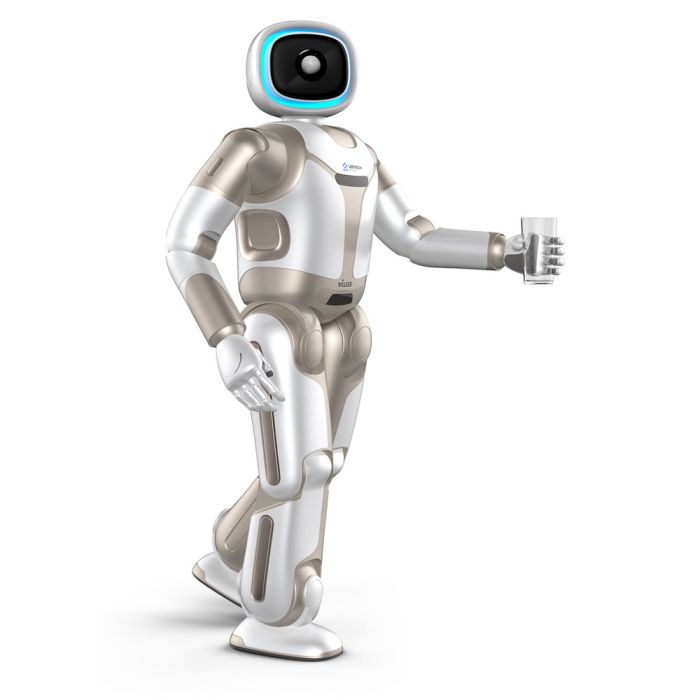
UBTECH Walker is a family of humanoid robots developed by UBTECH Robotics that targets human-centric environments—initially home and office assistance and later industrial and manufacturing scenarios. UBTECH describes the “Walker Robot” as a next-generation humanoid with 36 high-performance servo joints and multi-sensor perception (including force, vision, hearing, and spatial awareness) aimed at household and office use cases.
In stock
- BRAND:
- UBTECH
- PART #:
- Walker
- ORIGIN:
- China
- AVAILABILITY:
- SUBJECT TO AVAILABILITY
- SKU:
- UBTECH-Walker
UBTECH Walker Humanoid Robot
A house is full of small tests for a machine: a threshold, a carpet edge, a stair, a switch on the wall. The UBTECH Walker Humanoid Robot is built around the idea that a robot meant for people's spaces should move through them on two legs and sense them in several ways at once, rather than ask the space to change.
The product is available through this page, by quotation.
Background
UBTECH and the idea behind Walker
UBTECH describes Walker as a solid step forward in its mission to bring robots into every home. That mission explains the shape of the product. Walker is a humanoid service robot, not a fixed arm or a wheeled cart, and its design choices follow from the goal of working in rooms that were made for people.
The robot carries 36 high-performance servo joints and a full range of sensory systems covering force, vision, hearing and spatial awareness. Together they give the machine a body that can move, balance and respond to what is around it. For readers who follow the wider field, Walker sits among the Bipedal Humanoids we list, and the wider family is gathered under UBTECH Walker.
Key technology: joints, compute and software
Each joint uses an integrated drive unit made up of a frameless torque motor, precise harmonic reduction, a drive controller and a dual encoder. Joints talk to the rest of the robot over EtherCAT, a high-speed real-time bus. Wi-Fi and an RJ45 Ethernet interface handle the network side.
On the computing side, the robot uses an Intel i7 7500U with a frequency of 2.7Ghz or an Intel i5 6200U with a frequency of 2.3Ghz. The software stack combines Ubuntu, Linux RT Preempt, ROS and Android, and the emulation platform is URDF plus Gazebo. For teams that write their own behaviors, this means a familiar robotics toolchain and a simulation route before anything runs on hardware.
Technical Specifications
| Specification | Value |
|---|---|
| Product type | Humanoid service robot |
| Servo joints | 36 high-performance servo joints |
| Height | 145cm |
| Weight | 77kg |
| Integrated drive unit | Frameless torque motor, precise harmonic reduction, drive controller, dual encoder |
| Arm load | Extended state single arm 1.5kg |
| Arm span | Single arm 540mm |
| Wi-Fi | 802.11 a/b/g/n 5G/2.4 GHz dual-band |
| Ethernet | RJ45 interface |
| Real-time bus | EtherCAT, high-speed real-time bus |
| Battery | Lithium iron phosphate 54.6V/10Ah/ 6 kg |
| Charging time | 2h |
| Usage time | 2h |
| Processor | Intel i7 7500U, frequency 2.7Ghz; Intel i5 6200U, frequency 2.3Ghz |
| Operating system | Ubuntu + Linux RT Preempt + ROS + Android |
| Emulation platform | URDF+Gazebo |
| Navigation | Built-in visual navigation (U-SLAM) with autonomous path planning |
Specifications as published by the manufacturer; confirmed against the datasheet at quotation.
The manufacturer has not published the maximum walking speed, the IP rating, what is in the box, the camera resolution, the payload when walking, the noise level or the operating temperature; they are confirmed at quotation.
How does Walker move through a real home or office?
Through gait planning and control, Walker achieves stable walking on multiple types of terrain. The terrain list covers carpet, floor, grass, stairs, uphill, tiles and obstacles. For a buyer, the point is that the robot is designed around the mixed surfaces of everyday buildings, not a single flat test floor.
Finding its way is the job of the built-in visual navigation, called U-SLAM. It lets the robot gather richer information about its surroundings, such as contours, colors and depths, and it plans its own paths. Because the navigation is part of the robot and does not depend on markers you have to install, it suits sites where you cannot rebuild the room.
Hands matter as well. Each arm has a span of 540mm and can carry 1.5kg in the extended state. That is a modest figure, and it is better read as a guide to light handling than to heavy lifting. If your task involves carrying things from room to room, tell us when you request a quotation.
How does Walker deal with people?
Walker recognizes faces, objects and scenes through its stereo vision, and it mimics human verbal communication. Interaction is multimodal: text, voice, vision, movement and environment all take part, and UBTECH describes the aim as fully simulating the interaction between human beings.
The robot also has an open, convenient smart home interface. It can help users control lights, appliances, sockets and other home devices, independently and according to the use case. Taken together, these features describe a robot that can see who is in the room, talk with them and act on the building around them.
Who is the UBTECH Walker Humanoid Robot for?
Research groups and universities are an obvious fit. The ROS base, the real-time Linux layer, the EtherCAT bus and the URDF plus Gazebo simulation platform give developers an open environment for testing locomotion, perception and interaction ideas.
Technology showcases, training centers and demonstration spaces are another group. A humanoid that walks, recognizes faces and speaks draws attention, and it gives visitors a concrete picture of service robotics. Integrators who prototype smart home or assisted-living concepts can use the home interface to link the robot with lights, appliances and sockets.
If your work is closer to front-desk reception, look at the UBTECH Walker C Commercial Reception Humanoid Robot or the UBTECH Walker C1 Humanoid Service Robot. For factory-floor applications, the UBTECH Walker S Industrial Humanoid Robot is the page to open. Ask us if you are unsure which suits you.
What is the UBTECH Walker Humanoid Robot used for?
- Research and development. Test gait, perception and interaction software on a 36-joint humanoid with ROS and a simulation route.
- Teaching robotics. Give students a full humanoid platform built on Ubuntu, Linux RT Preempt and URDF plus Gazebo.
- Smart home control. Use the open interface to operate lights, appliances, sockets and other home devices.
- Greeting and conversation. Recognize faces and scenes and answer through text, voice and movement.
- Indoor navigation. Move through rooms with U-SLAM visual navigation and autonomous path planning.
- Public demonstrations. Show visitors a humanoid walking over several kinds of terrain and handling light objects.
Pricing and Availability
We do not print prices on this page. Quotation is the way to buy: send us your use case and we answer with a proposal for the UBTECH Walker Humanoid Robot. Delivery, customs and support are arranged with the quotation, so you see the whole picture before you commit. The UBTECH Walker Humanoid Robot is available on this page.
Frequently Asked Questions
How tall is the UBTECH Walker Humanoid Robot and how much does it weigh?
It stands 145cm tall and weighs 77kg.
How long does the battery last?
The lithium iron phosphate battery is rated 54.6V/10Ah and weighs 6 kg. Usage time is 2h and charging time is 2h.
What software does it run?
The operating system is Ubuntu with Linux RT Preempt, ROS and Android. The emulation platform is URDF plus Gazebo.
Can it carry objects?
A single arm carries 1.5kg in the extended state, with an arm span of 540mm. If you need to carry loads while walking, tell us when you request a quotation.
How does it connect to a network?
It offers dual-band Wi-Fi (802.11 a/b/g/n, 5G/2.4 GHz) and an RJ45 Ethernet interface. Inside the robot, EtherCAT serves as the high-speed real-time bus.
Can it walk on stairs and carpet?
Walker walks stably on multiple types of terrain, including carpet, floor, grass, stairs, uphill, tiles and obstacles.
Where can I buy the UBTECH Walker Humanoid Robot and what does it cost?
You can buy it through this page by requesting a quotation. We give no price here; the quotation sets out the cost together with delivery, customs and support.
Summary
The UBTECH Walker Humanoid Robot answers the home-as-obstacle-course problem with a body shaped for people's spaces: 36 servo joints, sensing across force, vision, hearing and spatial awareness, U-SLAM navigation, and an open software base. Its height, weight, arm reach, battery and compute are all stated above, so you can judge the fit for your project. For a quotation on the UBTECH Walker Humanoid Robot, this page is the starting point.


