
Unitree H1 Humanoid Robot - Fastest Robot in the World
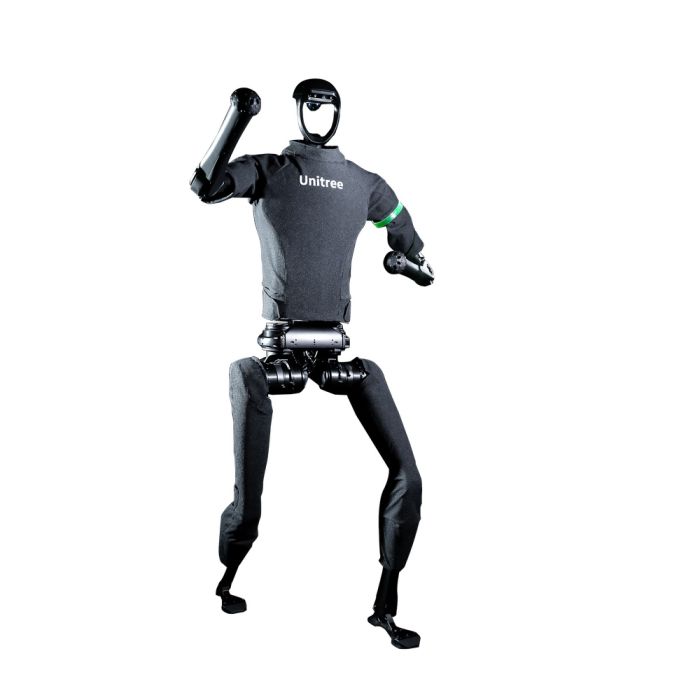
In stock
- BRAND:
- UNITREE ROBOTICS
- MODEL:
- H1
- ORIGIN:
- China
- AVAILABILITY:
- SUBJECT TO AVAILABILITY
- SKU:
- Unitree-H1
Unitree H1 Humanoid Robot - Fastest Robot in the World
Plenty of humanoids can stand for a photograph. Far fewer can run. The Unitree H1 Humanoid Robot - Fastest Robot in the World is built around the harder claim: a full-size, general-purpose humanoid with a running gait, made for teams who want to see what a human-scale machine can really do in motion.
This product is available through this page, by quotation.
Background
Unitree and the first universal humanoid
The H1 is Unitree's first universal humanoid robot. That matters for how you read it. It is the platform where the company's work on legged motion was brought together in a body of human proportions, rather than a smaller walker or a four-legged machine. It is also the first full-size general-purpose humanoid robot that can run in China, which places it as a milestone for the field in the region where it was developed.
The sources name two versions in this family: the Unitree H1 and the Unitree H1-2. The figures in this article belong to the Unitree H1. If you are comparing the two, the family overview sits in the Unitree H1 / H1-2 category, and the wider field of two-legged machines is gathered under Bipedal Humanoids.
Key technology: joints, torque and updates
A running humanoid lives or dies by its joints. The H1 uses industrial grade crossed roller bearings at the joint output, chosen for high precision and high load capacity. Its peak torque density is 189N.m/Kg, a figure that speaks to how much turning force the actuators deliver for their weight, which is the number that decides whether a legged robot can push off the ground, recover its balance and keep moving.
Each leg has 5 degrees of freedom: hip × 3, knee × 1 and ankle × 1. Each arm has 4 degrees of freedom and is expandable. For perception, the robot is equipped with 3D LiDAR and a depth camera, which acquire high-precision spatial data in real time to achieve panoramic scanning. Software is not frozen at delivery either: the H1 receives continuous OTA software upgrades and updates.
Technical Specifications
| Specification | Unitree H1 |
|---|---|
| Height | about 180CM |
| Weight | about 47kg |
| Key dimensions | (1520+285)mm × 570mm × 220mm |
| Peak torque density | 189N.m/Kg |
| Battery capacity | 864Wh, quickly replaceable |
| Battery | 15Ah (0.864KWh), max voltage 67.2V |
| DOF of each leg | 5 (Hip × 3 + Knee × 1 + Ankle × 1) |
| DOF of each arm | 4 (expandable) |
| Thigh and calf length | 400mm × 2 |
| Total arm length | 338mm × 2 |
| Joint output bearing | Industrial grade crossed roller bearings |
| Sensors | 3D LiDAR + depth camera |
| Computing | Intel Core i5 (platform function), Intel Core i7 (user development) |
| Dexterous hand | Optional |
| Software updates | Continuous OTA upgrade and update |
Specifications as published by the manufacturer; confirmed against the datasheet at quotation.
The manufacturer has not published the battery runtime, the IP rating, the connectivity options, the operating temperature, the charging time or the contents of the box; they are confirmed at quotation.
What makes the Unitree H1 different from a walking humanoid?
The difference is the gait. Walking is a slow, forgiving motion in which one foot is always planted. Running asks far more of the machine: strong actuators, joints that tolerate repeated load and a body light enough to be thrown forward and caught again. The H1 stands about 180CM tall and weighs about 47kg, so it carries a human-scale frame without a human-scale mass, and the 189N.m/Kg peak torque density is what lets that frame move briskly.
The second difference is that it is built to be developed on. The computing configuration is split by purpose: an Intel Core i5 for platform function and an Intel Core i7 for user development. In plain terms, the machine keeps its own motion control separate from the space where your team writes its own code. Combined with the 3D LiDAR and depth camera, that gives researchers real spatial data to work with from day one.
How does the battery work on the Unitree H1?
The H1 carries a 15Ah battery, 0.864KWh or 864Wh, with a maximum voltage of 67.2V. It is quickly replaceable, which is a practical advantage on a test day: a second pack means you swap rather than wait.
Who is the Unitree H1 for?
University and institute labs are the natural first buyers. A full-size bipedal platform with an open development computer, a sensing suite and expandable arms is a good fit for work on locomotion, balance, perception and whole-body control. Students can study a real humanoid instead of a simulation.
Robotics companies and system integrators form the second group. If you are exploring where a human-shaped machine might one day work, such as in buildings, workshops or public venues, the H1 lets you test ideas on real hardware. The optional dexterous hand and the expandable arms matter here, because manipulation is usually the next question after movement.
Demonstration and exhibition teams are the third group. A humanoid that runs draws attention at technology centers, trade shows and training institutions. If you want to compare other platforms before deciding, the Bipedal Humanoids category lists the alternatives, and the Unitree H1 / H1-2 category shows the family.
What is the Unitree H1 used for?
- Locomotion research. Study running, balance and recovery on a full-size bipedal body with 5 degrees of freedom per leg.
- Perception and mapping. Use the 3D LiDAR and depth camera to gather spatial data for navigation and scene understanding.
- Algorithm development. Write and test your own control software on the Intel Core i7 development computer.
- Manipulation studies. Work with the expandable 4-degree-of-freedom arms and the optional dexterous hand.
- Teaching and training. Give students hands-on time with a real humanoid platform in robotics courses.
- Public demonstrations. Show a running humanoid at exhibitions, innovation centers and corporate events.
Pricing and Availability
Pricing for the Unitree H1 is given by quotation and depends on the configuration you need, for example whether you want the optional dexterous hand. Send us your requirements and we will respond with a quotation. Delivery, customs and support are arranged together with the quotation, so you know the full picture before you commit. The Unitree H1 Humanoid Robot - Fastest Robot in the World is available on this page.
Frequently Asked Questions
How tall and heavy is the Unitree H1?
The H1 stands about 180CM tall and weighs about 47kg. Its key dimensions are (1520+285)mm × 570mm × 220mm.
Can the Unitree H1 really run?
Yes. It is the first full-size general-purpose humanoid robot that can run in China, and its joints use industrial grade crossed roller bearings built for high precision and high load capacity.
What sensors does it have?
It is equipped with 3D LiDAR and a depth camera. They acquire high-precision spatial data in real time to achieve panoramic scanning.
What computer does the Unitree H1 use?
The standard configuration is an Intel Core i5 for platform function and an Intel Core i7 for user development.
Is the battery easy to change?
Yes. The battery is 864Wh (15Ah, max voltage 67.2V) and is quickly replaceable.
Does the Unitree H1 come with hands?
The dexterous hand is an optional extra. Each arm has 4 degrees of freedom and is expandable.
Where can I buy the Unitree H1 and what does it cost?
You can buy it through this page by requesting a quotation. The cost depends on the configuration you choose, so we provide it in the quotation rather than listing it here.
Summary
The Unitree H1 is a humanoid that stops being a standing exhibit and starts to move. It combines a human-scale body of about 180CM and about 47kg, strong and precise joints, a sensing suite of 3D LiDAR and a depth camera, and a development computer for your own code, with continuous OTA updates to keep it current. For labs, integrators and demonstration teams that want a robot that runs, request a quotation; this page is the starting point.
Specifications
General
Physical
Performance
What's included
Related Products
Out of stock


