
Unitree Aliengo Quadruped Robot
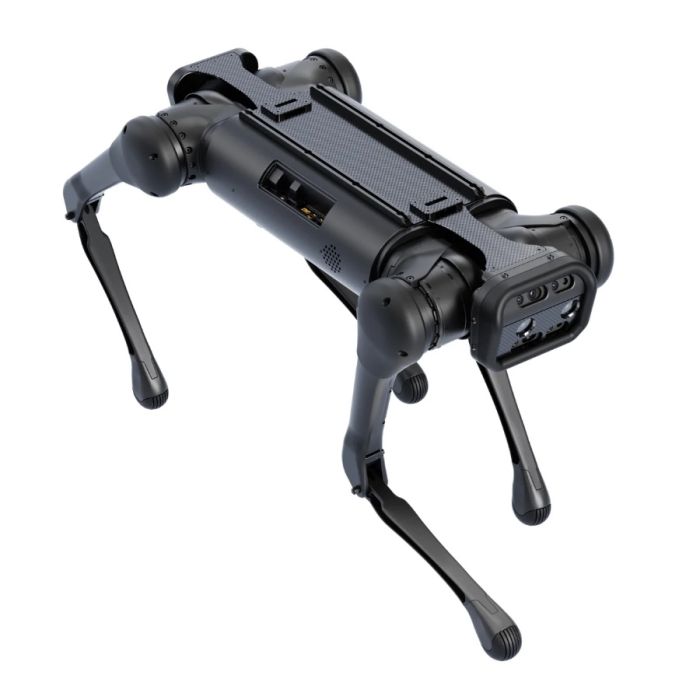
In stock
- BRAND:
- UNITREE ROBOTICS
- MODEL:
- ALIENGO
- ORIGIN:
- China
- AVAILABILITY:
- SUBJECT TO AVAILABILITY
- SKU:
- Unitree-Aliengo
Unitree Aliengo Quadruped Robot
A robot dog that only walks is a demonstration; one that carries your own sensors, runs your own code and folds away for the trip home is a tool. The Unitree Aliengo Quadruped Robot belongs in the second group: a twelve-motor legged chassis with depth vision and visual odometry already fitted, built for teams who want to develop on it rather than simply watch it.
The product is available through this page, by quotation.
Background
Unitree Robotics and the AlienGo line
Unitree Robotics is a maker of legged robots, and its quadrupeds are used in laboratories, classrooms and field-testing programs around the world. The Aliengo sits in the larger, developer-oriented part of that range, where the aim is a platform people can build on instead of a finished toy. You can see the wider family on the Unitree AlienGo category page.
The sources for this page name one version, the Developer version, and every figure below belongs to it. Where a buyer needs something the Developer version does not list, the right step is to ask, not to assume.
Positioning and key technology
The Aliengo pairs a walking base with a sensing stack. Two depth cameras and one visual odometer camera are fitted, and a single-line or multi-line lidar can be added as an option. The visual odometer uses a highly optimized V-SLAM, with a closed-loop offset of less than 1% and a delay of less than 6 milliseconds between attitude action and action reflection.
Movement control runs on Ubuntu, and environment sensing runs on Ubuntu-ROS. The software control interface is split into a high-level interface and an underlying interface, and it supports C/C++, ROS and more. For a research group already working in ROS, that is a familiar place to start.
Technical Specifications
| Specification | Value |
|---|---|
| Version | Developer version |
| Weight (without battery) | 21.5kg ±1kg |
| Dimensions standing (L*W*H) | 0.65*0.31*0.6m |
| Dimensions folded (L*W*H) | 0.60*0.31*0.15m |
| Load | 13kg |
| Maximum walking speed | >1.5m/s |
| Climbing angle | ≤25° |
| Endurance | 2.5-4.6h |
| Battery capacity | 12600mAh |
| Degrees of freedom (number of motors) | 12 |
| Foot-end sensors | 4 |
| Output power | 5V, 12V, 19V, BAT (24V~30V) |
| Sensing | Depth camera (2), visual odometer camera (1), lidar: single or multi-line (optional) |
| External interfaces | Ethernet port x2, USB 3.0 x2, USB 2.0 x1, 485 port x1 |
| Real-time operating system | Movement control: Ubuntu; environment sensing: Ubuntu-ROS |
| Protection | Wireless emergency stop protection, fall protection |
| Software control interface | High-level and underlying interfaces; C/C++, ROS, etc. |
Specifications as published by the manufacturer; confirmed against the datasheet at quotation.
The manufacturer has not published the IP rating, the operating temperature, the charging time, the maximum joint torque, the wireless connectivity or the battery voltage; they are confirmed at quotation.
What makes the Aliengo different from a ready-made robot dog?
Many quadrupeds are sold as finished products with a fixed purpose. The Aliengo is different because it leaves room for your own equipment. Users are allowed to carry their own modules, such as vision cameras, lidar, robotic arms and GPS systems, and the 13kg load figure gives a sense of how much a project can put on the back.
The power side supports that idea. The output power rails are 5V, 12V, 19V and BAT (24V~30V), so payload hardware with different supply needs has somewhere to connect. For data, the external interfaces are two Ethernet ports, two USB 3.0 ports, one USB 2.0 port and one 485 port. Together these make the robot a mobile mounting point for experiments, not only a walking exhibit.
The software is open to the developer as well. With a high-level interface for commanding movement and an underlying interface for deeper control, a team can start simple and go lower as its work demands. Support for C/C++ and ROS keeps the entry point close to what most robotics groups already use.
How does the Aliengo handle the field and the trip there?
The standing dimensions are 0.65*0.31*0.6m, and folded the robot measures 0.60*0.31*0.15m. That flat folded shape matters to anyone moving equipment between campuses, islands or job sites, because the robot can be packed with the rest of the kit instead of needing its own space.
Once it is out, the numbers describe a capable walker: a maximum walking speed above 1.5m/s, a climbing angle of up to 25°, and four foot-end sensors. Endurance is listed as 2.5-4.6h on a 12600mAh battery, so sessions can be planned around a range, not a single number. Wireless emergency stop protection and fall protection are listed as protection modes, which is reassuring when a robot is carrying an expensive payload.
Who is the Unitree Aliengo Quadruped Robot for?
University and institute labs are the natural first group. Legged locomotion, perception and control research all benefit from a platform with two depth cameras, a visual odometer and open software interfaces. Students can work with the same ROS tools they use elsewhere.
System integrators are a second group. A company building an inspection or sensing solution can mount its own camera, lidar or GPS module and treat the Aliengo as the moving base. The optional single-line or multi-line lidar can be discussed at quotation.
Training centers and technical colleges can use it to show how a legged robot balances, senses and is programmed. Teams that want a compact family of related quadrupeds can start from the Unitree AlienGo category and compare the options there. Buyers who only need a ready-to-walk consumer robot, with no development goals, will find this platform more than they need.
What is the Unitree Aliengo Quadruped Robot used for?
- Locomotion research. Twelve motors and four foot-end sensors give researchers a real legged platform to study gait and balance.
- Perception and mapping. Two depth cameras and a V-SLAM visual odometer support navigation and environment sensing work.
- Payload integration. A 13kg load lets teams mount cameras, lidar, robotic arms or GPS systems of their own.
- ROS development. Ubuntu-ROS for environment sensing and C/C++ and ROS control interfaces suit software teams.
- Teaching and demonstration. A robot that walks, climbs and senses is a strong classroom example of modern robotics.
- Field trials. Folded dimensions of 0.60*0.31*0.15m make it practical to transport to a test site and put to work.
Pricing and Availability
Pricing is handled by quotation, so that the configuration, any optional lidar and your project needs can be settled together. Delivery, customs and support are arranged with the quotation. The kit lists one Unitree AlienGo, one battery, one charger and one remote controller, and everything you need to request it is available on this page.
Frequently Asked Questions
What is included in the kit?
The kit includes one Unitree AlienGo, one battery, one charger and one remote controller.
How much can the Aliengo carry?
The listed load is 13kg. Users can carry their own modules such as vision cameras, lidar, robotic arms and GPS systems.
How long does the battery last?
Endurance is listed as 2.5-4.6h with a battery capacity of 12600mAh.
What software can I use to control it?
The control interface has a high-level part and an underlying part, and it supports C/C++, ROS and more. Movement control runs on Ubuntu, and environment sensing runs on Ubuntu-ROS.
Does it have a lidar?
A single-line or multi-line lidar is optional. The standard sensing set is two depth cameras and one visual odometer camera.
Does it have safety protection?
Yes. Wireless emergency stop protection and fall protection are listed as protection modes.
Where can I buy the Unitree Aliengo Quadruped Robot and what does it cost?
You can request it through this page, and the cost is given by quotation after your configuration and delivery needs are known. No price is printed here.
Summary
The Unitree Aliengo Quadruped Robot is worth choosing for what you can add to it, not only for how it walks. It offers twelve motors, a 13kg load, depth cameras, V-SLAM odometry, open interfaces for C/C++ and ROS, and a folded shape that travels easily. For research groups, integrators and trainers who want to build on a legged base, this page is the starting point.
Specifications
General
Physical
Performance
Battery + Power
What's included
Related Products
Out of stock


