
Unitree R1 Edu Pro B Humanoid Robot (R1 EDU U4)
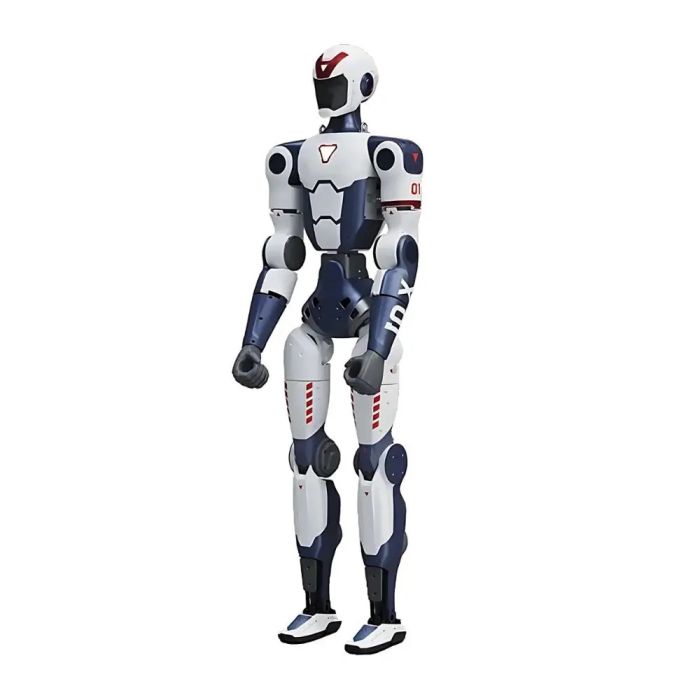
In stock
- BRAND:
- UNITREE ROBOTICS
- MODEL:
- R1 EDU PRO B
- PART #:
- R1 EDU U4
- ORIGIN:
- China
- Warranty:
- 12 MONTHS
- AVAILABILITY:
- SUBJECT TO AVAILABILITY
- SKU:
- Unitree-Robotics-R1-EDU-U4
Unitree R1 Edu Pro B Humanoid Robot (R1 EDU U4)
A humanoid that can walk is a demonstration. A humanoid that can feel what it holds is a tool. The Unitree R1 Edu Pro B Humanoid Robot (R1 EDU U4) is built for the second kind of work: two Dex3 dexterous hands, each reporting through 33 tactile sensors, mounted on a compact body that a small team can carry into a classroom, a lab or a trade-show hall.
The product is available through this page, by quotation.
Background
Unitree and the R1 family
Unitree Robotics is known for legged and humanoid platforms that research groups and universities can afford to experiment on, rather than only admire. The R1 line extends that approach to a smaller humanoid body. The sources name seven versions: R1 AIR, R1, R1 EDU, and four EDU Pro trims called R1 EDU Pro A (U3), Pro B (U4), Pro C (U5) and Pro D (U6).
The EDU versions are the ones aimed at secondary development, and the manufacturer points developers to its secondary development manual for details. The Pro trims then differ mainly in what the robot has at the end of its arms, which is why the hands matter so much in this family.
Where the U4 sits
The R1 EDU Pro B (U4) is the trim that pairs the Unitree Dex3 hands with tactile sensing. Each hand has 7 degrees of freedom and 33 tactile sensors, and the whole robot has 40 total degrees of freedom across the bipedal body, arms, waist and hands. It stands 123 cm tall.
Behind those hands sits an NVIDIA Jetson Orin delivering 100 TOPS of onboard AI compute. The robot is compatible with ROS 2 MoveIt2, Isaac Sim and the SDK2 developer ecosystem, so the same machine can be used for simulation, motion planning and real-world trials without changing platforms.
Technical Specifications
| Specification | Value (R1 EDU Pro B, U4) |
|---|---|
| Total degrees of freedom | 40, across bipedal body, arms, waist and hands |
| Height (standing) | 123 cm |
| Hands | Dual Dex3 dexterous hands, 7 DOF each |
| Tactile sensors | 33 per hand |
| AI compute | NVIDIA Jetson Orin, 100 TOPS |
| Developer ecosystem | ROS 2 MoveIt2, Isaac Sim, SDK2 |
| Battery | Hot-swap system, approximately 1 hour of runtime |
| Arm payload | 2 kg per arm |
| Audio and interaction | Built-in 4-mic array, speaker, multimodal voice and vision AI |
Specifications as published by the manufacturer; confirmed against the datasheet at quotation.
The manufacturer has not published the walking speed, the IP rating, the battery capacity, the operating temperature, the charging time or the operating system; they are confirmed at quotation.
What makes the U4 different from the other R1 EDU versions?
The short answer is touch. Every R1 EDU Pro trim shares the same compact humanoid concept, but the hands decide what experiments the robot can run. The U4 carries Unitree's own Dex3 hands, and each one has 33 tactile sensors that give real-time contact feedback during grasping and manipulation. A vision-only robot has to guess how firmly it is holding an object. The U4 can be told.
Other trims in the family take a different route. The R1 EDU Pro A (U3) is the sibling to compare first if you want to see how the Pro line is configured without this hand arrangement. The R1 EDU Pro C (U5) and the R1 EDU Pro D (U6) are fitted with BrainCo Revo 2 hands instead of Dex3 hands. If your work is built around the Dex3 hand and its tactile array, the U4 is the one that matches.
What does the onboard computing add?
Tactile data is only useful if something can act on it quickly. The NVIDIA Jetson Orin, at 100 TOPS of onboard AI compute, gives the robot room to process sensor streams, run vision and voice models, and make decisions on the machine itself rather than depending on a remote workstation. For a classroom or a demonstration stand with unreliable connectivity, that independence is a practical advantage.
The software side is equally open. Compatibility with ROS 2 MoveIt2 suits teams that already plan arm motion in the ROS 2 world. Isaac Sim lets them rehearse behaviors in simulation first. SDK2 gives direct access for custom development. The built-in 4-mic array, speaker and multimodal voice and vision AI add a natural interface for visitors and students.
Who is the Unitree R1 Edu Pro B (U4) for?
University laboratories are the clearest fit. A group studying grasping, in-hand manipulation or human-robot interaction needs hands that report contact and a computer that can process it. The U4 offers both in a compact humanoid body.
Teachers and training centers form a second group. At 123 cm tall with 40 degrees of freedom, the robot is a convincing subject for classroom robotics education, and the ROS 2 and Isaac Sim support means students learn tools that are used in industry.
Event and exhibition teams are a third. The built-in 4-mic array, speaker and multimodal voice and vision AI let the robot greet visitors, answer common questions and guide people through a space, which makes it a memorable presence at trade shows and corporate events.
Finally, pilot-project teams in industry can use it to test light handling tasks, since each arm carries 2 kg. If you do not need tactile hands, compare the other trims through the Unitree R1 EDU category, or look at the wider Unitree R1 range.
What is the Unitree R1 Edu Pro B (U4) used for?
- Grasp and manipulation research. The 33 tactile sensors per hand provide real-time contact feedback while the robot grips and handles objects.
- Classroom robotics education. A 123 cm humanoid with 40 degrees of freedom gives students a full robot to program, observe and discuss.
- Trade-show and corporate demonstrations. Its voice and vision AI lets it greet visitors, answer common questions and guide people through a space.
- Light transport between stations. With 2 kg of carry capacity per arm, it can move inspection tools or light supplies.
- Simulation-to-real development. Isaac Sim and ROS 2 MoveIt2 support let teams plan and test motion before running it on the hardware.
- Custom software and AI development. The Jetson Orin at 100 TOPS and the SDK2 ecosystem give developers a place to run their own models and control code.
Pricing and Availability
We do not print prices on this page. Quotation is the way to buy: tell us your use case and the quantity, and we prepare an offer for the R1 EDU Pro B (U4). Delivery, customs and support are arranged with the quotation. The Unitree R1 Edu Pro B Humanoid Robot (R1 EDU U4) is available on this page.
Frequently Asked Questions
How many degrees of freedom does the U4 have?
The R1 EDU Pro B (U4) has 40 total degrees of freedom across the bipedal body, arms, waist and hands. Each Dex3 hand accounts for 7 of them.
What does the tactile sensing do?
Each Dex3 hand has 33 tactile sensors that provide real-time contact feedback during grasping and manipulation. This lets the robot respond to what it touches rather than rely on cameras alone.
What software does it work with?
It is compatible with ROS 2 MoveIt2, Isaac Sim and the SDK2 developer ecosystem. It is driven by an NVIDIA Jetson Orin delivering 100 TOPS.
How long does the battery last?
The hot-swap battery system supports approximately 1 hour of runtime, and a spare battery can be swapped in without a long wait.
What is included in the box?
The package lists the robot, two Unitree Dex3 dexterous hands, a quick-release smart battery, a battery charger, a handheld remote control, a robot transport case and a protective gantry.
How much can the arms carry?
Each arm has a carry capacity of 2 kg, enough for inspection tools or light supplies.
Where can I buy the Unitree R1 Edu Pro B (U4) and what does it cost?
You can request it through this page, and the offer is prepared by quotation. We do not publish a price here; the quotation covers the configuration, delivery, customs and support.
Summary
A robot that sees but cannot feel is only half equipped for physical work. The Unitree R1 Edu Pro B (U4) closes that gap with Dex3 hands carrying 33 tactile sensors each, 40 degrees of freedom, a Jetson Orin at 100 TOPS and an open ROS 2, Isaac Sim and SDK2 toolchain, all in a 123 cm body. For labs, classrooms and demonstration teams that want touch as well as vision, this page is the starting point.


