
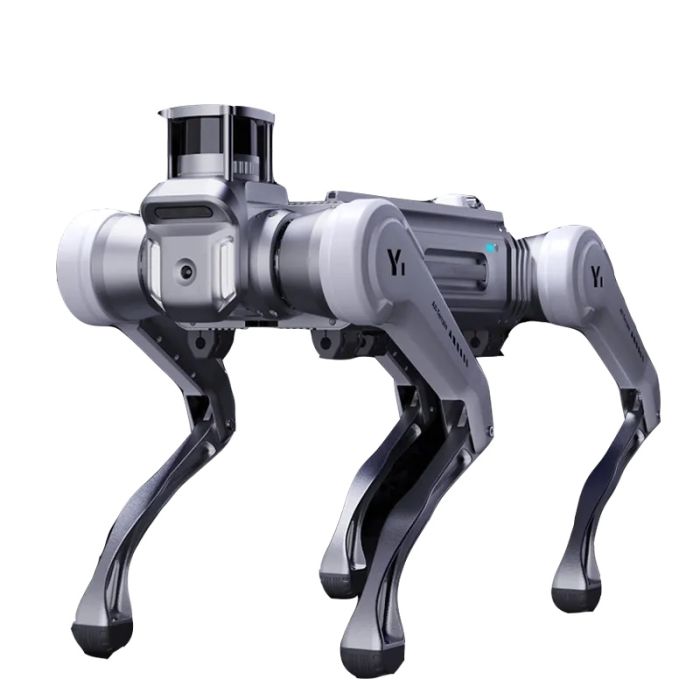
MagicLab MagicDog Y1 Quadruped Robot Dog
In stock
- BRAND:
- MAGICLAB
- MODEL:
- MAGICDOG Y1
- ORIGIN:
- China
- Warranty:
- 12 MONTHS
- AVAILABILITY:
- SUBJECT TO AVAILABILITY
- SKU:
- MagicLab-MagicDog-Y1
MagicLab MagicDog Y1 Quadruped Robot Dog
Most robots that walk well on a showroom floor stop being useful the moment the floor turns to gravel, rain or stairs. The MagicLab MagicDog Y1 Quadruped Robot Dog is built for the opposite situation: the site where the ground is uneven, the weather does not cooperate and the job still has to be done. It is a four-legged industrial platform that carries sensors and loads into places where wheels struggle.
The product is available through this page, by quotation.
Background
MagicLab and the arrival of the Y1
MagicLab builds legged and humanoid robots, and its range runs from quadruped platforms to several MagicBot humanoid models. On October 10, 2025, the company released the MagicDog Y1 as its first new-generation product aimed at industry applications. That detail tells you where the Y1 sits in the family: it is not a demonstration unit or a classroom companion, but a machine meant for work.
Buyers who know the wider range will notice the contrast. The MagicLab MagicDog Quadruped Robot and the MagicLab MagicDog-W Wheeled Quadruped Robot Dog serve other needs, while the Y1 concentrates on payload, protection and expansion.
Positioning and key technology
The Y1 combines an aircraft-grade material body with IP67 protection. It is specified for stable operation from -20℃ to 55℃, in conditions such as high temperature, cold, wind, sand, rain and snow. For computing, it offers an 8-core high-performance CPU as the base, with a high-performance computing module rated at 157 TOPS as an extension.
Perception is handled by one 3D LiDAR, two depth cameras and two optical cameras, and configurations may vary. Wi-Fi 6 and Bluetooth 5.2 are listed, with a 5G communication module optional for some versions. Together these make the Y1 a mobile carrier for the inspection and sensing equipment that industrial teams already use.
Technical Specifications
| Specification | Value |
|---|---|
| Product type | Industrial quadruped robot |
| Dimensions (L × W × H) | 1050mm×458mm×810mm |
| Total weight (with battery) | 70Kg |
| Maximum payload | 150kg |
| Dynamic payload | 45kg |
| Maximum speed | 6m/s |
| Maximum climbing height | ≥60cm |
| Maximum slope angle | ≥45° |
| Battery capacity | 45Ah (2400Wh), voltage 54V |
| Operating time | 4–6h (>4 h continuous walking with 20 kg load) |
| Ingress protection rating | IP67 |
| Operating temperature | -20℃ to 55℃ |
| Base computing power | 8-core high-performance CPU |
| Extended computing power | High-performance computing module (157 TOPS) |
| Communication module | Wi-Fi 6, BT 5.2, 5G communication module (optional for some versions) |
| Perception sensors | 3D LiDAR ×1 + depth cameras ×2 + optical cameras ×2 (configurations may vary) |
| User expansion interfaces | (24V+485 output)*4 power supply + power bus, USB3.0*4, (12V output+EthNet)*3 power supply + network; EthCat x 1 |
| Mounting holes for expansion parts | Extension boards, sliding rails, screw mounts, payload platform |
| Supported expansion devices | Infrared thermal imager, dual-light PTZ camera, gas sensor, acoustic imager, partial discharge sensor, etc. |
Specifications as published by the manufacturer; confirmed against the datasheet at quotation.
The manufacturer has not published the degrees of freedom, the joint torque, the package contents, the maximum power, the charging time, the camera resolution, the operating system and SDK support, the noise level or the maximum step height; they are confirmed at quotation.
What makes the MagicDog Y1 different from a light quadruped robot?
The difference starts with the load figures. The Y1 lists a maximum payload of 150kg and a dynamic payload of 45kg, which is a working load, not a token one. Add a body weight of 70Kg with battery, and the robot is clearly meant to carry equipment, not just itself.
The second difference is protection. An IP67 rating, an aircraft-grade body and a stated operating range from -20℃ to 55℃ mean the robot is specified for rain, sand, wind, snow, heat and cold. For a team that inspects outdoor plant or a site with open ground, that matters more than a clever demonstration.
The third is the terrain envelope. The Y1 is listed with a maximum climbing height of at least 60cm and a maximum slope angle of at least 45°, and it is described as conquering stairs, rocky surfaces and shallow waters. A top speed of 6m/s also lets it cover ground quickly between inspection points.
How does the Y1 carry extra equipment?
A quadruped is only as useful as what it can carry and power. The Y1 offers four 24V outputs with a 485 power bus, four USB3.0 ports, three 12V outputs with Ethernet, and one EthCat interface. Mounting holes accept extension boards, sliding rails, screw mounts and a payload platform.
The supported expansion devices include an infrared thermal imager, a dual-light PTZ camera, a gas sensor, an acoustic imager and a partial discharge sensor. In practice this turns the robot into a mobile sensing station: you choose the instrument for the job, mount it, and let the robot reach the location. The 157 TOPS computing module is there for teams that need heavier processing on board.
Endurance supports that approach. The 45Ah (2400Wh) battery at 54V gives an operating time of 4–6h, and the manufacturer states more than 4 hours of continuous walking with a 20 kg load.
Who is the MagicDog Y1 for?
Industrial inspection teams are the clearest fit: power, energy, process and infrastructure operators who need a robot to visit places that are hard, hot, wet or dusty. The expansion interfaces and supported sensors suit that routine well.
Logistics and site-transport users will look at the payload figures first, especially where stairs, rough ground or shallow water rule out wheeled carriers. Research groups and integrators who want a rugged base for their own payloads will value the power and data ports and the mounting options; they may also browse the Research Robots category for related platforms.
If your work is lighter, or you want a simpler entry point, the Standard Quadrupeds category and the MagicDog-W wheeled version are better places to start. The Y1 is for those who need the load, the protection and the expansion headroom.
What is the MagicDog Y1 used for?
- Industrial inspection. Carry an infrared thermal imager or a dual-light PTZ camera along a fixed route.
- Gas and leak checks. Mount a gas sensor and survey areas that are unpleasant or unsafe for people.
- Electrical diagnostics. Use a partial discharge sensor or an acoustic imager to examine equipment from a distance.
- Equipment transport. Move tools and materials over stairs, slopes and rocky ground using the payload platform.
- Harsh-weather patrols. Work through rain, sand, snow, wind, heat and cold within the rated temperature range.
- Custom integration. Build your own payloads on the extension boards, sliding rails and power and network ports.
Pricing and Availability
We do not print prices on this page. Please request a quotation, and we will confirm the configuration you need, including the optional 5G module where it applies. Delivery, customs and support are arranged with the quotation. The MagicLab MagicDog Y1 Quadruped Robot Dog is available on this page.
Frequently Asked Questions
What payload can the MagicDog Y1 carry?
The maximum payload is 150kg and the dynamic payload is 45kg. The 4–6h operating time includes more than 4 hours of continuous walking with a 20 kg load.
Is the MagicDog Y1 waterproof?
It carries an IP67 rating and is described as capable of working in rain and shallow water. It is specified for stable operation from -20℃ to 55℃.
What terrain can it handle?
The Y1 is listed with a maximum climbing height of at least 60cm and a maximum slope angle of at least 45°. It is described as conquering stairs, rocky surfaces and shallow waters.
What sensors does it have?
It has one 3D LiDAR, two depth cameras and two optical cameras, and configurations may vary. Extra devices such as a thermal imager, gas sensor or acoustic imager can be added.
How much computing power is available?
The base is an 8-core high-performance CPU. A high-performance computing module rated at 157 TOPS is available as an extension.
How is it connected?
It lists Wi-Fi 6 and Bluetooth 5.2, with a 5G communication module optional for some versions. Please confirm the version you need at quotation.
Where can I buy the MagicDog Y1 and what does it cost?
The robot is available through this page, by quotation. We do not print a price here; send a request and we will respond with a quotation for your configuration.
Summary
The MagicDog Y1 answers a simple question: what happens when a robot has to leave the clean floor? It brings a 150kg maximum payload, an IP67 body, a 6m/s top speed, terrain capability and a generous set of power and data ports to industrial work outdoors and underfoot. Its endurance of 4–6h and the 157 TOPS extension module add to the case for teams that inspect, carry and integrate. If that matches your site, this page is the starting point.


