
MagicLab MagicDog-W Wheeled Quadruped Robot Dog
In stock
- BRAND:
- MAGICLAB
- MODEL:
- MAGICDOG-W
- ORIGIN:
- China
- Warranty:
- 12 MONTHS
- AVAILABILITY:
- SUBJECT TO AVAILABILITY
- SKU:
- MagicLab-MagicDog-W
MagicLab MagicDog-W Wheeled Quadruped Robot Dog
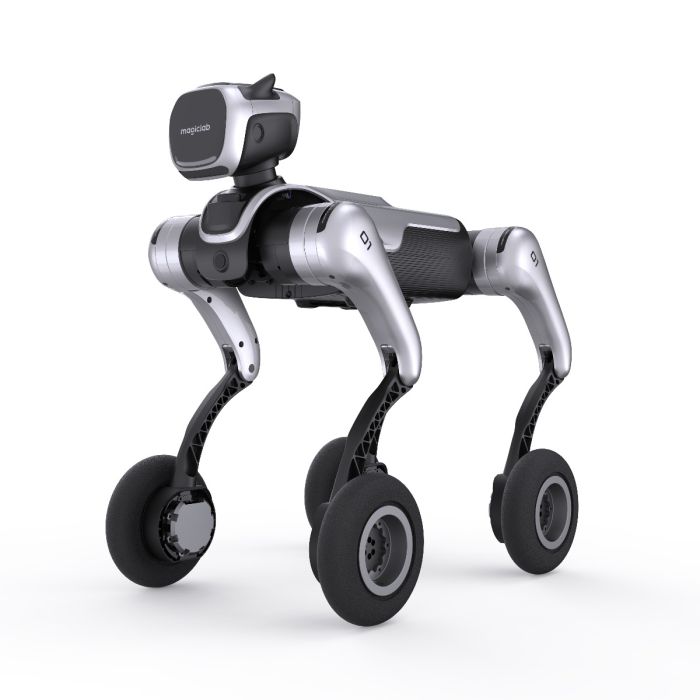
A robot that walks everywhere is slow on a smooth warehouse floor, and a robot that only rolls stops at the first step. The MagicLab MagicDog-W Wheeled Quadruped Robot Dog is built for the places where both problems show up in the same day, and it asks the buyer to give up neither.
The product is available through this page, by quotation.
Background
MagicLab and the MagicDog line
MagicLab is the brand behind a family of legged and humanoid machines, and this store lists several of them, among them the MagicLab MagicDog Quadruped Robot and the MagicLab MagicDog Y1 Quadruped Robot Dog. The MagicDog-W belongs to that family and takes its name from the letter W, for wheeled. It keeps the four-legged body plan that makes a robot dog useful on uneven ground, and it adds a pneumatic tire to the end of each leg.
Two versions of this model exist: the MagicDog-W, the Standard version, and the MagicDog-W Pro. The figures in this article are those of the MagicDog-W. Ask us how the Pro version differs for your project.
Why wheels on a quadruped matter
The key idea is the combination of locomotion modes. Wheels are efficient on corridors, pavement and factory floors. Legs are what carry a machine over a curb, a ramp or broken ground. On the MagicDog-W the 7-inch pneumatic tires give the machine a motion speed of 0-3 m/s, while the legs, driven by 16 joint motors plus one head motor, let it handle a maximum slope angle of up to 40°.
The body is built from aluminum alloy and high-strength engineering plastic, and the maximum joint torque is 37.5 N·m. Onboard computing power is 6TOPS, and the sensor set covers 2D LiDAR, a dual camera, a depth camera, a 4K HD camera, a fisheye camera and ultrasonic sensors. For a patrol, inspection or demonstration robot, that is a broad set of eyes.
Technical Specifications
| Specification | Value |
|---|---|
| Standing dimensions | 670*350*650mm |
| Prone dimensions | 720*500*290mm |
| Total weight | 22.5 kg (with battery) |
| Payload | Maximum 10 kg |
| Motion speed | 0-3 m/s |
| Material | Aluminum Alloy + High-Strength Engineering Plastic |
| Tire type and size | 7-inch Pneumatic Tire |
| Motor number | 16+1 (Head Motor) |
| Maximum joint torque | 37.5 N·m |
| Maximum slope angle | ≤ 40° |
| Onboard computing power | 6TOPS |
| Sensors | 2D LiDAR + Dual Camera + Depth Camera + 4K HD Camera + Fisheye Camera + Ultrasonic Sensors |
| Communication | WiFi 5, 4G Module, BT 5.0 |
| Battery | Capacity: 8200 mAh, Rated Voltage: 29.6 V |
| Battery life | 2-4 h |
| Operating temperature range | -5° ~ 40° |
| Facial expression display | 24 |
Specifications as published by the manufacturer; confirmed against the datasheet at quotation.
The manufacturer has not published the IP rating, the charging time, whether the battery can be swapped, the maximum runtime per charge under load or the noise level; they are confirmed at quotation.
What makes the MagicDog-W different from a legged-only robot dog?
The first difference is how it covers distance. A robot that walks on every step spends energy and time on each stride, even on a flat, smooth surface. The MagicDog-W can roll on its four pneumatic tires, with a motion speed of 0-3 m/s, and keep its legs for the moments when the terrain asks for them. For routes that are mostly flat with the occasional obstacle, that is a practical advantage.
The second difference is the load it can carry. The maximum payload is 10 kg against a total weight of 22.5 kg with battery, so the machine is a working platform and not only a showpiece. Together with the aluminum alloy and engineering plastic construction, this points to field use, demonstrations and inspection tasks where equipment has to ride along.
The third difference is the connectivity. WiFi 5, a 4G module and BT 5.0 give the operator more than one way to reach the robot, which matters when it is working beyond the range of a single local network.
What can be mounted on the backplate?
The MagicDog-W carries a versatile backplate that is compatible with expansion docks. Peripherals such as LiDAR and gimbals are examples of what can be mounted there. For a research group, this turns the robot into a base on which a sensing or imaging package can be built and changed from project to project.
The built-in sensors already cover a wide range, from the 2D LiDAR and the depth camera to the 4K HD camera, the fisheye camera and the ultrasonic sensors. The backplate extends that foundation. Tell us what your application needs and we will help you choose the docks and peripherals.
The robot also shows 24 facial expressions, which gives it a friendly face for visitors, students and audiences. That is useful when the robot is meant to be approached and not only operated.
Who is the MagicDog-W for?
Research laboratories and universities will find a mobile platform with 6TOPS of onboard computing power, a rich sensor set and a mounting plate for their own equipment. Training centers and robotics programs can use it to teach navigation, perception and legged-wheeled locomotion on real hardware.
Integrators and technology teams building inspection, patrol or guided-tour solutions will value the speed on flat ground combined with the ability to climb slopes of up to 40°. Exhibition organizers, hotels and venues that want an eye-catching, interactive machine will appreciate the expressive face and the quick, smooth rolling motion.
If your work calls for a purely legged machine without wheels, the MagicLab MagicDog Quadruped Robot and the MagicLab MagicDog Y1 Quadruped Robot Dog are worth comparing. For humanoid work, the store also lists the MagicLab MagicBot Z1 Standard Edition Humanoid Robot.
What is the MagicDog-W used for?
- Research and development. A mobile base for testing navigation, perception and control with an open mounting plate.
- Education and training. A hands-on platform for robotics courses, student projects and competitions.
- Inspection and patrol. Rolling along corridors and yards, then stepping over obstacles and up slopes where wheels alone would stop.
- Payload carrying. Moving equipment of up to 10 kg across a site or a demonstration area.
- Mapping and sensing. Using the 2D LiDAR, depth camera and other sensors, with added LiDAR or gimbals on the backplate.
- Exhibitions and public engagement. Greeting visitors with its 24 facial expressions and drawing a crowd at events and showrooms.
Pricing and Availability
We do not print prices on this page. Please request a quotation, and we will prepare an offer for the MagicDog-W matched to your application and quantity. Delivery, customs and support are arranged together with the quotation, so that you know the full picture before you commit. The MagicLab MagicDog-W Wheeled Quadruped Robot Dog is available on this page.
Frequently Asked Questions
How fast does the MagicDog-W move?
The motion speed is 0-3 m/s. It rolls on four 7-inch pneumatic tires.
How much can it carry?
The maximum payload is 10 kg. The robot itself weighs 22.5 kg with battery.
What slopes can it climb?
The maximum slope angle is up to 40°. Its maximum joint torque is 37.5 N·m.
How long does the battery last?
The battery life is 2-4 h, from an 8200 mAh battery with a rated voltage of 29.6 V.
Which sensors and connections does it have?
It carries 2D LiDAR, a dual camera, a depth camera, a 4K HD camera, a fisheye camera and ultrasonic sensors. Communication is by WiFi 5, a 4G module and BT 5.0.
Can I add my own equipment?
Yes. The versatile backplate is compatible with expansion docks for mounting peripherals such as LiDAR and gimbals.
Where can I buy the MagicDog-W and what does it cost?
You can buy it through this page, by quotation. The cost depends on your configuration and quantity, so send us a request and we will reply with an offer.
Summary
Most mobile robots make you choose between the speed of wheels and the reach of legs. The MagicDog-W puts both on one frame: 7-inch pneumatic tires for a motion speed of 0-3 m/s, 16 joint motors plus a head motor for stepping and climbing, a maximum payload of 10 kg, a broad sensor set and a backplate ready for your own equipment. For research, training, inspection and public display in the Caribbean and beyond, it is a flexible machine with a friendly face. When you are ready to compare configurations and plan delivery, this page is the starting point.


