
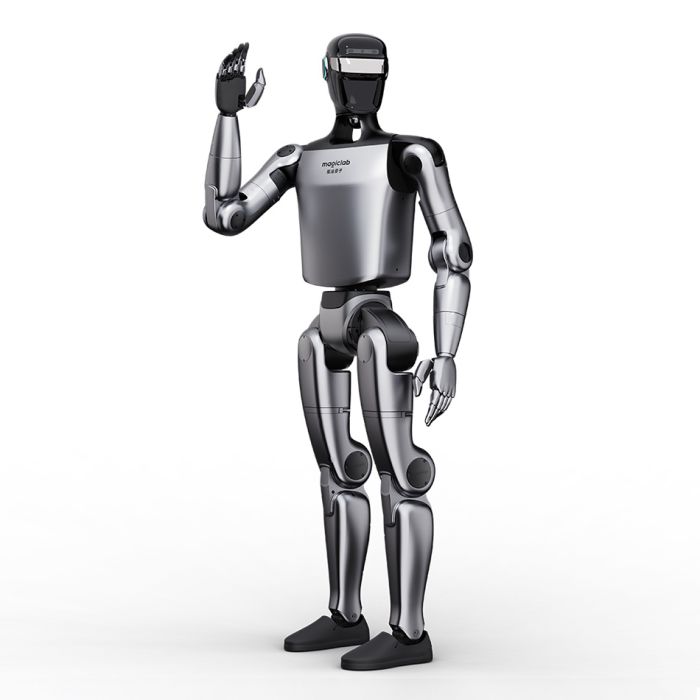
MagicLab MagicBot Z1 Development Edition Humanoid Robot
In stock
- BRAND:
- MAGICLAB
- MODEL:
- MAGICBOT Z1 DEVELOPMENT EDITION
- ORIGIN:
- China
- Warranty:
- 12 MONTHS
- AVAILABILITY:
- SUBJECT TO AVAILABILITY
- SKU:
- MagicLab-MagicBot-Z1-Dev
MagicLab MagicBot Z1 Development Edition Humanoid Robot
A humanoid that only ever walks across a stage is a showpiece; one that can be opened up, reprogrammed and pushed to its limits is a tool. The MagicLab MagicBot Z1 Development Edition Humanoid Robot is meant to be the second kind. It is a highly dynamic humanoid for scientific research and education, exhibitions and exchanges, commercial performances and entertainment, and home companionship, and this edition is the one built for teams that want to go beyond the factory behavior and write their own.
The product is available through this page, by quotation.
Background
The company and its lineage
The MagicBot Z1 is made by Magiclab Robotics Technology (Wuxi) Co., Ltd., based in Wuxi, Jiangsu, China. The company builds humanoid and quadruped robots, and the Z1 sits among them as a compact biped. Its siblings include the full-size MagicLab MagicBot X1 Full-Size Humanoid Robot, and a Standard Edition of the Z1 itself, which you can read about on the page for the MagicLab MagicBot Z1 Standard Edition Humanoid Robot.
Within that family the Z1 is the platform for people who need a humanoid at a manageable size. It stands at a height that fits through ordinary doorways and onto a lab bench or exhibition stand, yet it carries the joint hardware and sensing of a serious research machine.
Positioning and key technology
The Development Edition is the version that supports OTA updates and secondary development, which means your own software can be built on top of the robot. Its joints use industrial-grade high-rigidity roller bearings, chosen to help withstand impact during robot experiments. That matters for a machine that is expected to fall now and then while a new gait or balance controller is being tuned.
The robot supports humanoid walking, humanoid running and getting up after falling. Perception comes from a 3D LiDAR, a depth camera and a binocular fisheye camera, and the basic computing module is an 8-core high-performance CPU with a high-computing-power module available as an option. Voice commands and chatbot voice interaction round out the package for demonstrations and teaching. It belongs in the category of Bipedal Humanoids and is a natural fit for Research Robots programs.
Technical Specifications
| Specification | Value |
|---|---|
| Standing dimensions (H × W × T) | 1369 × 422 × 200 mm (136.9 × 42.2 × 20 cm) |
| Total weight | Approx. 40 kg+ (with battery) |
| Degrees of freedom | 24 basic DoF, expandable up to 50 DoF |
| Single-arm DoF | 5+ (optional addition of 2 wrist DoF) |
| Dexterous hand | Optional 11-DoF WeiKuan dexterous hand |
| Maximum joint torque | 130 N·m |
| Joint range of motion | Up to 320° (some joints); knee joint –152°, head Z-axis ±40° |
| Battery | 10000 mAh (quick-release smart battery) |
| Sensors | 3D LiDAR, depth camera, binocular fisheye camera |
| Computing module | 8-core high-performance CPU (basic), optional high-computing-power module |
| Audio | Voice commands, chatbot voice interaction |
| Motion | Humanoid walking, humanoid running, getting up after falling |
| Software | OTA / secondary development supported |
| Joint structure | Industrial-grade high-rigidity roller bearings |
Specifications as published by the manufacturer; confirmed against the datasheet at quotation.
The manufacturer has not published the charging time, the IP rating, the maximum walking speed, the charger rating for the Development Edition or the contents of the box for the Development Edition; they are confirmed at quotation.
What makes the Development Edition different from the Standard Edition?
The two editions share the same family and the same purpose, but they are aimed at different users. The Standard Edition suits those who want a ready humanoid for display, teaching and entertainment. The Development Edition is the one to choose when the robot itself is the subject of the work. It supports OTA updates and secondary development, so research groups and integrators can build their own behaviors rather than rely only on what ships with the robot.
Its configuration is also built to grow. The basic robot offers 24 degrees of freedom and can be expanded up to 50. Each arm starts at 5+ degrees of freedom, with an optional addition of 2 wrist degrees of freedom, and an optional 11-DoF WeiKuan dexterous hand is available for work that involves gripping and manipulation. On the computing side, the 8-core CPU is the basic module, and a high-computing-power module is offered for heavier perception or learning workloads.
How does the Z1 handle impact and falls?
Anyone who has tuned a walking controller knows that robots fall during development. The Z1 is designed with that in mind. Industrial-grade high-rigidity roller bearings in the joints help withstand impact during robot experiments, and joint torque reaches up to 130 N·m, which powers dynamic walking and motion testing. The robot supports humanoid walking and running, and it can get up after falling, so a test session does not end each time the robot goes down.
The joint range of motion adds to this: up to 320° on some joints, with the knee joint at –152° and the head Z-axis at ±40°. Together with the 3D LiDAR, depth camera and binocular fisheye camera, this gives developers a platform on which balance, navigation and whole-body motion can be tried and measured in practice.
Who is the MagicBot Z1 Development Edition for?
Universities and robotics laboratories are the clearest fit. They need a humanoid that can be programmed, extended and tested repeatedly, and the Development Edition provides that. System integrators and commercial development teams will find it useful for building and demonstrating application prototypes before committing to a larger program.
Educators can use it to teach embodied intelligence, locomotion and human-robot interaction, since voice commands and chatbot voice interaction make it engaging in a classroom. Exhibition organizers and entertainment companies also use it, though if you only need a robot for display and performance and do not plan to write your own software, the Standard Edition is the simpler choice. For organizations that need a full-size body, the MagicBot X1 is the larger option in the range.
What is the MagicBot Z1 Development Edition used for?
- Locomotion research. Walking, running and recovery after a fall can be studied and improved on real hardware.
- Secondary development. OTA and secondary development support lets teams add their own software to the platform.
- Manipulation experiments. Optional wrist degrees of freedom and the 11-DoF WeiKuan dexterous hand extend work into grasping.
- Perception and navigation. The 3D LiDAR, depth camera and binocular fisheye camera support mapping and scene understanding projects.
- Teaching and exchanges. Universities and training centers use it to show students how a humanoid moves, senses and responds.
- Exhibitions and performances. Its dynamic motion and voice interaction suit trade shows, stage work and entertainment.
Pricing and Availability
We do not list a price on this page, because the configuration you choose, including the dexterous hand, wrist expansion and computing module, shapes the offer. Please request a quotation and tell us how you plan to use the robot. Delivery, customs and support are arranged together with the quotation. The MagicLab MagicBot Z1 Development Edition Humanoid Robot is available on this page.
Frequently Asked Questions
How many degrees of freedom does the Z1 Development Edition have?
It has 24 basic degrees of freedom, expandable up to 50 DoF. Each arm has 5+ DoF, with an optional addition of 2 wrist DoF.
Does it support custom software?
Yes. The robot supports OTA updates and secondary development, which is the main reason to choose this edition.
What sensors does it carry?
It carries a 3D LiDAR, a depth camera and a binocular fisheye camera. The basic computing module is an 8-core high-performance CPU, with a high-computing-power module as an option.
Can it be fitted with hands?
An optional 11-DoF WeiKuan dexterous hand is available.
How heavy is it and how is it powered?
The total weight is approx. 40 kg+ with the battery. Power comes from a 10000 mAh quick-release smart battery.
Can it get up after a fall?
Yes. The robot supports humanoid walking, humanoid running and getting up after falling.
Where can I buy the MagicBot Z1 Development Edition and what does it cost?
You can buy it through this page by requesting a quotation. We do not publish a price here, because the cost depends on the configuration and options you select.
Summary
The MagicBot Z1 Development Edition is a humanoid made to be pushed, tested and rewritten. It combines a compact body, joint torque up to 130 N·m, impact-ready roller bearings, a full sensor set and a platform open to OTA and secondary development, with room to grow from 24 to 50 degrees of freedom. For laboratories, universities, integrators and teams who need a humanoid to work with rather than only to watch, it is a strong candidate. When you are ready to discuss configuration, delivery and support, this page is the starting point.


