
MagicLab MagicBot Z1 Standard Edition Humanoid Robot
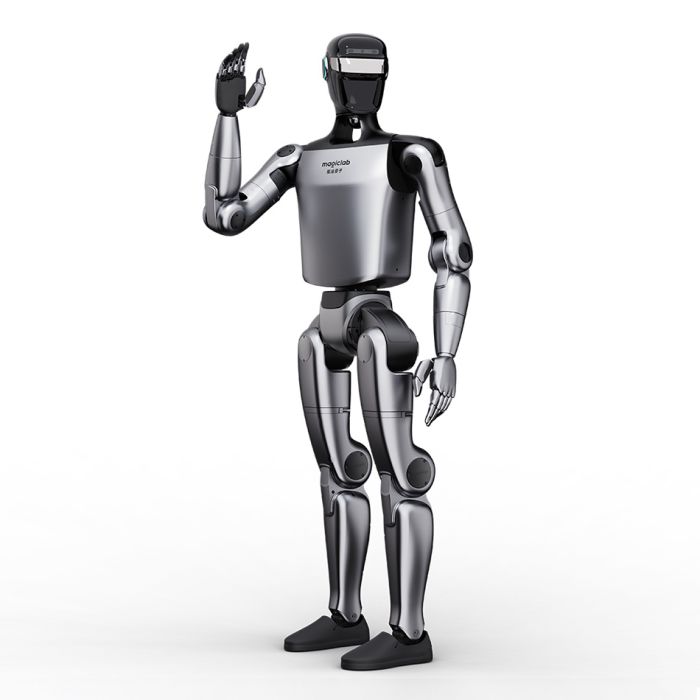
In stock
- BRAND:
- MAGICLAB
- MODEL:
- MAGICBOT Z1 STANDARD EDITION
- ORIGIN:
- China
- Warranty:
- 12 MONTHS
- AVAILABILITY:
- SUBJECT TO AVAILABILITY
- SKU:
- MagicLab-MagicBot-Z1
MagicLab MagicBot Z1 Standard Edition Humanoid Robot
Every robotics team eventually faces the same question: how do you get your first walking humanoid without building a program around it? The MagicLab MagicBot Z1 Standard Edition Humanoid Robot is MagicLab's answer. It is the entry-level edition of a bipedal platform, with the essential motion capabilities, a full sensor suite and a quick-release battery, and it leaves open-ended software work to the Development Edition.
The product is available through this page, by quotation.
Background
MagicLab and the Z1 launch
MagicLab is a global leader in embodied AI, and the MagicBot Z1 is one of its bipedal humanoid robots. The company unveiled the Z1 on July 8, 2025, and the manufacturer of record is Magiclab Robotics Technology (Wuxi) Co., Ltd. The Z1 sits within a wider MagicLab range that also includes other humanoids and quadruped robots, so a buyer who starts here is entering a family and not a one-off machine.
The Z1 comes in two main editions, the Standard Edition and the Developer Edition. The Standard Edition provides essential motion capabilities and is an entry-level experience for robotics enthusiasts and tech players. Teams that want secondary development on the platform are directed to the MagicLab MagicBot Z1 Development Edition Humanoid Robot.
Positioning and key technology
The Z1 is built around a wide joint motion range of up to 320°. That range supports demanding, large-amplitude actions such as a backbend, which is the kind of hardware headroom that matters when a robot is meant to be pushed beyond a simple walking demonstration. In total the Standard Edition has 24 degrees of freedom, with 5 in each arm.
MagicLab also provides a standardized robot controller powered by motion control algorithms. This controller lets the Z1 adapt to terrains and environments such as flat ground, grass, gravel and stairs. For buyers comparing options, this places the robot among the bipedal humanoids that are designed to leave the lab floor, not just stand on it.
Technical Specifications
| Specification | Z1 Standard Edition |
|---|---|
| Dimensions, standing (H×W×D) | 1369*422*200mm |
| Dimensions, folded (H×W×D) | 730*422*395mm |
| Weight with battery | Approximately 40kg |
| Total degrees of freedom | 24 |
| Single arm degrees of freedom | 5 |
| Joint motion range | Up to 320° |
| Maximum knee torque | 100N.m |
| Maximum arm load | 2kg |
| Perception sensors | 3D LiDAR + Depth Camera + Binocular Fisheye Camera + Head Tactile Sensor |
| Basic computing power | 8-core high-performance CPU |
| Smart battery (quick release) | 10000mAh |
| Battery life | Approximately 2h |
| Charger | 62V 5A |
| Handheld remote control | Included |
| Wireless connectivity | WiFi6, Bluetooth 5.2 |
| Secondary development | None (the Development Version has it) |
| OTA upgrade | Supported |
Specifications as published by the manufacturer; confirmed against the datasheet at quotation.
The manufacturer has not published the maximum walking speed, the IP rating, the charging time, the operating temperature, the memory and storage or the camera resolution; they are confirmed at quotation.
What makes the Z1 Standard Edition different from the Development Edition?
The difference is software access. The Standard Edition lists secondary development as none, and the Development Version has it. If your plan is to run the robot as delivered, to study its motion, to demonstrate it or to teach with it, the Standard Edition covers that ground. If your plan is to write your own functions on top of the platform, the Development Edition is the version to ask about.
The hardware story is shared in spirit: the Z1 platform offers solid hardware support for secondary functional development in real-world industry applications. The Standard Edition gives you the body and its controller; the Developer Edition opens the door to extending them. Figures in this article belong to the Standard Edition only, and the Development Edition's own figures should be requested separately.
What does the Z1 carry for sensing and power?
Perception on the Standard Edition combines a 3D LiDAR, a depth camera, a binocular fisheye camera and a head tactile sensor. That is a mix of long-range mapping, depth sensing, wide-angle vision and touch, which gives a robot several independent ways to understand its surroundings. An 8-core high-performance CPU provides the basic computing power, and WiFi6 with Bluetooth 5.2 handles wireless connectivity.
Power comes from a 10000mAh smart battery with a quick-release design, rated at approximately 2h of battery life. A 62V 5A charger is part of the specification, and a handheld remote control is included. OTA upgrade is supported, so the robot's software can be updated over the air without a workshop visit.
Who is the MagicBot Z1 Standard Edition for?
Robotics enthusiasts and technology players are the buyers this edition is made for, and it suits them well: a real bipedal humanoid with a serious sensor set, without the commitment of a full development program. Universities and training centers can use it to put students in front of a working humanoid, and demonstration teams can use it where people need to see a walking robot with their own eyes.
Integrators and research groups that already know they need to write their own code should look at the Development Edition first, since the Standard Edition has no secondary development. Buyers who are still weighing the wider field can browse the humanoid robots category to see how the Z1 compares with other machines before asking for a quotation.
What is the MagicBot Z1 Standard Edition used for?
- Robotics education: a working 24-degree-of-freedom biped gives students a concrete machine to study posture, balance and joint design.
- Locomotion demonstrations: the standardized controller lets the robot adapt to flat ground, grass, gravel and stairs, which makes for convincing live shows.
- Perception experiments: 3D LiDAR, a depth camera, a binocular fisheye camera and a head tactile sensor provide several sensing channels to observe and compare.
- Light arm tasks: each arm has 5 degrees of freedom and the maximum arm load is 2kg, enough to show simple reaching and carrying motions.
- Exhibitions and public events: the folded size of 730*422*395mm makes the robot easier to store and move between venues.
- Platform evaluation: teams can learn the Z1 platform, with OTA updates keeping the software current, before deciding whether the Development Edition fits a later project.
Pricing and Availability
Pricing for the MagicBot Z1 Standard Edition is provided by quotation. Send us your request and we will respond with the details for your project. Delivery, customs and support are arranged together with the quotation, so there are no surprises after you decide. The MagicLab MagicBot Z1 Standard Edition Humanoid Robot is available on this page.
Frequently Asked Questions
How tall is the Z1 Standard Edition?
Standing, the robot measures 1369*422*200mm in height, width and depth. Folded, it measures 730*422*395mm.
How much does the robot weigh?
The weight with the battery fitted is approximately 40kg.
How long does the battery last?
Battery life is approximately 2h on the 10000mAh quick-release smart battery.
Which terrains can the Z1 handle?
The standardized controller lets the Z1 adapt to flat ground, grass, gravel and stairs.
Can I develop my own software on the Standard Edition?
No. Secondary development is listed as none on the Standard Edition, and the Development Version has it. OTA upgrade is supported for software updates.
Is a remote control included?
Yes, a handheld remote control is part of the specification, together with WiFi6 and Bluetooth 5.2 connectivity.
Where can I buy the MagicBot Z1 Standard Edition and what does it cost?
You can request it through this page. The cost is given in a quotation prepared for your order, which also covers delivery, customs and support.
Summary
The Z1 Standard Edition answers the question of the first humanoid: it gives a team a real biped with 24 degrees of freedom, a wide joint range, four kinds of perception and a quick-release battery, while keeping the more open-ended software work for the Development Edition. It is a sensible starting point for education, demonstration and platform evaluation. If that matches your plans, this page is the starting point.


