
Unitree B2-W Wheeled Quadruped Robot
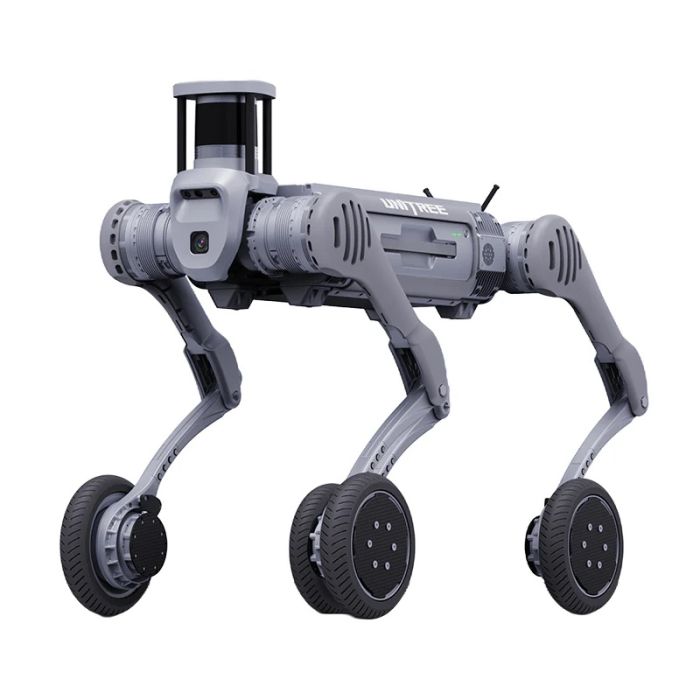
In stock
- BRAND:
- UNITREE ROBOTICS
- MODEL:
- B2-W
- ORIGIN:
- China
- AVAILABILITY:
- SUBJECT TO AVAILABILITY
- SKU:
- Unitree-B2-W
Unitree B2-W Wheeled Quadruped Robot
Most robots make you choose: roll fast on flat ground, or walk slowly over anything. The Unitree B2-W Wheeled Quadruped Robot is built to refuse that choice. It is a four-legged machine with a driven wheel at the end of each leg, so it can cruise along a road and then step up a flight of stairs without a change of vehicle.
The Unitree B2-W Wheeled Quadruped Robot is available through this page, by quotation.
Background
Unitree and the B2 family
Unitree Robotics builds quadruped robots that range from compact education platforms to heavier systems for industrial work. The sources for this page name three versions in the B2 line: the B2, the B2-W, and the B2-W with Nav Kit. The B2 walks on legs alone. The B2-W adds wheels to the same basic idea, and the Nav Kit version is the B2-W supplied with a navigation kit. The figures in this article belong to the B2-W.
Why wheels on a walking robot
A legged robot spends energy on every stride, even on a smooth service road. A wheeled robot spends very little on a smooth road but stalls at the first curb. The B2-W combines the two. On flat ground it drives on its wheels. When the route turns into stairs, a slope or broken ground, the legs do the work. For sites with long routes and a few awkward obstacles, that mix matters more than any single number on a datasheet.
Technical Specifications
| Specification | B2-W |
|---|---|
| Product type | Wheeled quadruped robot |
| Dimensions (standing) | ≈ 1098 mm × 550 mm × 758 mm |
| Dimensions (lying prone) | ≈ 950 mm × 550 mm × 450 mm |
| Weight | ≈ 85 kg (battery included) |
| Battery capacity and voltage | > 2 kWh, 58 V |
| Speed | 15 km/h |
| Endurance (with 40 kg load) | up to 25 km |
| Endurance (no load) | mileage ≈ 30 km |
| Maximum static load (standing) | 120 kg |
| Load while walking | > 40 kg |
| Wheel diameter | 225 mm |
| Maximum wheel speed | 50 rad/s |
| Maximum wheel torque | 40 N.m |
| Continuous stair climbing | Steps of 20 to 25 cm |
| Slope angle | > 45° |
| Operating temperature | -20 ℃ to 55 ℃ |
| Ingress protection | IP67 |
| Computing (standard) | Intel Core i5 (platform functions), Intel Core i7 (user development) |
| Computing (optional) | Intel Core i7 and Jetson Orin NX (up to 3 devices) |
| Sensors | 1 3D LiDAR, 2 depth cameras, 2 optical cameras |
| Battery | Removable, quick replacement, optional autonomous charging solution |
| Connectivity | WiFi 6, Bluetooth 5.2 |
Specifications as published by the manufacturer; confirmed against the datasheet at quotation.
The manufacturer has not published the payload mounting interfaces, the charging time, the noise level, the warranty-independent service life or the camera resolution; they are confirmed at quotation.
What makes the B2-W different from a walking-only quadruped?
The first difference is range. On its wheels, the B2-W reaches 15 km/h and runs up to 25 km with a 40 kg load, or a mileage of about 30 km with no load. A robot that only walks spends much of its battery on leg motion, so a long patrol route is harder for it. Here the wheels carry the distance, and the battery of more than 2 kWh at 58 V supports that.
The second difference is what it keeps from the legs. The B2-W climbs continuous stairs with steps of 20 to 25 cm and handles slopes steeper than 45°. A wheeled-only platform would stop at both. The wheels themselves are substantial: 225 mm in diameter, with a maximum wheel speed of 50 rad/s and a maximum wheel torque of 40 N.m.
The third difference is the load. The robot can hold a static load of 120 kg while standing, and it carries more than 40 kg while walking. That is a useful margin when the task is to move sensors or equipment around a site rather than just a camera.
How is the B2-W built for rough weather and long shifts?
Outdoor work is hard on equipment, so the published figures here are worth reading closely. The ingress protection is IP67, and the operating temperature runs from -20 ℃ to 55 ℃. That covers cold mornings, hot afternoons and the occasional downpour on a yard inspection.
The power system uses a removable battery with quick replacement. A crew can swap a pack and keep the robot working instead of waiting beside a charger. For sites that want no human involvement at all, an autonomous charging solution can be added depending on requirements.
For perception, the robot carries one 3D LiDAR, two depth cameras and two optical cameras. The standard computing is an Intel Core i5 for platform functions and an Intel Core i7 for user development. An optional configuration adds an Intel Core i7 and Jetson Orin NX, up to 3 devices, for teams that want to run their own perception or autonomy software on board. The robot supports WiFi 6 and Bluetooth 5.2.
Teams that need navigation from day one can look at the Unitree B2-W Industry Grade Quadruped Robot Dog with Wheels, Basic B2-W Kit with Battery, Navigation Kit, which is the version listed with a navigation kit.
Who is the Unitree B2-W for?
Industrial operators who patrol plants, yards, substations and warehouses will find the combination of speed and stair climbing useful. The route may be long, but the obstacles along it are short and sudden.
Research laboratories and universities can use the Intel Core i7 user-development computing and the optional Jetson Orin NX configuration to build and test their own software on a platform that works outdoors.
System integrators who deliver inspection or monitoring solutions can fit the robot into a larger package, with the removable battery and the optional autonomous charging solution supporting round-the-clock operation.
Public-safety and utility teams who must send a machine into places that people would rather not enter can rely on the temperature range and the IP67 rating. Buyers who want a navigation kit supplied from the start should ask about the Nav Kit version linked above.
What is the Unitree B2-W used for?
- Site inspection: it carries its LiDAR and cameras along routes that include stairs, curbs and slopes.
- Security patrols: it covers long perimeters quickly on its wheels and walks where the ground turns difficult.
- Equipment carrying: it moves a working load of more than 40 kg while walking, with a static load of 120 kg.
- Research and development: the Intel Core i7 and optional Jetson Orin NX let teams run their own code.
- Outdoor monitoring in harsh weather: the IP67 rating and the -20 ℃ to 55 ℃ range support work in cold, heat and rain.
- System integration: it serves as a mobile base for larger inspection and automation projects.
Pricing and Availability
We do not print prices on this page. The way to buy is a quotation: tell us the configuration you need, including whether you want the optional computing or the navigation kit, and we will respond with a proposal. Delivery, customs and support are arranged with the quotation. The Unitree B2-W Wheeled Quadruped Robot is available on this page.
Frequently Asked Questions
How fast does the B2-W move?
The published speed is 15 km/h. The maximum wheel speed is 50 rad/s.
How far can it travel on a battery?
With a 40 kg load, endurance is up to 25 km. With no load, the mileage is about 30 km.
Can it climb stairs?
Yes. It climbs continuous stairs with steps of 20 to 25 cm, and it handles slopes greater than 45°.
Is it suitable for wet and cold conditions?
The ingress protection is IP67 and the operating temperature is -20 ℃ to 55 ℃.
Can I run my own software on it?
The standard configuration includes an Intel Core i7 for user development. An optional configuration adds an Intel Core i7 and Jetson Orin NX, up to 3 devices.
What sensors does it carry?
It carries one 3D LiDAR, two depth cameras and two optical cameras. The camera resolution is confirmed at quotation.
Where can I buy the Unitree B2-W Wheeled Quadruped Robot and what does it cost?
You can buy it through this page by requesting a quotation. The cost depends on the configuration you choose, and it is given in the quotation rather than listed here.
Summary
The B2-W answers a plain question: what if a robot did not have to choose between speed and reach? Wheels give it range and pace on open ground. Legs give it stairs, slopes and broken surfaces. An IP67 body, a removable battery, a sensor suite and open computing options round out the package for demanding sites. If that profile matches your work, this page is the starting point.
Specifications
General
Physical
Performance
Sensors
Software
Battery + Power
Feature
-
Size(Standing)
≈ 1098mm×550mm×758mm
-
Size(Lying Prone)
≈ 950mm×550mm×450mm
-
Battery Capacity
>2kwh,voltage 58V
-
Maximum horizontal pulling force
15km/h [1]
-
Endurance Ability
Maximum endurance of 25km with 40kg load [2]
Maximum endurance without load > 4h, and the mileage ≈70km
-
Maximum Load(Standing)
120kg
-
Load(Walking)
> 40kg
-
Wheel Diameter
225mm
-
Maximum wheel speed
50rad/s
-
Maximum wheel torque
40N.m
-
Continuous Stair Climbing
Stairs of 20~25cm
-
Climbing Ability
Climb up and down stairs of 40cm in forward direction
-
Operating Temperature
-20℃ ~ 55℃
-
Climbing Angle
> 45°
-
Control and Perception
Standard configuration: Intel Core i5(Platform Function) ,Intel Core i7(User Development)
Optional Configuration: Intel Core i7 and Jetson Orin NX (Maximum up to 3 devices)


