
Genisom L1-W Ultra Compact Industrial Grade Wheeled Quadruped Robot Dog
In stock
- BRAND:
- GENISOM
- PART #:
- L1-W
- ORIGIN:
- China
- AVAILABILITY:
- SUBJECT TO AVAILABILITY
- SKU:
- Genisom-L1-W
Genisom L1-W Ultra Compact Industrial Grade Wheeled Quadruped Robot Dog
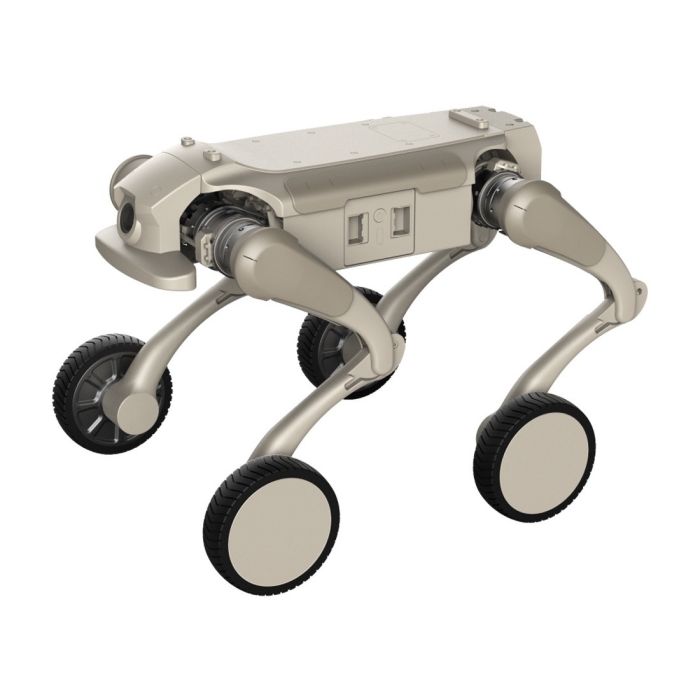
Most robot dogs walk everywhere, and most wheeled robots stop at the first kerb. The Genisom L1-W Ultra Compact Industrial Grade Wheeled Quadruped Robot Dog refuses that choice: it rolls where the floor is smooth and uses its legs where the ground is not. For teams that need a small mobile platform to cover distance quickly and still get over a step, a cable or a threshold, that combination is the whole point.
The product is available through this page, by quotation.
Background
The Genisom L1 family
Genisom builds quadruped robots, and the sources name four versions of its compact L1 line: the Genisom L1, the Genisom L1-W, the Genisom L1 EDU and the Genisom L1 Maker. The L1-W is the wheeled member of that family. Its letter W marks the feature that sets it apart from the walking versions, which is a wheel at the end of each leg.
Buyers sometimes read across from one version to another, and that is where mistakes start. The figures in this article belong to the L1-W only. Where a walking sibling is of interest, such as the Genisom L1 EDU Quadruped Robot, its specifications are handled separately in the quotation.
Wheel-foot design and open interfaces
The L1-W is a wheel-foot design that combines high-speed navigation with obstacle-crossing capability. In plain terms, each leg carries a drive wheel, so the robot can travel like a small wheeled vehicle and still lift and place its feet when something is in the way. It crosses obstacles 60cm high and reaches a maximum speed of 5.5m/s.
Beyond the chassis, the L1-W is built to be extended. It offers Ethernet, USB, SBUS, UART and power interfaces, and it comes with full SDK access that opens up motion, video stream and status interfaces. It supports high-compute boards, perception modules, positioning modules and 4G modules. That makes it a platform for your own payload and software, not a closed appliance. If you want to compare it with other machines of its kind, the Wheeled Quadrupeds category is the place to look.
Technical Specifications
| Specification | Genisom L1-W |
|---|---|
| Locomotion | Wheel-foot design |
| Obstacle crossing height | 60cm |
| Maximum speed | 5.5m/s |
| Standing size (L×W×H) | ~63 × 44 × 45.5 cm |
| Prone size (L×W×H) | ~69 × 58 × 14.5 cm |
| Weight (with battery) | ~20 kg |
| Battery capacity | 5Ah, 43.2V |
| Runtime | 1-2 hours |
| Range | 9 km |
| Continuous payload | ~10 kg (limit ~12 kg) |
| Stair-climbing height | >16 cm |
| Slope capability | Standard 30°, limit 40° |
| Operating temperature | 0°C – 40°C (limit -20°C – 50°C) |
| Protection rating | IP54 |
| Expansion interfaces | Ethernet, USB, SBUS, UART, Power |
| SDK | Full SDK access with open motion, video stream and status interfaces |
| Supported expansion modules | High-compute boards, perception modules, positioning modules, 4G modules |
Specifications as published by the manufacturer; confirmed against the datasheet at quotation.
The manufacturer has not published the battery charging time, the contents of the box or the onboard compute; they are confirmed at quotation.
What makes the L1-W different from a walking-only robot dog?
A walking quadruped spends energy on every step, even across a flat warehouse floor. The L1-W moves on wheels across smooth ground, which is how it reaches a top speed of 5.5m/s alongside a range of 9 km. Legs then step in only when the route demands it. For a patrol that is mostly corridor and occasionally obstacle, this is a sensible split of work.
The obstacle figure matters just as much. The L1-W crosses obstacles 60cm high, and its stair-climbing height is more than 16 cm. A purely wheeled robot of similar size would be stopped by a step of that kind. The trade-off is weight and complexity: at about 20 kg with battery, the L1-W is a machine you plan for, not one you toss in a car boot without thought.
The L1-W also has a different answer to the question of what comes next. Because it opens motion, video stream and status interfaces through its SDK, a research group or an integrator can write its own behavior on top of it.
How does the L1-W cope with slopes, weather and long shifts?
On slopes, the standard capability is 30°, with a limit of 40°. The operating temperature is 0°C – 40°C as standard, with a limit of -20°C – 50°C. For a region with heat and humidity, it is the upper end of those ranges you should check against your site, and the IP54 protection rating tells you what to expect from dust and splashing water. It is not a rating for submersion or hard jets, so plan routes accordingly.
On the battery side, the pack is 5Ah at 43.2V, and the runtime is 1-2 hours. That is a realistic figure for a compact robot carrying a load, and it means a working day calls for a plan: spare packs, a charging point on the route, or shorter missions.
Payload follows the same logic. Continuous payload is about 10 kg, with a limit of about 12 kg. A sensor head, a compute board and a 4G module fit comfortably within that class; a heavy tool does not. Anything you add also draws on the battery, so the runtime figure is a starting point and not a promise for every configuration.
Who is the Genisom L1-W for?
Integrators and system builders are the first group. The Ethernet, USB, SBUS, UART and power interfaces, together with the SDK, let them mount their own hardware and write their own control software. A wheeled base that can also cross a 60cm obstacle gives them a flexible chassis for inspection and monitoring projects.
Universities and research labs are the second. A compact robot that moves quickly, steps over obstacles and exposes its motion, video and status data is useful for work on navigation, perception and remote operation. If your focus is teaching and a classroom setting, ask about the Genisom L1-W EDU Wheeled Quadruped Robot and the Genisom L1-W EDU RoamerX Pro Wheeled Quadruped Robot, and compare them with this version in your quotation.
Facility and utility operators are the third group. Plants, campuses, warehouses and outdoor sites often need repeatable rounds over mixed surfaces. The L1-W suits routes of paved and indoor floor with the odd step or threshold, provided the load and the weather stay inside the figures above. Where the job calls for heavier carrying, tell us about it when you request your quotation.
What is the Genisom L1-W used for?
- Site inspection. Carry cameras or sensors along a fixed route and send the video stream back to an operator.
- Patrol and monitoring. Cover corridors, yards and perimeters quickly on wheels, then step over cables and kerbs.
- Research and development. Use the SDK to test motion control, perception and navigation on a real mobile platform.
- Payload carrying. Move light equipment or instruments within the continuous payload class.
- Remote connectivity projects. Add a 4G module and a positioning module to operate and track the robot beyond local networks.
- Custom integration. Fit high-compute boards or perception modules through the expansion interfaces to build a purpose-made machine.
Pricing and Availability
We do not print a price on this page, because the right configuration depends on how you plan to use the robot. Ask for a quotation and tell us your site, your payload and your timetable. Delivery, customs and support are arranged with the quotation, so you see the full picture before you commit. The Genisom L1-W is available on this page.
Frequently Asked Questions
How fast is the Genisom L1-W?
The maximum speed is 5.5m/s. Actual working speed depends on the surface, the load and the route.
What obstacles can it cross?
It crosses obstacles 60cm high. Stair-climbing height is more than 16 cm, and slope capability is 30° as standard with a limit of 40°.
How long does the battery last?
The battery is 5Ah at 43.2V, with a runtime of 1-2 hours and a range of 9 km.
How much can it carry?
The continuous payload is about 10 kg, with a limit of about 12 kg. Added modules count toward that load.
Can I connect my own hardware and software?
Yes. It has Ethernet, USB, SBUS, UART and power interfaces, and full SDK access with open motion, video stream and status interfaces. It supports high-compute boards, perception modules, positioning modules and 4G modules.
Is it protected against dust and water?
The protection rating is IP54. The standard operating temperature is 0°C – 40°C, with a limit of -20°C – 50°C.
Where can I buy the Genisom L1-W and what does it cost?
You can request it through this page. The cost is given in a quotation that also covers delivery, customs and support, and no price is shown here.
Summary
The Genisom L1-W answers a simple question: what if a robot dog could roll when the floor is easy and step when it is not? With a 5.5m/s top speed, a 60cm obstacle crossing ability, a continuous payload of about 10 kg and open interfaces, it is a practical base for inspection, research and custom integration. Its limits are equally clear: a 1-2 hour runtime, an IP54 rating and a weight of about 20 kg. If those figures fit your project, this page is the starting point.


