
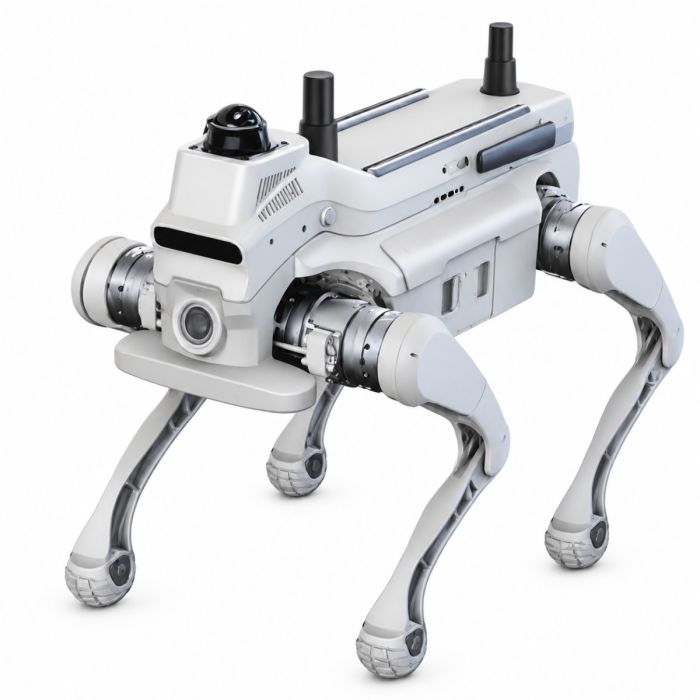
Genisom L1 EDU Quadruped Robot
In stock
- BRAND:
- GENISOM
- MODEL:
- L1 EDU
- ORIGIN:
- China
- AVAILABILITY:
- SUBJECT TO AVAILABILITY
- SKU:
- Genisom-L1-EDU
Genisom L1 EDU Quadruped Robot
Most robot dogs are bought to be watched; the Genisom L1 EDU Quadruped Robot is bought to be worked on. It is a legged research platform that arrives with the computing, the sensing and the connectivity a laboratory would otherwise spend months assembling, so the first day can go to algorithms instead of cabling.
The product is available through this page, by quotation.
Background
The company behind the L1 line
GENISOM AI is a Beijing-based full-stack embodied AI company. It develops and manufactures quadruped robots, humanoid robots, robotic joint modules and embodied intelligence technologies. That breadth matters to a buyer, because a legged robot is only as good as its joints, and this maker builds its own joint modules rather than buying them in.
The L1 family reflects that approach. The standard Genisom L1 is described with 12 fully self-developed high power density joint modules. The family also includes the Genisom L1 EDU, the wheeled Genisom L1-W and the Genisom L1 Maker. The EDU version is the one aimed at research and teaching.
Where the L1 EDU sits in the range
The Genisom L1 EDU is designed as a research and secondary-development platform for SLAM, autonomous navigation and embodied AI applications. Where a standard robot dog is a finished product to operate, the EDU is a starting point to build on. It supports SLAM, 3D mapping and open-source development, which makes it relevant for universities, laboratories and developers exploring robotics applications.
Its computing platform is NVIDIA Orin NX, providing up to 100 TOPS. Around it sits a highly integrated sensor set: a built-in 3D laser radar, a depth camera, a GNSS satellite positioning module and a 5G communication module. Together they let the robot fuse visible light, depth vision and laser point cloud into a triple perception of its surroundings. On the research and development side, the sources name the combination as NVIDIA Jetson Orin NX computing with Livox Mid-360 lidar, RealSense depth cameras, GNSS and 5G connectivity.
Technical Specifications
| Specification | Value | Version |
|---|---|---|
| Computing platform | NVIDIA Orin NX, up to 100 TOPS | L1 EDU |
| Lidar | Built-in 3D laser radar (Livox Mid-360) | L1 EDU |
| Vision | Depth camera (RealSense) | L1 EDU |
| Positioning | GNSS satellite positioning module | L1 EDU |
| Communication | 5G communication module | L1 EDU |
| Joint modules | 12 fully self-developed high power density modules | L1 |
| Peak torque | 48N·m | L1 |
| Protection level | IP54 | L1 |
| Operating temperature | 0-40℃ | L1 |
| Motion control | Built-in AI reinforcement learning algorithm | L1 |
| Hardware interfaces | Ethernet, USB 3.0/2.0, 24V/12V power supply, etc. | L1 |
| SDK | Motion interface, video stream interface and status interface; full software SDK openness | L1 |
| Expansion modules | High-performance computing cards, perception modules, positioning modules, 4G modules, long-range image transmission modules, etc. | L1 |
| Target tracking | High-definition camera with AI monocular vision perception model | L1 |
Specifications as published by the manufacturer; confirmed against the datasheet at quotation.
The manufacturer has not published the dimensions, the weight of the EDU version, the battery capacity, the battery life of the EDU version, the maximum speed of the EDU version, the package contents, the remote controller or the software and operating system details; they are confirmed at quotation.
What makes the Genisom L1 EDU different from the standard L1?
The difference is mainly in what the machine is meant to do. The standard L1 is presented through its body and its motion: self-developed joint modules, a peak torque of 48N·m, an IP54 protection level and a built-in AI reinforcement learning algorithm for handling complex terrain. The EDU is presented through its perception and computing: NVIDIA Orin NX with up to 100 TOPS, a 3D laser radar, a depth camera, GNSS and 5G, all built in.
For a research group, that changes the workload. Mapping, localization and navigation experiments need a lidar, a depth camera and a capable onboard computer before the first test can run. On the EDU these come as part of one integrated design. The sources name the Livox Mid-360 lidar and RealSense depth cameras, both widely used in robotics research, which means existing code, tutorials and habits carry over more easily.
The standard L1 body also offers a way to extend the robot. Its listed expansion options include high-performance computing cards, perception modules, positioning modules, 4G modules and long-range image transmission modules. Its SDK offers a motion interface, a video stream interface and a status interface, with full software SDK openness. These figures are published for the L1, so please confirm with us how they apply to the EDU configuration you have in mind.
Why does the IROS 2025 result matter for the L1 EDU?
A University of Manchester team won first place in the IROS 2025 Quadruped Robot Challenge using the GENISOM L1 EDU. A competition is not a sales brochure. It sets a task, a deadline and rivals, and it exposes weak points in hardware and software quickly. A first-place result on this platform shows that it can serve as the base for demanding work, not only for classroom demonstrations.
For a buyer, the lesson is practical. A team that wins with a platform spends its time on its own algorithms. That is the promise of an integrated research robot: the sensing, computing and connectivity are already settled, so the effort goes into the part that is new.
Who is the Genisom L1 EDU for?
The EDU suits universities that want a teaching and research robot for courses and graduate projects in SLAM, autonomous navigation and embodied AI. Because it supports open-source development, students can work with tools they will meet again in industry and research.
It suits laboratories that need a legged base for experiments in perception and mapping. The combination of lidar, depth camera and GNSS covers indoor and outdoor work, and the 5G module opens the way to remote operation and data transfer.
It suits developers and small teams building secondary-development projects. They get a computing platform that is powerful enough for onboard learning-based methods without having to design a payload from scratch.
Some buyers will need a different configuration. If your project calls for wheels, the Genisom L1-W EDU Wheeled Quadruped Robot and the Genisom L1-W EDU RoamerX Pro Wheeled Quadruped Robot are listed as separate versions. If you want to compare against a higher-tier EDU package, see the Genisom L1 EDU RoamerX Pro Quadruped Robot. For the wider family, the GENISOM AI GangBeng L1 Series Bionic Quadruped Robot page is a good place to start. Our team can help you choose.
What is the Genisom L1 EDU used for?
- SLAM research: build and test simultaneous localization and mapping methods with lidar and depth camera data from one moving platform.
- 3D mapping: capture environments as laser point clouds and combine them with depth vision for detailed spatial models.
- Autonomous navigation: develop and test route planning and obstacle avoidance on a legged robot with satellite positioning for outdoor work.
- Embodied AI experiments: run learning-based perception and decision methods on the onboard NVIDIA Orin NX computing platform.
- University teaching: give students hands-on experience with a real legged robot in courses on robotics, perception and control.
- Secondary development: extend the robot with your own software, drawing on its open-source support and the interfaces published for the L1.
Pricing and Availability
We do not print prices on this page. Every Genisom L1 EDU is quoted to order, because the configuration, the intended use and the destination all shape the offer. Delivery, customs and support are arranged together with the quotation, so you have one point of contact from the first question to the handover. To begin, send us your requirements and the Genisom L1 EDU Quadruped Robot is available on this page.
Frequently Asked Questions
What computing platform does the Genisom L1 EDU use?
It is equipped with NVIDIA Orin NX, providing up to 100 TOPS of computing power. This is the platform for onboard perception, mapping and navigation work.
Which sensors are built in?
The EDU has a built-in 3D laser radar, a depth camera, a GNSS satellite positioning module and a 5G communication module. The sources name the Livox Mid-360 lidar and RealSense depth cameras.
Is the platform open for my own software?
Yes. The L1 EDU supports SLAM, 3D mapping and open-source development. For the L1, the SDK offers a motion interface, a video stream interface and a status interface, with full software SDK openness.
How tough is the robot?
For the standard L1, the published protection level is IP54 and the operating temperature is 0-40℃. Please ask us how this applies to the EDU version you plan to order.
Can I add modules?
For the L1, the listed expansion options include high-performance computing cards, perception modules, positioning modules, 4G modules and long-range image transmission modules. Standard interfaces include Ethernet, USB 3.0/2.0 and 24V/12V power supply.
Has the L1 EDU been proven in competition?
Yes. A University of Manchester team won first place in the IROS 2025 Quadruped Robot Challenge using the GENISOM L1 EDU.
Where can I buy the Genisom L1 EDU Quadruped Robot and what does it cost?
It is available through this page, by quotation. Send us your request and we will prepare an offer, with delivery, customs and support arranged alongside it.
Summary
The Genisom L1 EDU Quadruped Robot is a robot dog meant to be worked on rather than watched. It combines NVIDIA Orin NX computing with up to 100 TOPS, a built-in 3D laser radar, a depth camera, GNSS and 5G, and it supports SLAM, 3D mapping and open-source development. A first-place result at the IROS 2025 Quadruped Robot Challenge shows what a team can do with it. For related equipment, see our Research Robots category. If you are planning research, teaching or development on a legged platform, this page is the starting point.