
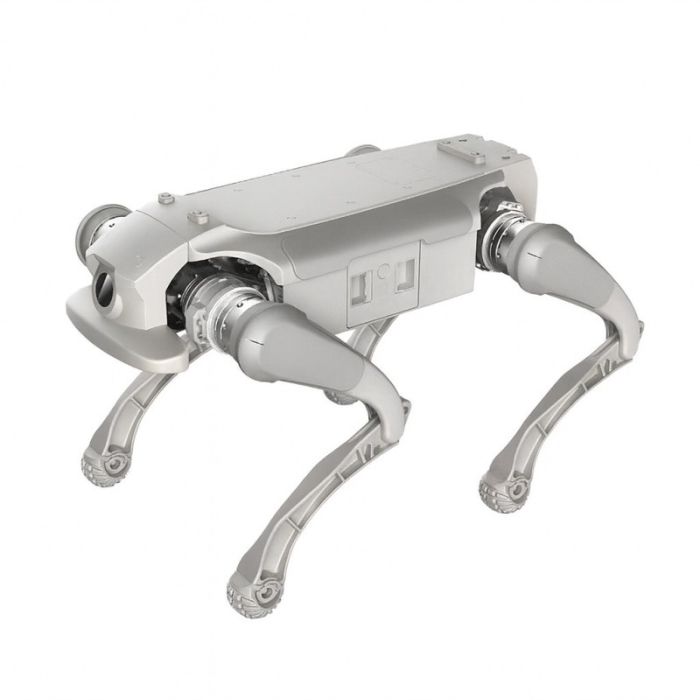
GENISOM AI GangBeng L1 Series Bionic Quadruped Robot
In stock
- BRAND:
- GENISOM
- PART #:
- L1
- ORIGIN:
- China
- AVAILABILITY:
- SUBJECT TO AVAILABILITY
- SKU:
- Genisom-L1
GENISOM AI GangBeng L1 Series Bionic Quadruped Robot
Most robots are built for the factory floor, and the floor is rarely where the work is. The GENISOM AI GangBeng L1 Series Bionic Quadruped Robot goes where wheels struggle: stairs, slopes, uneven yards and tight corners. It does this in a compact four-legged body with open software and hardware, so a team can make it their own.
The product is available through this page, by quotation.
Background
The company and its lineage
GENISOM builds legged robots, and the L1 is the compact machine in its quadruped line. The same family includes the L1 EDU, the wheeled L1-W and the L1 Maker. Each version is aimed at a slightly different kind of buyer, from a field team to a university lab.
The record shows that this is not a laboratory curiosity. By late December 2025 the company had reached 5,000 mass-production deliveries. For a buyer in the Caribbean, that matters in a practical way. A robot that is made in volume tends to come with a more settled design, and a settled design is easier to support, to train staff on and to plan a project around.
The L1 is also built around a clear idea of what a small legged robot should be. It should be light enough for one or two people to handle, yet strong enough to carry real equipment. It should also be open enough that engineers are not locked out of their own machine.
Positioning and key technology
The heart of the L1 is its set of 12 fully self-developed, high power density joint modules. Together they deliver 48N·m of peak torque, and they need no calibration, which makes it easier to unlock additional special moves. For a team that wants to start working rather than tuning, that is a welcome detail.
The joints are made from a self-developed Kirin alloy. It is a triple breakthrough of lightweight, high load and strong durability, and the overall power output approaches the level of large four-legged robots. That is the L1's central bargain: a small body that behaves like a bigger one.
For perception, the robot carries a high-definition camera and an AI monocular vision perception model. It can identify and track targets. It also supports heterogeneous collaboration with drones, which creates a cooperative system from air to ground and from mobility to operation. Instead of one machine doing every job alone, a drone can survey from above while the L1 works on the ground.
Openness is the other pillar. The software SDK is fully open, with a motion interface, a video stream interface and a status interface. On the hardware side, the standard interfaces include Ethernet, USB 3.0/2.0 and 24V/12V power supply, among others. Expansion modules include high-performance computing cards, perception modules, positioning modules, 4G modules and long-range image transmission modules.
Technical Specifications
| Specification | Value |
|---|---|
| Standing size (L×W×H), L1 | ~63 × 36 × 41.5 cm |
| Weight with battery, L1 | ~15 kg |
| Battery, L1 | 5Ah, 43.2V |
| Runtime, L1 | 1‑2 hours |
| Range, L1 | 6 km |
| Max speed, L1 | 3.7 m/s (limit 5 m/s) |
| Slope capability, L1 | Standard 30°, limit 40° |
| Continuous payload, L1 | ~8 kg (limit ~10 kg) |
| Stair-climbing height, L1 | >16 cm |
| Protection level | IP54 |
| Operating temperature | 0-40℃ |
| Joint modules | 12, with 48N·m peak torque |
| Computing, L1 EDU | NVIDIA Orin NX, up to 100 TOPS |
| Interfaces | Ethernet, USB 3.0/2.0, 24V/12V power supply, etc. |
Specifications as published by the manufacturer; confirmed against the datasheet at quotation.
The manufacturer has not published the charging time, the contents of the box, the noise level, the wireless connectivity or the camera resolution; they are confirmed at quotation.
What makes the L1 different from a wheeled robot?
A wheeled platform is hard to beat on a smooth, flat surface. The trouble is that real sites are seldom smooth or flat. The L1 is built with legs so that it can climb stairs taller than 16 cm, take a standard slope of 30° and, at its limit, a slope of 40°. Those are the places where an inspection route usually ends for a wheeled robot.
The L1 also carries a useful load. Its continuous payload is about 8 kg, with a limit of about 10 kg, so a sensor head, a camera or a small module can ride along without the robot losing its footing. Its body is rated IP54 and works across 0-40℃, which suits outdoor summer use, high-temperature factories and cold nights.
If your route is mostly flat and you want wheels on part of it, the range also includes the wheeled Genisom L1-W EDU Wheeled Quadruped Robot. We would suggest asking about it when you request your quotation.
What does the EDU version add?
The L1 EDU adds computing power. It is equipped with an NVIDIA Orin NX, providing up to 100 TOPS. That is the figure to look at if your work involves running perception or learning models on the robot itself, rather than sending data elsewhere.
Combined with the open SDK and the expansion modules, it gives a lab or a development team a base to build on. You can read more on the Genisom L1 EDU Quadruped Robot page. Note that the 100 TOPS figure belongs to the EDU version only, and we do not give it to the standard L1.
Who is the L1 for?
The first group is inspection and patrol teams. Think of facilities, plants and yards where a person would otherwise walk the same route again and again, in heat or at night. The L1's climbing ability and its target identification and tracking suit that kind of routine.
The second group is schools, universities and research labs. The open interfaces and the expansion options let students and engineers work on motion, vision and autonomy with a real machine. Our Research Robots category shows other platforms for this kind of work. If computing is the priority, the L1 EDU is the better fit.
The third group is organizations working in difficult or hazardous conditions. A small legged robot can go ahead of people and report back by video. See our Emergency Response category for related equipment. Teams that want a drone working together with a ground robot should note that the L1 supports heterogeneous collaboration with drones.
What is the L1 used for?
- Inspection rounds. Walk a set route, stream video and report status through the open interfaces.
- Security patrol. Cover grounds and corridors, including at night, and track targets with the vision model.
- Teaching. Give students a working legged robot to program and study.
- Research. Test motion control, perception and autonomy on an open platform.
- Air-ground teamwork. Pair the robot with a drone so one machine surveys while the other works on the ground.
- Payload carrying. Carry sensors or modules, such as a positioning module or a 4G module, to where they are needed.
Pricing and Availability
We do not print prices on this page. A quotation is the next step, and it lets us match the version, the modules and the quantity to what you need. Delivery, customs and support are arranged with the quotation, so you know the whole picture before you decide. The GENISOM AI GangBeng L1 Series Bionic Quadruped Robot is available on this page.
Frequently Asked Questions
How long does the L1 run on a charge?
The runtime is 1‑2 hours, and the range is 6 km. The battery is 5Ah, 43.2V.
Can the L1 work outdoors?
Yes. It has an IP54 protection level and an operating temperature of 0-40℃, which suits outdoor summer use, high-temperature factories and cold nights.
What can it carry?
The continuous payload is about 8 kg, with a limit of about 10 kg. It weighs about 15 kg with its battery.
Can we program it ourselves?
Yes. The software SDK is fully open, with motion, video stream and status interfaces. Ethernet, USB 3.0/2.0 and 24V/12V power supply are also available as standard interfaces.
Which version suits development work?
The L1 EDU carries an NVIDIA Orin NX with up to 100 TOPS, which suits perception and learning work on the robot. The L1 Maker is also among the versions; ask us about it when you request a quotation.
Does it work with drones?
It supports heterogeneous collaboration with drones. This creates a cooperative system from air to ground.
Where can I buy the L1 and what does it cost?
You can request a quotation on this page. We do not publish a price here; the cost depends on the version and the options, and it is given with the quotation.
Summary
The L1 answers a simple question: what if a small robot could go where the work actually is? Twelve self-developed joint modules, a Kirin alloy body, IP54 protection, stair and slope capability, and an open SDK make it a practical tool for inspection, teaching and research. The EDU version adds computing power for those who need it. If it fits your project, this page is the starting point.


