
Genisom L1 EDU RoamerX Pro Quadruped Robot
In stock
- BRAND:
- GENISOM
- MODEL:
- L1 EDU RoamerX Pro
- ORIGIN:
- China
- AVAILABILITY:
- SUBJECT TO AVAILABILITY
- SKU:
- Genisom-L1-EDU-RoamerX-Pro
Buy now, pay later
Genisom L1 EDU RoamerX Pro Quadruped Robot
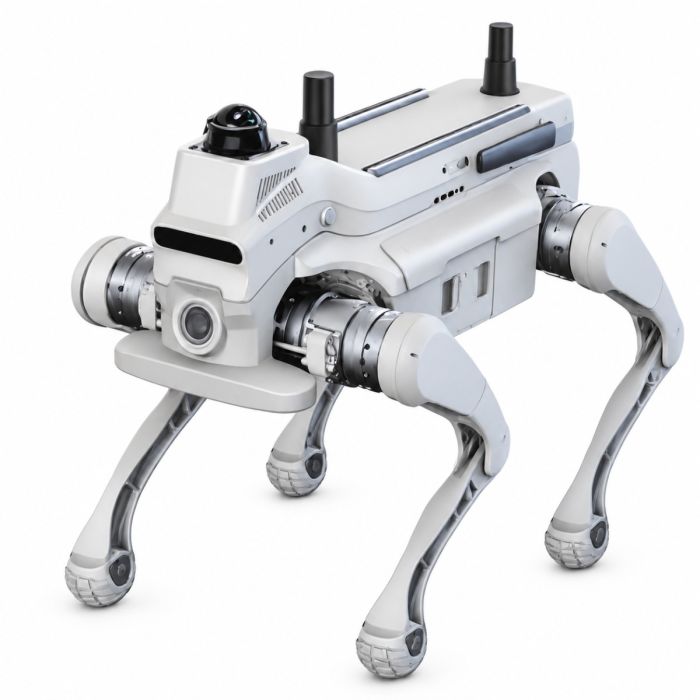
Most robot dogs are built to impress on a stage; a research robot has to earn its keep in a lab, on a campus and in the field. The Genisom L1 EDU RoamerX Pro Quadruped Robot belongs to the second group: a four-legged platform that carries its own computer, lidar, depth camera, satellite positioning and 5G link, so a team can start on perception and navigation work instead of bolting hardware together.
The product is available through this page, by quotation.
Background
GENISOM AI and the L1 family
GENISOM AI is a robotics company from China, founded in 2023. Its L1 line of quadruped robots comes in several versions: the Genisom L1, the Genisom L1 EDU, the wheeled Genisom L1-W and the Genisom L1 Maker. The standard L1 is the base platform, and the EDU version builds on it for research and teaching.
If you want to compare neighbors in the family, the Genisom L1 EDU Quadruped Robot is the sibling listing for the EDU edition, and the GENISOM AI GangBeng L1 Series Bionic Quadruped Robot presents the series from the industrial side. Buyers who need wheels as well as legs can look at the Genisom L1-W EDU RoamerX Pro Wheeled Quadruped Robot.
Positioning and key technology
The EDU version is built around NVIDIA Orin NX, which provides up to 100 TOPS of computing power. Its sensing is highly integrated: a 3D laser radar, a depth camera, a GNSS satellite positioning module and a 5G communication module are built in. Together they allow visible light, depth vision and laser point cloud perception to be fused into one picture of the surroundings.
The lidar is a Livox Mid-360 and the depth cameras are RealSense, working with NVIDIA Jetson Orin NX computing. The EDU version is designed to support simultaneous localization and mapping (SLAM), 3D reconstruction, autonomous navigation research and open-source development workflows. It sits in our Research Robots category for that reason.
Underneath is the L1 platform. It has a built-in AI reinforcement learning algorithm for motion control, which gives the robot its adaptability on complex terrain. It uses 12 fully self-developed high power density joint modules with no calibration required.
Technical Specifications
The table keeps each figure with the version it belongs to. The L1 column describes the standard Genisom L1; the L1 EDU column describes the research edition. A dash means the version has no entry on that line.
| Specification | Genisom L1 | Genisom L1 EDU |
|---|---|---|
| Onboard compute | — | NVIDIA Orin NX, up to 100 TOPS |
| Built-in sensing and communication | — | 3D laser radar, depth camera, GNSS satellite positioning module, 5G communication module |
| Lidar and depth camera | — | Livox Mid-360 lidar, RealSense depth cameras |
| Motion control | Built-in AI reinforcement learning algorithm | — |
| Joint modules | 12 self-developed modules, 48N·m peak torque | — |
| Continuous walking load | 8kg | — |
| Step climbing | 16cm steps, continuous climbing | — |
| Maximum climbing angle | 40° | — |
| Protection level | IP54 | — |
| Operating temperature | 0-40℃ | — |
| SDK | Motion interface, video stream interface and status interface; full software SDK openness | — |
| Standing dimensions (L×W×H) | ~63 × 36 × 41.5 cm | — |
| Weight (with battery) | ~15 kg | — |
| Battery capacity | 5Ah, 43.2V | — |
| Maximum speed | 3.7 m/s (limit 5 m/s) | — |
Specifications as published by the manufacturer; confirmed against the datasheet at quotation.
The manufacturer has not published the weight, the dimensions, the battery capacity, the runtime, the maximum speed or the payload of the EDU version, nor the contents of the box, the operating system or the wireless standards; they are confirmed at quotation.
What makes the L1 EDU different from the standard L1?
The standard L1 is a capable legged platform: it climbs 16cm steps continuously, handles a 40° climbing angle, walks with an 8kg load and carries an IP54 protection level. It also has a high-definition camera with an AI monocular vision model that identifies and tracks targets. It is an excellent base for general work.
The EDU version turns that base into a research instrument. It adds the NVIDIA Orin NX computer with up to 100 TOPS and the full sensor set of lidar, depth camera, GNSS and 5G. That is the equipment a team needs to run mapping, 3D reconstruction and navigation experiments without first assembling a sensor rig.
There is also a competition result to consider. A University of Manchester team won first place at the IROS 2025 Quadruped Robot Challenge using a GENISOM L1 EDU platform. For a university lab, that shows the platform has been used in a demanding setting.
What does the RoamerX Pro version add?
The RoamerX Pro name marks the configuration listed on this page. The contents of its software package are set out in your quotation.
What we can say is how the platform is meant to be extended. The L1 offers a motion interface, a video stream interface and a status interface, with full software SDK openness. Expansion options include high-performance computing cards, perception modules, positioning modules, 4G modules and long-range image transmission modules. A team can therefore grow the robot as its project grows.
Who is the Genisom L1 EDU RoamerX Pro for?
Universities and research institutes are the first audience. Robotics courses and graduate projects need a platform that can run SLAM and navigation research on real terrain, and students can work with open-source tools on it.
Development teams in companies are the second. If you are building an autonomy stack, a mapping service or an inspection concept, you need compute and sensing on the robot itself, and the EDU version supplies both.
Competition teams are the third, given the IROS 2025 result mentioned above. Training centers and technical colleges across the region can also use it to give learners hands-on time with a legged robot.
If your work needs wheels combined with legs, compare the Genisom L1-W EDU Wheeled Quadruped Robot. If you do not need the research sensor set, the standard line may be enough.
What is the Genisom L1 EDU RoamerX Pro used for?
- SLAM research: build and test simultaneous localization and mapping with lidar, depth and visible light data.
- 3D reconstruction: capture the laser point cloud and depth imagery of a site and rebuild it in three dimensions.
- Autonomous navigation studies: develop and test navigation methods on a legged platform that moves over uneven ground.
- Open-source development: connect your own code and tools through the motion, video stream and status interfaces.
- Teaching and student projects: give classes a real quadruped with an onboard computer and a full sensor set.
- Robotics competitions: prepare a team for challenge events that test mobility and navigation.
Pricing and Availability
We do not print prices on the product page. Please ask for a quotation, and tell us your intended use, your quantity and your destination. Delivery, customs and support are arranged with the quotation. The Genisom L1 EDU RoamerX Pro Quadruped Robot is available on this page.
Frequently Asked Questions
What computer does the L1 EDU carry?
It is equipped with NVIDIA Orin NX, which provides up to 100 TOPS of computing power.
Which sensors are built in?
The EDU version has a 3D laser radar, a depth camera, a GNSS satellite positioning module and a 5G communication module. They are a Livox Mid-360 lidar and RealSense depth cameras.
What research is it designed for?
It is designed to support SLAM, 3D reconstruction, autonomous navigation research and open-source development workflows.
Can I develop my own software for it?
Yes. The L1 platform offers a motion interface, a video stream interface and a status interface, with full software SDK openness.
Can the robot be expanded?
The L1 platform supports high-performance computing cards, perception modules, positioning modules, 4G modules and long-range image transmission modules.
What are the weight, battery and speed of the EDU version?
Ask us when you request a quotation and we will give you the EDU figures. For the standard L1, a reseller listing gives about 15 kg, a 5Ah, 43.2V battery and a maximum speed of 3.7 m/s.
Where can I buy the Genisom L1 EDU RoamerX Pro Quadruped Robot and what does it cost?
You can request it through this page, and we answer with a quotation. The cost depends on configuration, quantity and destination, so no price is printed here.
Summary
A research robot is only useful when it arrives ready to work. The L1 EDU RoamerX Pro combines an NVIDIA Orin NX computer with up to 100 TOPS, lidar, depth camera, GNSS and 5G, all on the legged L1 platform, and it has been used by a winning team at IROS 2025. For a lab or development team in the Caribbean that wants to start on mapping and navigation, this page is the starting point.