
Deep Robotics LYNX M20 Omni Terrain Industrial Wheeled Quadruped Robot Dog
In stock
- BRAND:
- DEEP ROBOTICS
- MODEL:
- LYNX M20
- ORIGIN:
- China
- AVAILABILITY:
- ALLOW 2-4 WEEKS FOR DELIVERY
- SKU:
- Deep-Robotics-LYNX-M20
Deep Robotics LYNX M20 Omni Terrain Industrial Wheeled Quadruped Robot Dog
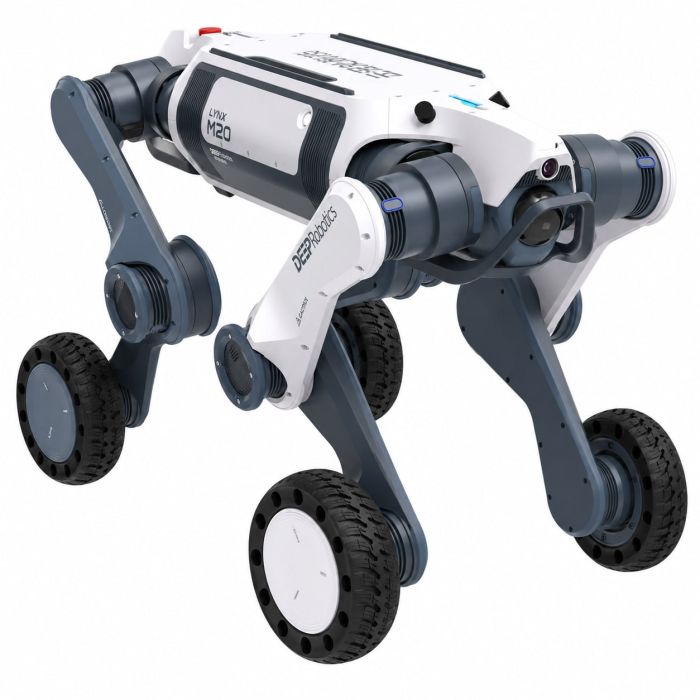
Every site walk ends at the same place: a staircase, a pipe run or a hatch that a wheeled cart cannot cross and a person should not have to enter alone. The Deep Robotics LYNX M20 Omni Terrain Industrial Wheeled Quadruped Robot Dog is built for that moment. It rolls across open ground, then changes its posture and steps over what stands in the way.
The product is available through this page, by quotation.
Background
DEEP Robotics and the LYNX line
DEEP Robotics develops legged robots for industrial work. The LYNX family is its wheeled-legged line, and the manufacturer describes the LYNX M20 series as the world's first wheeled-legged robot built specifically for challenging terrains and hazardous environments during industrial operation. The same line includes the Deep Robotics LYNX M20 Pro Omni Terrain EDU Wheeled Quadruped Robot Dog and the Deep Robotics LYNX M20S Omni Terrain Industrial Wheeled Quadruped Robot Dog. You can compare this robot with other machines of its kind in our Wheeled Quadrupeds category.
The LYNX M20 is the mid-size model. The manufacturer says this form balances mobility in narrow spaces, with 50 cm of clearance, against payload and endurance, and that this balance suits harsh industrial demands.
Wheels and legs in one platform
A classic quadruped robot dog walks on its feet. A wheeled vehicle rolls. The LYNX M20 does both. Its articulated joints allow seamless leg-mode switching, for example a front-elbow and rear-knee posture, so the robot can adapt its stance to the obstacle in front of it. According to the manufacturer, this lets it climb 25 cm stairs, move through tunnels and pipelines, and bridge the gap between manual labor and heavy machinery.
Perception is built around dual 96-line LiDAR units and dual wide-angle cameras. Two industrial processors handle the computing. Together they support omnidirectional obstacle avoidance and a point-cloud surround view of the robot's environment.
Technical Specifications
| Specification | Value |
|---|---|
| Standing dimensions | 820 × 430 × 570 mm |
| Weight (with battery) | 33 kg |
| Payload capacity | 15 kg |
| Maximum load capacity | 50 kg |
| Unloaded endurance and range | 3 h / 15 km |
| Loaded endurance and range (15 kg) | 2.5 h / 12 km |
| Charging time (single battery) | 1.5 h |
| Maximum speed (lab-tested) | 5 m/s |
| Safe operational speed | 2 m/s |
| Maximum continuous stair height | 25 cm |
| Maximum single-step height | 80 cm |
| Maximum slope | 45° |
| Narrow-space clearance | 50 cm |
| Computing power | Dual octa-core 64-bit industrial processors (16 GB + 128 GB) × 2 |
| LiDAR | Dual 96-line units (360° × 90°, ~860,000 pts/s) |
| Cameras | Dual wide-angle cameras |
| Ingress protection | IP66 |
| Operating temperature | -20 °C to +55 °C |
| Electrical ports | 72 V power input, Gigabit Ethernet |
| Functional features | Omnidirectional obstacle avoidance, point-cloud surround view, front/rear bidirectional lighting, RF image transmission, OTA upgrades |
| Options | Self-charging and modular expansion (optional) |
Specifications as published by the manufacturer; confirmed against the datasheet at quotation.
The manufacturer has not published the battery capacity, the battery chemistry, the wheel size, the included accessories, the control software details, the payload mounting interface or the wireless connectivity standards; they are confirmed at quotation.
What makes the LYNX M20 different from a conventional quadruped robot dog?
The difference is how the robot spends its energy. A purely legged robot pays for every meter of flat ground with the effort of walking. The LYNX M20 carries wheels, so on firm ground it can cover distance at a lab-tested maximum of 5 m/s, while the safe operational speed is 2 m/s. When the route turns into stairs, a step or a pipe, the legs take over. The 25 cm continuous stair height, the 80 cm single-step height and the 45° maximum slope are the figures that show how far this goes.
It also carries more than most robots of this size. The payload capacity is 15 kg and the maximum load capacity is 50 kg. With the 15 kg payload, the robot runs 2.5 h over 12 km, against 3 h over 15 km unloaded. For an inspection team, those two numbers show how far a payload cuts into a working round.
How is the LYNX M20 prepared for harsh conditions?
Industrial sites rarely offer clean, comfortable conditions. The LYNX M20 is rated IP66 for ingress protection and operates from -20 °C to +55 °C. Front and rear bidirectional lighting lets it work where the light is poor, and RF image transmission sends the camera view back to the operator. Updates arrive over the air, so the software can be kept current without a trip back to the workshop.
For integration, the robot has a 72 V power input and a Gigabit Ethernet port. Self-charging and modular expansion are available as options. At 33 kg with the battery, one operator can handle the robot, which matters when it has to be carried to a site or lifted over an obstacle it cannot cross on its own.
Who is the LYNX M20 for?
Plant and facility operators will find the clearest use here: inspection rounds in tunnels, pipe galleries, utility corridors and yards where stairs and uneven ground break up a route. The 50 cm clearance suits tight spaces, and the sensors give a 360° view of the surroundings.
Emergency and safety teams can use the robot to look into places that are unsafe for people to enter. Our Emergency Response category shows other machines for this work. Research groups and integrators who want to add their own equipment can use the 72 V input, the Gigabit Ethernet port and the optional modular expansion as a starting point. Buyers who need a configuration aimed at education and research should look at the LYNX M20 Pro, and those who want to compare another industrial option can review the LYNX M20S.
What is the LYNX M20 used for?
- Industrial inspection. Routine rounds through plants, yards and utility spaces, with the cameras and LiDAR recording the route.
- Hazardous-environment work. Entering places where sending a person is risky, with the operator watching through RF image transmission.
- Tunnel and pipeline passage. Narrow routes, where the 50 cm clearance and the leg-mode switching come into play.
- Stair and step access. Reaching platforms, mezzanines and equipment rooms that wheeled carts cannot reach.
- Payload carriage. Carrying sensors or tools up to the 15 kg payload capacity over a working round.
- Mapping and research. Collecting point-cloud data and developing new applications over the Ethernet port and the modular expansion.
Pricing and Availability
We do not list a price for the LYNX M20 on this page. Please ask for a quotation, and tell us your site, your payload and the options you need. Delivery, customs and support are arranged together with the quotation. The Deep Robotics LYNX M20 Omni Terrain Industrial Wheeled Quadruped Robot Dog is available on this page.
Frequently Asked Questions
How heavy is the LYNX M20?
The manufacturer states 33 kg with the battery. That is light enough for one operator to handle.
How long does the LYNX M20 run on one charge?
Unloaded, it runs 3 h over 15 km. With a 15 kg payload, it runs 2.5 h over 12 km. A single battery charges in 1.5 h.
What obstacles can it climb?
It climbs continuous stairs up to 25 cm high, single steps up to 80 cm and slopes up to 45°.
Is the LYNX M20 weatherproof?
It carries an IP66 rating and operates from -20 °C to +55 °C.
What sensors does it carry?
It carries dual 96-line LiDAR units covering 360° × 90° at about 860,000 pts/s, plus dual wide-angle cameras. They support omnidirectional obstacle avoidance and a point-cloud surround view.
What is the difference between the LYNX M20, the M20 Pro and the M20S?
All three belong to the same line. The figures on this page apply to the LYNX M20 only; ask us for the details of the M20 Pro and the M20S when you request a quotation.
Where can I buy the LYNX M20 and what does it cost?
You can buy it through this page, by quotation. The cost depends on your configuration and options, so send us a request and we will reply with a quotation.
Summary
The LYNX M20 answers the problem of the staircase at the end of the corridor. It rolls where the ground is firm and steps where it is not, and it carries LiDAR, cameras and industrial computing the whole way. IP66 protection, a 15 kg payload and 2.5 h of loaded endurance make it a working tool for inspection and hazardous-environment work. If this fits your site, this page is the starting point.
Specifications
General
Physical
Performance
Computing
Sensors
Connectivity
Battery + Power
What's included
Downloads
Related Products
Out of stock