
Deep Robotics LYNX M20S Omni Terrain Industrial Wheeled Quadruped Robot Dog
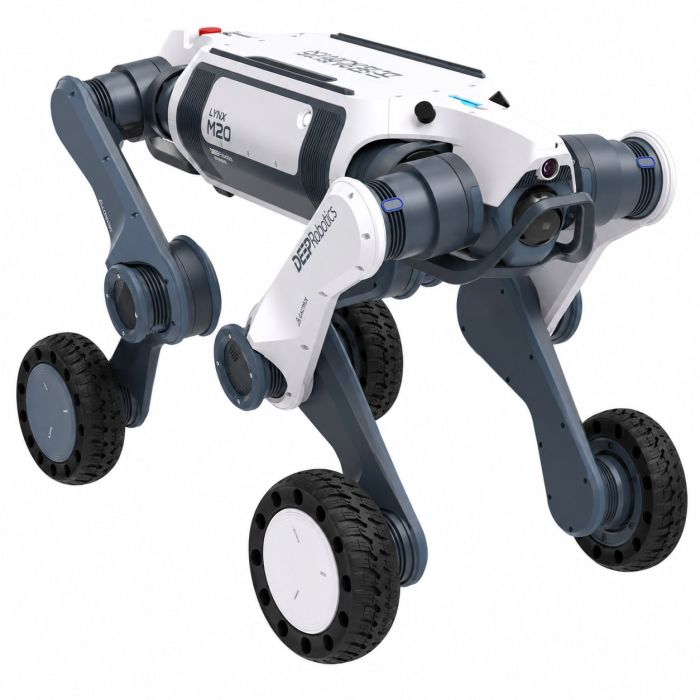
In stock
- BRAND:
- DEEP ROBOTICS
- MODEL:
- LYNX M20S
- ORIGIN:
- China
- AVAILABILITY:
- ALLOW 2-4 WEEKS FOR DELIVERY
- SKU:
- Deep-Robotics-LYNX-M20S
Deep Robotics LYNX M20S Omni Terrain Industrial Wheeled Quadruped Robot Dog
Rain on the access road, mud in the yard and a culvert that floods after every storm are the daily reality of outdoor industrial sites. The Deep Robotics LYNX M20S Omni Terrain Industrial Wheeled Quadruped Robot Dog is built for those conditions: sealed to IP67, rated to work from -30°C to 55°C, and able to roll across firm ground and then climb steps when the route demands it.
The product is available through this page, by quotation.
Background
DEEP Robotics and the LYNX M20 series
DEEP Robotics is a Chinese developer of quadruped and wheeled-legged robots for industrial work. The LYNX M20 series is described as the world's first wheeled-legged robot built for challenging terrains and hazardous environments during industrial operation. The series has three named versions: the LYNX M20, the LYNX M20 Pro and the LYNX M20S described on this page.
The idea behind the series is simple. A pure walking robot spends a lot of energy on ground that a wheel could cover easily. A pure wheeled vehicle stops at the first obstacle. Putting wheels at the ends of articulated legs gives one machine both behaviors.
Where the M20S sits in the line-up
The M20S is the version in this series with the heaviest-duty figures on the fact sheet: a maximum payload capacity of 100kg, a hot-swappable dual battery system and an IP67 rating. It also carries a full autonomy package. That package covers SLAM mapping and localization, autonomous navigation and omnidirectional obstacle avoidance. Autonomous charging is available as an option.
Sensing comes from two LiDAR units and two wide-angle cameras. Three octa-core 64-bit industrial processors handle the computing. The result is a robot meant to work on a site for a full shift rather than perform in a demonstration.
Technical Specifications
| Specification | Value |
|---|---|
| Dimensions (standing) | 820mm×430mm×570mm |
| Weight (with battery) | 36kg |
| Effective payload (standard terrain) | 36kg |
| Maximum payload capacity | 100kg |
| Continuous load capacity on flat terrain | 35kg |
| Operating time (no payload) | 3.5–5 hours |
| Range (no payload) | 16–20 km |
| Operating time (with payload) | 2.5–3.5 hours |
| Range (with payload) | 12–15 km |
| Single battery charging time | 1.5 hours |
| Max. tested speed | 9m/s |
| Max. operating speed | 2m/s |
| Max. stair height | 30cm |
| Max. single-step obstacle height | 100cm |
| Max. slope | 45° |
| Computing power | 3 × octa-core 64-bit industrial processors (16GB + 128GB) |
| LiDAR | ×2 (128 channels, 360° × 95°, ~1,152,000 pts/s) |
| Cameras | Wide-angle cameras ×2 |
| Ingress protection rating | IP67 |
| Immersion | Submersion in water up to 1 meter deep for 30 minutes |
| Operating temperature | -30°C to 55°C |
| Electrical interfaces | Power input (24V/72V), Gigabit Ethernet, USB 3.0 |
| Battery system | Hot-swappable dual battery system |
| Navigation and autonomy | SLAM mapping and localization; autonomous navigation; omnidirectional obstacle avoidance; autonomous charging (optional) |
| Communications and updates | RF image transmission; OTA upgrades |
Specifications as published by the manufacturer; confirmed against the datasheet at quotation.
The manufacturer has not published the battery capacity, the included accessories, the software development kit, the wheel specifications or any certifications other than the IP rating; they are confirmed at quotation.
What makes the LYNX M20S different from a conventional robot dog?
A conventional quadruped walks everywhere. That is impressive on rubble, but it is slow and costly in energy on a long, flat service road. The LYNX M20S rolls on its wheels when the ground is firm. It has a maximum operating speed of 2m/s and a maximum tested speed of 9m/s. Its articulated legs let it change posture for obstacles, so it can take stairs up to 30cm in height and single-step obstacles up to 100cm.
The endurance figures show what that buys you. With no payload the robot works 3.5–5 hours and covers 16–20 km. With payload the figures are 2.5–3.5 hours and 12–15 km. For a patrol or inspection round, that is a meaningful distance on a single charge.
The hot-swappable dual battery system matters just as much. A single battery charges in 1.5 hours, and because the batteries can be swapped hot, a team can keep the robot working instead of waiting beside a charger. Where autonomous charging is fitted as the option, the robot can also return to its dock on its own.
Weather is the other difference. The IP67 rating, the -30°C to 55°C operating range and the ability to be submerged in water up to 1 meter deep for 30 minutes mean a downpour or a flooded low spot is not a reason to cancel a mission.
What does the LYNX M20S carry and how does it see?
The M20S is rated for an effective payload of 36kg on standard terrain and a maximum payload capacity of 100kg. On regular flat terrain its continuous load capacity reaches 35kg.
For perception, the robot carries two LiDAR units, each with 128 channels and a field of 360° × 95°, together producing about 1,152,000 points per second. Two wide-angle cameras add visual coverage. Three octa-core 64-bit industrial processors with 16GB + 128GB run the SLAM mapping, localization and obstacle avoidance. RF image transmission sends the picture to the operator, and OTA upgrades keep the software current without a visit to the workshop.
For payload integration, the robot offers power input at 24V/72V, Gigabit Ethernet and USB 3.0. Those interfaces suit inspection sensors, communication gear and other mounted equipment.
Who is the LYNX M20S for?
The M20S suits operators who need a robot to work outdoors, carry real equipment and keep going. That includes utility and energy operators with long inspection routes, industrial sites with stairs and uneven yards, and ports and logistics yards where distance matters as much as agility. It also suits emergency teams who need to send a machine ahead of people. If emergency work is your focus, see our Emergency Response category.
Teams that want a lighter starting point can compare the Deep Robotics LYNX M20 Omni Terrain Industrial Wheeled Quadruped Robot Dog. Research and education groups should look at the Deep Robotics LYNX M20 Pro Omni Terrain EDU Wheeled Quadruped Robot Dog. The full range is listed under Wheeled Quadrupeds. Choose the M20S when sealing, payload and endurance are the deciding factors.
What is the LYNX M20S used for?
- Industrial inspection. Patrol plants, substations and pipe racks on a schedule, with the cameras and LiDAR recording as it goes.
- Hazardous-environment work. Send the robot into areas where it is unsafe or unpleasant for people to walk.
- Emergency response support. Scout ahead after a storm, a spill or a structural failure and relay images over the RF link.
- Payload carriage. Move equipment on site, with a maximum payload capacity of 100kg.
- Mapping and autonomous patrol. Use SLAM mapping and localization and autonomous navigation to repeat routes.
- Field research and development. Mount your own sensors through the power, Ethernet and USB interfaces and test them outdoors.
Pricing and Availability
We do not publish prices for the LYNX M20S. Send us a request and we will prepare a quotation for your configuration, including the optional autonomous charging. Delivery, customs and support are arranged together with the quotation, so you know the full picture before you commit. The Deep Robotics LYNX M20S Omni Terrain Industrial Wheeled Quadruped Robot Dog is available on this page.
Frequently Asked Questions
Is the LYNX M20S waterproof?
It has an IP67 rating, and it can be submerged in water up to 1 meter deep for 30 minutes. It operates from -30°C to 55°C.
How much can it carry?
The effective payload on standard terrain is 36kg, and the maximum payload capacity is 100kg. On regular flat terrain the continuous load capacity reaches 35kg.
How long does it run on a charge?
With no payload it runs 3.5–5 hours over 16–20 km. With payload it runs 2.5–3.5 hours over 12–15 km. A single battery charges in 1.5 hours.
Can it climb stairs and slopes?
Yes. It handles stairs up to 30cm high, single-step obstacles up to 100cm and slopes up to 45°.
What sensors and autonomy does it have?
It carries two 128-channel LiDAR units and two wide-angle cameras. It offers SLAM mapping and localization, autonomous navigation and omnidirectional obstacle avoidance. Autonomous charging is optional.
Can I connect my own equipment?
The robot has power input at 24V/72V, Gigabit Ethernet and USB 3.0 for mounted sensors and other gear.
Where can I buy the LYNX M20S and what does it cost?
You can request it through this page. The cost is given in a quotation prepared for your configuration, and we do not list a price here.
Summary
The LYNX M20S answers a practical question: what if one robot could roll like a vehicle and step like an animal, and then keep working in rain and heat? With IP67 sealing, a 100kg maximum payload capacity, up to 5 hours of operation without payload and a hot-swappable dual battery system, it is built for work rather than display. If that matches your site, this page is the starting point.
Specifications
General
Physical
Performance
Computing
Sensors
Connectivity
Battery + Power
What's included
Downloads
Related Products
Out of stock


