
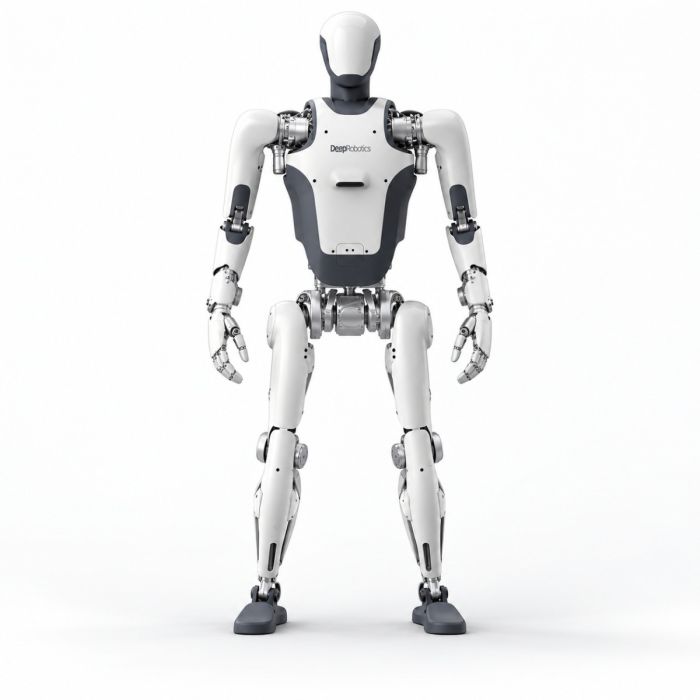
Deep Robotics DR01 Humanoid Robot
In stock
- BRAND:
- DEEP ROBOTICS
- PART #:
- DR01
- ORIGIN:
- China
- AVAILABILITY:
- SUBJECT TO AVAILABILITY
- SKU:
- Deep-Robotics-DR01
Deep Robotics DR01 Humanoid Robot
A robot that walks well is a useful thing; a robot that keeps walking after someone shoves it, or after the floor turns slick, is a research tool. The Deep Robotics DR01 Humanoid Robot is built for that second kind of work, where the interesting question is not how a humanoid moves on a flat, dry lab floor but how it copes when the ground and the situation change without notice.
The product is available through this page, by quotation.
Background
DEEP Robotics and the lineage of the DR01
DEEP Robotics is better known in many markets for its legged machines, and the store lists several of them, including the Lite3 quadruped line. The DR01 brings that legged-locomotion experience to two legs. A biped is a harder balancing problem than a four-legged robot, because the support area under the machine is small and every step is a controlled fall. That is exactly why a biped is attractive as a platform for learning-based control.
One detail of the DR01 points to how the company works: the robot is equipped with self-developed J60 lightweight joints and J100 high-torque joints. Designing the joints in-house means the actuators and the control software are developed with each other in mind, which matters when a walking algorithm has to react within moments to a slip or a push.
The DR01 also has a sibling in the same family. Buyers whose work is aimed at outdoor or industrial conditions may wish to look at the Deep Robotics DR02 All-Weather Industrial Grade Humanoid Robot alongside it.
Positioning: an embodied intelligence explorer
The DR01 is described as an embodied intelligence explorer. In plain terms, it is a body for artificial intelligence: a platform on which AI and big data training can be carried out in the physical world, with the aim of driving the iteration and advancement of embodied intelligence technology and exploring applications in the humanoid robot industry.
Two technical ideas sit behind that positioning. The first is fusion perception. The DR01 integrates the robot's own perception with perception of its environment, and a learning algorithm that combines sensing and control lets it traverse complex and discrete terrains in a stable way. The second is autonomous skill generation. Through AI and big data training, the DR01 can generate new behavioral skills by itself in response to changing environments and task requirements.
Readers who want to compare this robot with other walking machines will find them in the Bipedal Humanoids category and the wider Humanoids range.
Technical Specifications
| Specification | Value |
|---|---|
| Walking speed | Over 1.6 m/s |
| Step height | 18 cm steps |
| Slope capability | 25° slopes |
| Terrain | Uneven terrain, complex and discrete terrains |
| Joints | Self-developed J60 lightweight joints and J100 high-torque joints |
| Disturbance handling | Balance recovery on slippery surfaces and under external forces |
Specifications as published by the manufacturer; confirmed against the datasheet at quotation.
The manufacturer has not published the height, the weight, the battery runtime, the degrees of freedom, the payload, the onboard computing, the sensor list, the connectivity, the IP rating, the dimensions or what is in the box; they are confirmed at quotation.
What makes the DR01 different from a standard walking robot?
Many walking robots are tuned for a clean demonstration: a known surface, a known route, a predictable result. The DR01 is presented around a different goal, which is robustness. The robot can swiftly recover its balance and keep walking steadily even under unknown disturbances, with slippery surfaces and external forces as examples. For a researcher, this changes what can be tested. A platform that stays upright after a push lets a team study how learned behavior holds up, rather than spending the day picking the robot off the floor.
The second difference is the way sensing and control are joined. Instead of treating perception as one module and the walking controller as another, the DR01 uses a learning algorithm that combines the two, drawing on the robot's own state and on what it perceives of its surroundings. The result is stable traversal across complex and discrete terrains, such as steps and broken footing, where a controller that only looks at its own body would struggle.
The numbers give that a concrete shape: a walking speed of over 1.6 m/s, 18 cm steps and 25° slopes. These are the figures to hold against your own test site. If your stairs, ramps or thresholds fall inside them, the DR01 is a reasonable candidate. If they do not, say so when you request a quotation.
Can the DR01 learn new skills on its own?
Yes, within the frame of AI and big data training. The DR01 can autonomously generate new behavioral skills as environments and task requirements change. This is the heart of the embodied intelligence idea: the intelligence is not only a program that runs on a computer but a behavior that is shaped through the robot's body and tested against real surfaces and forces.
For a lab, that means the DR01 is less a finished appliance and more a long-term research partner. Training data collected on the robot feeds back into better behavior, and better behavior opens new tasks to try. Nothing is published on the software tools, the development interface or the onboard computing, so a team planning its own algorithms should raise those points when it requests a quotation.
Who is the DR01 for?
The DR01 suits several groups of buyers, and being clear about which one you belong to makes the quotation conversation shorter.
University and institute laboratories that study legged locomotion, reinforcement learning or embodied AI will find a platform made for exactly that, with disturbance recovery as a central feature rather than an afterthought.
Corporate research and development teams exploring the humanoid robot industry can use the DR01 to build experience with learning-based control before committing to a specific application.
Technical training institutions can use a walking humanoid to show students how perception, control and learning fit together in one machine.
Demonstration and exhibition programs may value a robot that can show stable walking over steps and slopes, though anyone with that need should raise operating details when requesting a quotation.
If your plans point towards harsh outdoor or industrial conditions, the DR02 is the sibling to review first. If your work is rather about four-legged inspection or education, the Lite3 quadrupeds are a different class of machine, such as the Lite3 Pro Quadruped Robot Dog.
What is the DR01 used for?
- Embodied intelligence research: a physical body on which AI and big data training can be tested in real conditions.
- Locomotion algorithm development: a biped for studying learning-based walking, from steady strides to recovery after a disturbance.
- Terrain traversal trials: testing behavior on 18 cm steps, 25° slopes and uneven ground.
- Perception and control studies: work on the fusion of the robot's own sensing with awareness of its environment.
- Skill generation experiments: observing how the robot produces new behaviors as tasks and surroundings change.
- Humanoid industry exploration: building early knowledge of where humanoid robots may help productivity and everyday life.
Pricing and Availability
We do not print prices on this page. A quotation is the way to proceed, and it is where the configuration, the open technical points and the commercial terms are settled for your project. Delivery, customs and support are arranged with the quotation, so you receive one clear picture instead of several separate conversations. The Deep Robotics DR01 Humanoid Robot is available on this page.
Frequently Asked Questions
How fast can the DR01 walk?
The DR01 walks at over 1.6 m/s. This is a walking figure for the biped, not a running claim.
What terrain can it handle?
The DR01 can navigate 18 cm steps, 25° slopes and uneven terrain. Its learning algorithm combines sensing and control to handle complex and discrete terrains.
What happens if the robot is pushed or the floor is slippery?
It is designed to recover its balance swiftly and keep walking steadily under unknown disturbances such as slippery surfaces and external forces.
What joints does the DR01 use?
It is equipped with self-developed J60 lightweight joints and J100 high-torque joints.
Can the DR01 learn new behaviors?
Yes. Through AI and big data training, it can autonomously generate new behavioral skills in response to changing environments and task requirements.
What are the height, weight, payload and battery runtime?
These figures are not available yet, and neither are the IP rating, the dimensions and the contents of the box. Ask for them when you request a quotation.
Where can I buy the DR01 and what does it cost?
You can request it through this page, by quotation. The cost depends on configuration and delivery, so it is given in the quotation and not printed here.
Summary
The Deep Robotics DR01 Humanoid Robot is judged less by how it walks on a perfect floor and more by how it behaves when the floor, the load or the task changes. Its strengths are a walking speed of over 1.6 m/s, 18 cm steps, 25° slopes, balance recovery under disturbance, fusion of sensing and control, and the ability to generate new skills through training, all carried by self-developed J60 and J100 joints. Several practical specifications remain open and are settled in the quotation. If you are planning embodied intelligence work in the Caribbean or beyond, this page is the starting point.
Specifications
General
What's included
Related Products
Out of stock


