
Deep Robotics Lite3 Pro Quadruped Robot Dog
In stock
- BRAND:
- DEEP ROBOTICS
- PART #:
- Lite3 Venture
- ORIGIN:
- China
- AVAILABILITY:
- ALLOW 2-4 WEEKS FOR DELIVERY
- SKU:
- Deep-Robotics-Lite3-Pro
Deep Robotics Lite3 Pro Quadruped Robot Dog
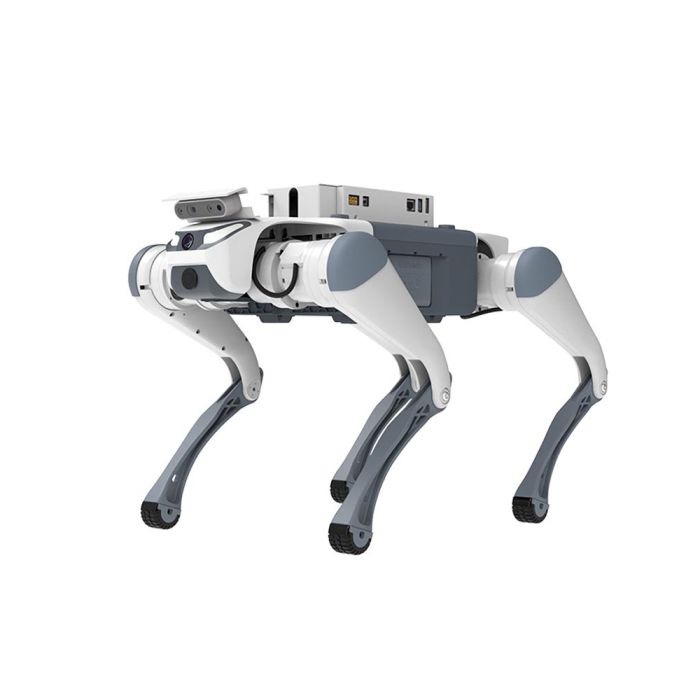
Most robotics labs have a familiar problem: the algorithm works beautifully in simulation, and then it meets a real floor. The Deep Robotics Lite3 Pro Quadruped Robot Dog is built for that moment. It is a small legged platform that one person can carry to a field site or a classroom, and it brings a depth camera, a dedicated perception computer and open ROS support along with it.
The product is available through this page, by quotation.
Background
The company and the Lite3 lineage
DEEP Robotics develops quadruped robots, and the Lite3 is its compact line for academic research, reinforcement learning experiments and robotics education. The family is presented in four versions: Basic, Venture, Pro and LiDAR. The current Lite3 generation delivers enhanced joint torque (up 50%), faster response bandwidth and precise motion control.
That lineage matters to a buyer because the Lite3 is not a showpiece. It is a working tool for people who train locomotion policies, test navigation stacks or teach students how legged machines behave. If you are comparing versions, the Lite3 Basic, the Lite3 Venture and the Lite3 LIDAR each have their own page.
Positioning and key technology
The Pro sits at the perception end of the family. It uses an RK3588 ARM-architecture processor for the motion host and an NVIDIA Jetson Xavier NX for the perception host. Keeping balance on the motion side and vision on the perception side lets researchers work on each without disturbing the other.
The platform runs Ubuntu 20.04 and is compatible with ROS1 (Noetic) and ROS2 (Foxy). An Intel RealSense D435i depth camera is integrated. Optional Livox or Leishen LiDAR modules are available for 3D mapping, localization and environmental reconstruction. The Pro also carries front and rear obstacle stop, visual following and forward obstacle avoidance.
Technical Specifications
| Specification | Value (Pro) |
|---|---|
| Standing dimensions (L × W × H) | 610 × 370 × 450 mm |
| Weight | 12.9 kg |
| Payload capacity | 4 kg |
| Maximum slope | 40° |
| Obstacle clearance | 18 cm |
| Continuous operation | 1.5 – 2 hours |
| Maximum range | 3.4 km |
| Perception features | Front/rear obstacle stop, visual following, forward obstacle avoidance |
| Interfaces | USB 3.0, HDMI, Ethernet; External Power Input (24V/12V/5V); Power Connector |
| Motion host | RK3588 ARM-architecture processor |
| Perception host | NVIDIA Jetson Xavier NX |
| Operating system | Ubuntu 20.04 |
| ROS compatibility | ROS1 (Noetic), ROS2 (Foxy) |
| Depth camera | Intel RealSense D435i |
| Thermal protection | Overtemperature protection: automatically stops and lies down if motors overheat |
Specifications as published by the manufacturer; confirmed against the datasheet at quotation.
The manufacturer has not published the joint torque figures, the IP rating, the battery capacity or the charging time; they are confirmed at quotation.
What makes the Lite3 Pro different from the other Lite3 versions?
The short answer is perception. The Pro and LiDAR versions carry the NVIDIA Jetson Xavier NX perception host, so this is where the Pro steps beyond a pure locomotion platform. With the depth camera, the perception computer and the obstacle functions, a team can build behaviors that react to the scene rather than only to the terrain under the feet.
The Pro also carries a practical set of ports: USB 3.0, HDMI and Ethernet, plus an external power input that accepts 24V, 12V or 5V. In daily lab work this means a monitor, a sensor or a custom board can be connected without a hunt for adapters. Anyone who has tried to mount a new payload on a robot with a closed port set will appreciate the difference.
If your work centers on LiDAR mapping, the LiDAR version is the closer match, and it is worth reading its page next to this one. If your focus is on locomotion alone, the Basic is the simpler starting point.
Is the Lite3 Pro easy to integrate with existing research software?
For most university teams, yes. Ubuntu 20.04 is a common baseline in robotics labs, and compatibility with both ROS1 (Noetic) and ROS2 (Foxy) means that existing nodes, visualization tools and message types carry over. Teams that are mid-migration from ROS1 to ROS2 can keep both environments in play instead of choosing one on the robot's behalf.
The platform is also aimed at reinforcement learning work. Policies trained in simulation can be brought onto real legs, observed and refined. The up 50% joint torque gain and the faster response bandwidth support that kind of experimentation.
One safety feature deserves a mention for shared labs: if the motors overheat, the robot stops and lies down on its own. That is a sensible behavior when students are running long sessions.
Who is the Lite3 Pro for?
University and institute labs are the core audience. A group working on legged locomotion, visual following or autonomous navigation gets a platform with a depth camera and a separate perception computer already on board. Graduate students can start on real hardware instead of building a robot first.
Teachers and training centers form a second group. The robot is documented for robotics education, and its size makes it manageable in a classroom. Moving it between rooms or loading it into a vehicle does not call for a crew.
Developers and prototyping teams are the third group. Companies exploring embodied AI, inspection concepts or custom payloads can use the Pro as a development bench, with the 4 kg payload capacity and the external power input giving room to mount and power additional equipment.
Who should look elsewhere? If you only need basic locomotion for demonstrations, the Lite3 Basic may be enough. If you want a broader view of the class, the Standard Quadrupeds category lists the alternatives, and the Lite3 Academic & Research page is another place to compare.
What is the Lite3 Pro used for?
- Reinforcement learning experiments: train locomotion policies in simulation and test them on a real quadruped.
- Perception and autonomy prototyping: use the depth camera and the Jetson Xavier NX perception host for obstacle avoidance and visual following.
- Robotics education: teach legged control, ROS development and sensor integration on hardware students can see and touch.
- ROS1 and ROS2 development: build and compare software in Noetic or Foxy environments on the same robot.
- Payload and sensor trials: carry and power custom equipment through the 4 kg payload capacity and the 24V, 12V and 5V external power input.
- Terrain testing: evaluate gait and stability on slopes up to 40° and obstacles up to 18 cm.
Pricing and Availability
We do not print prices on this page. Quotation is the way to buy: tell us your application, your quantity and your delivery location, and we prepare an offer. Delivery, customs and support are arranged with the quotation. The Deep Robotics Lite3 Pro Quadruped Robot Dog is available on this page.
Frequently Asked Questions
How much can the Lite3 Pro carry?
The payload capacity for the Pro is 4 kg. The robot itself weighs 12.9 kg.
How long does it run on one charge?
Continuous operation is 1.5 – 2 hours, with a maximum range of 3.4 km.
Which software environments does it support?
It supports Ubuntu 20.04 and is compatible with ROS1 (Noetic) and ROS2 (Foxy).
What sensors come with it?
An Intel RealSense D435i depth camera is integrated. Optional Livox or Leishen LiDAR modules are available for 3D mapping and localization.
What happens if the motors get too hot?
The overtemperature protection stops the robot and lies it down automatically.
What connections does it offer for my own equipment?
The Pro has USB 3.0, HDMI and Ethernet, an external power input for 24V, 12V or 5V, and a power connector.
Where can I buy the Deep Robotics Lite3 Pro and what does it cost?
You can request a quotation through this page. We do not list prices; the offer is prepared for your quantity and destination, with delivery, customs and support arranged alongside it.
Summary
The gap between a simulation result and a robot that walks across a real floor is where much research stalls. The Lite3 Pro narrows that gap with a carryable body, separate motion and perception computers, a depth camera, open ROS support and a useful set of ports. It is a practical tool for labs, classrooms and prototyping teams. If that matches your plans, this page is the starting point.
Specifications
General
Physical
Performance
Software
What's included
Downloads
Related Products
Out of stock


