
Deep Robotics Lite3 Venture Quadruped Robot Dog
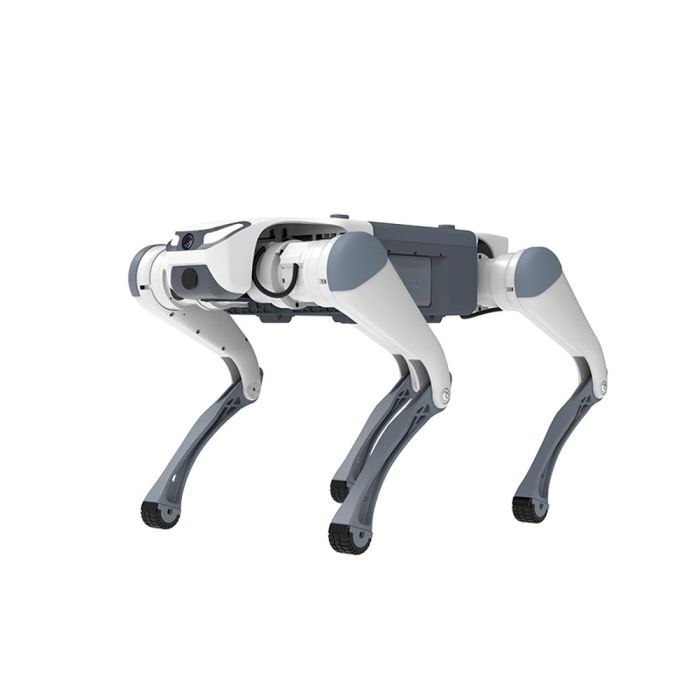
In stock
- BRAND:
- DEEP ROBOTICS
- PART #:
- Lite3 Venture
- ORIGIN:
- China
- AVAILABILITY:
- ALLOW 2-4 WEEKS FOR DELIVERY
- SKU:
- Deep-Robotics-Lite3-Venture
Deep Robotics Lite3 Venture Quadruped Robot Dog
A robot dog that only walks is a fine demonstration, but a research team soon wants it to carry a sensor, take external power and run its own code. The Deep Robotics Lite3 Venture Quadruped Robot Dog is built for that next step. It is the Lite3 version with extra connectivity, made for AI programming, robotics labs and intermediate research.
The product is available through this page, by quotation.
Background
Deep Robotics and the Lite3 family
DEEP Robotics builds legged robots, and the Lite3 is its compact quadruped line. The fact sheet names four versions: Basic, Venture, Pro and LIDAR. They share one body concept and differ in what is added around it. The Lite3 Basic is the entry point. The Lite3 Pro and the Lite3 LIDAR are the versions that use an NVIDIA Jetson Xavier NX as the perception host. The Venture sits between them as the extended version with additional I/O interfaces.
The wider range is listed in the Lite Series category. Larger platforms are grouped under Standard Quadrupeds.
Positioning and key technology
The Lite3 is built around an RK3588 ARM-architecture processor as its motion host. It supports Ubuntu 20.04 and works with both ROS1 (Noetic) and ROS2 (Foxy). The manufacturer describes enhanced joint torque (up 50%), faster response bandwidth and precise motion control for the Lite3.
For a lab, the open SDK and API matter most. They allow secondary motion and perception development on both ROS1 and ROS2. Students and researchers can write their own behaviors on a legged platform instead of living with a closed demo. The modular design also supports a wide range of additional functional modules, so the robot can grow with a project.
The Venture adds two Ethernet ports and an external power input. Its perception features are front and rear obstacle stop and visual following. Together these make it a practical base for attaching and powering extra equipment.
Technical Specifications
| Specification | Value |
|---|---|
| Standing dimensions (L × W × H) | 610 × 370 × 445 mm |
| Weight | 12.2 kg |
| Payload capacity | 4.5 kg |
| Maximum slope | 40° |
| Obstacle clearance | 18 cm |
| Continuous operation | 1.5 – 2 hours |
| Maximum range | 4 km |
| Interfaces | Ethernet × 2; External Power Input (24V/12V/5V) |
| Perception features | Front/rear obstacle stop; Visual following |
| Motion host processor | RK3588 ARM-architecture processor |
| Operating system | Ubuntu 20.04 |
| ROS compatibility | ROS1 (Noetic) and ROS2 (Foxy) |
| Protection | Overtemperature protection: automatically stops and lies down if motors overheat |
Specifications as published by the manufacturer; confirmed against the datasheet at quotation.
The manufacturer has not published the top speed, the degrees of freedom, the battery capacity, the IP rating, the operating temperature, the control frequency or the contents of the box; these are confirmed at quotation.
What makes the Lite3 Venture different from the Basic version?
The main difference is what the robot connects to. The Venture is described as the extended version with additional I/O interfaces. In practice that means two Ethernet ports and an external power input that accepts 24V, 12V or 5V. A team that mounts a camera, a compute board or a custom sensor needs these connections from the first day. Without them, every added device has to find power and a data link some other way.
The Venture also lists visual following and front and rear obstacle stop as its perception features. A robot that stops before it hits something is easier to share between students. It is also easier to use in a room where people are working. These features let a team spend its first sessions on its own experiments instead of basic safety logic.
The body is the same compact Lite3 frame. The figures on this page, a weight of 12.2 kg and a payload of 4.5 kg, belong to the Venture. Figures for other versions should be taken from their own pages and not read across.
How does the Venture compare with the Pro and LIDAR versions?
The Pro and LIDAR versions use an NVIDIA Jetson Xavier NX as the perception host. The fact sheet does not state a perception host for the Venture, so this page makes no claim about one. If your work depends on heavy onboard perception, look at the Pro or LIDAR pages. If you need a dependable walking base with power and Ethernet for your own hardware, the Venture fits that need directly.
Every Lite3 version works with the open SDK and API. Whichever version you choose, the software route is the same: ROS1 or ROS2 on Ubuntu 20.04. A team can therefore start on the Venture and keep most of its software knowledge if it later moves to another version.
Who is the Lite3 Venture for?
University labs and teaching programs are the clearest fit. Students can write controllers, test them on a real legged robot and log results, using tools they already know from ROS. The manufacturer positions this version for AI programming and robotics labs, and that is where it works best.
Research groups at an intermediate stage are the second segment. They have outgrown a basic walking demo but do not yet need an industrial platform. The 4.5 kg payload and the modular design let them add a payload and iterate. Developers of inspection or monitoring ideas can use the Venture as a test bed before committing to a larger system. For heavier duty, the Standard Quadrupeds category lists larger platforms.
Buyers who only need a first, simple platform may prefer the Lite3 Basic. Buyers who need a dedicated perception host should look at the Lite3 Pro or the Lite3 LIDAR.
What is the Lite3 Venture used for?
- AI programming courses: students run their own code on a real legged robot through the open SDK and API.
- Robotics lab research: teams study gait, balance and motion control on ROS1 or ROS2.
- Payload experiments: sensors and compute modules are mounted and powered through the external power input and Ethernet ports.
- Perception development: visual following and obstacle stop serve as a starting point for secondary perception work.
- Slope and obstacle testing: the robot is tried on inclines and on steps in semi-structured outdoor settings.
- Prototype development: teams test inspection and monitoring ideas before moving to larger platforms.
Pricing and Availability
Prices for the Deep Robotics Lite3 Venture Quadruped Robot Dog are given by quotation, based on your project and the number of units. Delivery, customs and support are arranged together with the quotation. Send us your requirements and we will prepare an offer. The Deep Robotics Lite3 Venture Quadruped Robot Dog is available on this page.
Frequently Asked Questions
What payload can the Lite3 Venture carry?
The payload capacity is 4.5 kg. This is the figure for the Venture version.
How long does it run on one charge?
Continuous operation is 1.5 to 2 hours. The battery capacity itself has not been published by the manufacturer.
Which software does it support?
It runs Ubuntu 20.04 and works with ROS1 (Noetic) and ROS2 (Foxy). An open SDK and API allow secondary motion and perception development.
What connections does the Venture have?
It has two Ethernet ports and an external power input that accepts 24V, 12V or 5V. These are the extra interfaces that set it apart from the Basic version.
Can it handle slopes and obstacles?
The maximum slope is 40° and the obstacle clearance is 18 cm. Front and rear obstacle stop is also listed.
What happens if the motors get too hot?
Overtemperature protection is built in. The robot stops automatically and lies down if the motors overheat.
Where can I buy the Lite3 Venture and what does it cost?
You can request it through this page. The cost is given by quotation, together with delivery, customs and support arrangements, and no price is listed here.
Summary
The Lite3 Venture is for the moment a lab robot has to do more than walk. It combines a compact body, an open SDK, ROS1 and ROS2 support, two Ethernet ports and a flexible external power input. Its obstacle stop and overtemperature protection help it work safely around people. The published figures include a 4.5 kg payload, a 40° slope, an 18 cm obstacle clearance and 1.5 to 2 hours of continuous operation. If your lab or project needs a legged platform it can build on, this page is the starting point.
Specifications
General
Physical
Performance
Software
Battery + Power
What's included
Downloads
Related Products
Out of stock


