
Deep Robotics Lite3 LIDAR Quadruped Robot Dog
In stock
- BRAND:
- DEEP ROBOTICS
- PART #:
- Lite3 Venture
- ORIGIN:
- China
- AVAILABILITY:
- ALLOW 2-4 WEEKS FOR DELIVERY
- SKU:
- Deep-Robotics-Lite3-LIDAR
Deep Robotics Lite3 LIDAR Quadruped Robot Dog
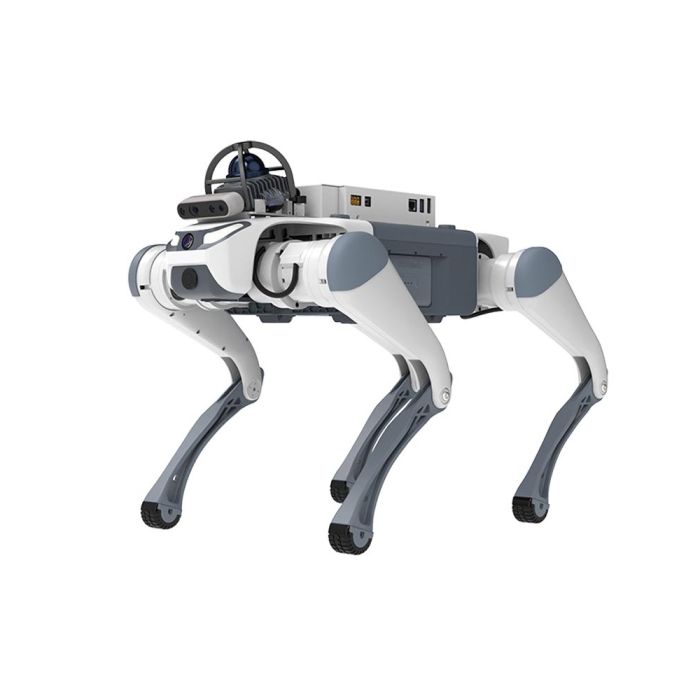
A robot dog earns its place in a laboratory when it stops being a demonstration and becomes an instrument, something a team can send down a corridor and trust to bring back data. The Deep Robotics Lite3 LIDAR Quadruped Robot Dog is the Lite3 configuration built for that role. It pairs a compact legged body with a depth camera, optional LiDAR modules and a dedicated perception computer, so the robot can navigate on its own as well as walk.
The Deep Robotics Lite3 LIDAR Quadruped Robot Dog is available through this page, by quotation.
Background
DEEP Robotics and the Lite3 lineage
DEEP Robotics builds legged robots, and the Lite3 is its compact platform for academic research, reinforcement learning experiments and robotics education. It is meant for teams that want to study locomotion, train control policies and test perception software on real hardware rather than only in simulation. The family comes in four versions: Basic, Venture, Pro and LIDAR. They share the same body and gait foundation but differ in the sensing and computing they carry.
The Lite3 has a 50% boost in joint torque. This gives the robot high torque density, rapid response bandwidth and high reverse transmission efficiency. In practice that means smoother, more precise movement across varied terrain, which matters when a policy trained in simulation has to survive a real floor.
Where the LIDAR configuration sits
The LIDAR version is the one in the family aimed at autonomy. Its perception functions are autonomous navigation, front and rear obstacle stop, visual following and forward obstacle avoidance. It integrates an Intel RealSense D435i depth camera and accepts optional Livox or Leishen LiDAR modules for 3D mapping, localization and environmental reconstruction.
Two computers share the work. An RK3588 ARM-architecture processor runs the motion host, and an NVIDIA Jetson Xavier NX runs the perception host. Keeping the two apart lets locomotion stay steady while mapping and navigation software uses its own computing resources.
Technical Specifications
| Specification | Value (LIDAR version) |
|---|---|
| Standing dimensions (L × W × H) | 610 × 370 × 496 mm |
| Weight | 13.5 kg |
| Payload capacity | 2.5 kg |
| Maximum slope | 40° |
| Obstacle clearance | 18 cm |
| Continuous operation | 1.5 – 2 hours |
| Maximum range | 2.7 km |
| Motion host | RK3588 ARM-architecture processor |
| Perception host | NVIDIA Jetson Xavier NX |
| Depth camera | Intel RealSense D435i |
| LiDAR | Optional Livox or Leishen modules |
| Perception functions | Autonomous navigation, front/rear obstacle stop, visual following, forward obstacle avoidance |
| Operating system | Ubuntu 20.04 |
| ROS compatibility | ROS1 (Noetic) and ROS2 (Foxy) |
| Interfaces | USB 3.0, HDMI, Ethernet; External Power Input (24V/12V/5V); Power Connector |
| Protection | Overtemperature protection: stops and lies down if motors overheat |
Specifications as published by the manufacturer; confirmed against the datasheet at quotation.
The manufacturer has not published the IP rating, the maximum speed of this version, the battery capacity, the LiDAR range or the service life independent of warranty; they are confirmed at quotation.
What makes the Lite3 LIDAR different from the other Lite3 versions?
The difference is autonomy. The Basic, Venture and Pro versions have their own pages, and the perception host is named for the Pro and LIDAR versions only. What sets the LIDAR version apart is the full navigation package: autonomous navigation on top of obstacle stop, visual following and forward obstacle avoidance. If your project is about teaching a robot to find its own way, this is the version that carries the matching software features.
If your work is mainly locomotion, for example training gaits or testing reinforcement learning policies, you may not need the extra sensing. In that case compare the Lite3 Basic, the Lite3 Venture and the Lite3 Pro before you decide. Every figure in the table above belongs to the LIDAR version only and should not be read across to the others.
What can a research team build on this platform?
The software side is open to developers. The Lite3 runs Ubuntu 20.04 and works with both ROS1 (Noetic) and ROS2 (Foxy), so teams can keep the tools they already know. A Motion SDK with example code and libraries is available on the Lite3 Motion SDK GitHub repository, which gives students and engineers a starting point for custom control work.
On the hardware side, the robot offers USB 3.0, HDMI and Ethernet ports, an external power input for 24V, 12V or 5V, and a power connector. These let you attach extra sensors, a display or a network link. With a payload capacity of 2.5 kg, a small instrument package can ride along.
A built-in safeguard also matters in a teaching setting: if the motors overheat, the robot stops and lies down by itself. That protects the hardware during long experiments.
Who is the Lite3 LIDAR for?
Universities and research labs are the first segment. They get a legged platform that supports mapping, localization and navigation studies with ROS tools. Robotics educators are the second: a robot that walks, sees and navigates gives students something concrete to program, and the Ubuntu and ROS environment matches common course material.
Developers doing secondary development form the third segment. They can use the Motion SDK, the interfaces and the two-computer layout to prototype applications. Teams that only need walking and policy training can look at the Lite Series to find a simpler version, and those with industrial duties in mind can browse the wider Standard Quadrupeds category.
What is the Lite3 LIDAR used for?
- Reinforcement learning experiments. Test policies trained in simulation on a real legged body.
- 3D mapping. Build maps of rooms, corridors and outdoor areas with the depth camera and optional LiDAR.
- Localization research. Study how a legged robot tracks its position as it moves.
- Autonomous navigation trials. Send the robot between points and evaluate how it avoids obstacles.
- Robotics teaching. Give students a platform that runs Ubuntu 20.04 with ROS1 and ROS2.
- Payload prototyping. Mount and test small sensor packages using the available interfaces and power inputs.
Pricing and Availability
Pricing is provided by quotation and depends on the configuration you need, including the choice of optional LiDAR module. Delivery, customs and support are arranged together with the quotation, so you receive one clear plan. To start, send us your requirements, and the Deep Robotics Lite3 LIDAR Quadruped Robot Dog is available on this page.
Frequently Asked Questions
What processors does the Lite3 LIDAR use?
The motion host uses an RK3588 ARM-architecture processor. The perception host uses an NVIDIA Jetson Xavier NX.
Which operating system and ROS versions are supported?
It supports Ubuntu 20.04 and is compatible with ROS1 (Noetic) and ROS2 (Foxy).
How much can it carry and how steep can it climb?
The payload capacity is 2.5 kg and the maximum slope is 40°. It clears obstacles up to 18 cm.
How long does it run on one charge?
Continuous operation is 1.5 – 2 hours.
Which sensors does it carry?
It integrates an Intel RealSense D435i depth camera and accepts optional Livox or Leishen LiDAR modules. These support 3D mapping, localization and environmental reconstruction.
What happens if the motors get too hot?
The overtemperature protection stops the robot and makes it lie down automatically. This protects the motors during long sessions.
Where can I buy the Deep Robotics Lite3 LIDAR Quadruped Robot Dog and what does it cost?
You can request it through this page. The cost is given in a quotation that also covers delivery, customs and support.
Summary
The Lite3 LIDAR matters because it moves the Lite3 from walking to knowing where it is. It combines a compact legged body, a depth camera, optional LiDAR, two dedicated computers and an open software environment based on Ubuntu 20.04 with ROS1 and ROS2. For teams that need a quadruped for mapping, navigation and learning research, it is a practical instrument rather than a showpiece. To discuss your project and receive a quotation, this page is the starting point.
Specifications
General
Physical
Performance
Software
What's included
Downloads
Related Products
Out of stock


