
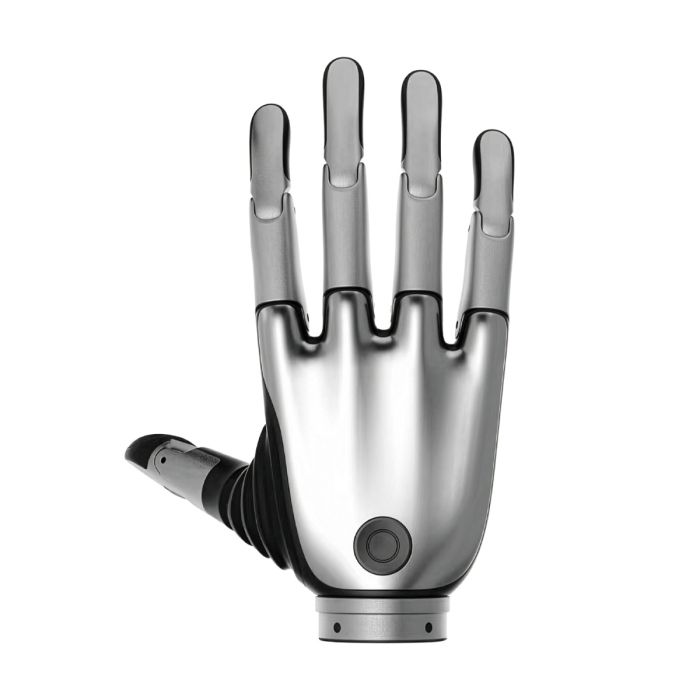
Brainco Revo 2 Touch Biomimetic Dexterous Right Hand (XTR)
In stock
- BRAND:
- BRAINCO
- MODEL:
- REVO 2 TOUCH
- PART #:
- XTR
- ORIGIN:
- China
- AVAILABILITY:
- SUBJECT TO AVAILABILITY
- SKU:
- BrainCo-Revo-2-Touch
Brainco Revo 2 Touch Biomimetic Dexterous Right Hand (XTR)
Picture picking up an egg with your eyes closed. The skill is not in the fingers' strength but in what they report back. The Brainco Revo 2 Touch Biomimetic Dexterous Right Hand (XTR) is built on that idea. It is the right-hand model of the Touch version in the Revo 2 family, a bionic dexterous hand for robot integration and research, with a multi-dimensional fingertip tactile module so the robot can sense an object rather than merely close on it.
The product is available through this page, by quotation.
Background
BrainCo and the Revo 2 family
BrainCo was founded in 2015 and incubated by the Harvard Innovation Lab. The company is based in Somerville, Mass. A hardware maker that grows out of a university lab tends to build for people who write their own code, and the Revo 2 reflects that. Its SDK supports Python and C and is compatible with Linux, Windows and ROS systems, so a research group can usually reach the hand from the software environment it already uses.
The Revo 2 comes in three versions, each with a left and a right model. Basic is sold as the XRL and XRR, Pro as the XEL and XER, and Touch as the XTL and XTR. This page covers the XTR, the right-hand Touch model. If your project needs the matching left hand, see the Brainco Revo 2 Touch Biomimetic Dexterous Left Hand (XTL).
Where the Touch version sits
Within the family, the Touch version is the one that adds a multi-dimensional fingertip tactile module. The Basic version does not list this module. The advanced (Pro) and tactile (Touch) versions both support three communication interfaces for control: RS-485, CAN FD and EtherCAT. The interface is located below the wrist, which matters when you plan cable routing inside a forearm or a test rig.
In short, the XTR is the right-hand member of the family for teams who want to study contact, not only motion. It is meant to be fitted to a robot arm or humanoid platform, or used as the subject of manipulation research on a bench.
Technical Specifications
| Specification | Value |
|---|---|
| Model | Brainco Revo 2 Touch Biomimetic Dexterous Right Hand (XTR) |
| Version code | XTR (Touch, right hand) |
| Product type | Bionic dexterous hand for robot integration and research |
| Pinch force | ≥15N |
| Control precision | 0.1° |
| Tactile module | Multi-dimensional fingertip tactile module |
| Communication interfaces | RS-485, CAN FD, EtherCAT |
| SDK | Python/C; Linux, Windows and ROS systems |
| Protections | Current, stall, high-temperature and anti-collision protection |
| Default device ID (right hand) | 127 |
| Standard colors | Space Gray, Silver (bulk color customization supported) |
Specifications as published by the manufacturer; confirmed against the datasheet at quotation. The manufacturer has not published the package contents, the ingress protection rating, the tactile sensor resolution or the cable length; they are confirmed at quotation.
What makes the Touch version different from the Basic and Pro versions?
The clearest difference is the fingertip tactile module. The Touch version carries a multi-dimensional module at the fingertips, and that is the feature the other two versions in the family do not list. For a controller, this changes the kind of question it can ask. Instead of only commanding a finger to a position, it can look for information from the point of contact itself.
The second difference is in communication. The Pro and Touch versions support RS-485, CAN FD and EtherCAT, so a system integrator can choose the bus that fits the robot's existing architecture. If your platform already runs EtherCAT, or you prefer CAN FD for a compact wiring harness, the XTR can fit either way. Teams with simpler needs may find the Basic right hand, the BrainCo Revo 2 Basic Right Dexterous Bionic Hand (XRR), a closer match, and teams that want the wider interface choice without touch sensing can look at the BrainCo Revo 2 Pro Dexterous Right Hand (XER).
What the versions share is the character of the hand: a bionic design for robot integration and research, a control precision of 0.1° and a software kit that works with Python, C and ROS. The XTR adds sensing to that base rather than changing it.
What does the tactile module let a robot do?
Touch sensing is the difference between a hand that executes a grasp and a hand that takes part in one. With a multi-dimensional fingertip tactile module, a research team can record how contact develops as the fingers close, and can use that signal in its own control or learning software. The sensor data comes from the hand itself, so it still works when a camera view is blocked by the fingers or by the object.
The hand also protects itself and what it holds. It lists current protection, stall protection, high-temperature protection and anti-collision protection. During long experiments, where a hand may be driven repeatedly against objects and fixtures, those protections are practical. The pinch force of at least 15N gives a clear reference for the kind of small objects and light tasks the hand is designed to take on.
The tactile sensor resolution is not published, so teams that depend on a particular sensing granularity should raise it when they request a quotation.
Who is the Brainco Revo 2 Touch Right Hand (XTR) for?
Humanoid robot developers are the first segment. A right hand that senses contact lets a humanoid platform work on tasks where vision alone is not enough. University and corporate laboratories form the second segment: groups working on grasping, in-hand manipulation and tactile learning need a hand whose sensing is part of the hardware, along with an SDK they can script.
System integrators are the third. The three interfaces, with the connection below the wrist, make it possible to fit the hand into different robot designs. If your project is a left-hand or two-handed build, the Touch left hand (XTL) is the matching model. If you do not need touch sensing, the Basic and Pro versions are the better place to start. Teams looking more broadly can browse the Hands category or the Research Robots category.
What is the Brainco Revo 2 Touch Right Hand (XTR) used for?
- Humanoid robot integration. It serves as the right hand of a humanoid platform that needs to sense what it holds.
- Manipulation research. Laboratories study grasping and in-hand handling with contact data from the fingertips.
- Tactile learning experiments. Researchers feed the hand's touch signals into their own control and learning software.
- Robot arm end-effector development. Integrators fit the hand to an arm using RS-485, CAN FD or EtherCAT.
- Teaching and training. Universities use it to show students how touch changes robot control, with Python, C or ROS.
- Prototype testing. Product teams try small-object handling tasks before committing to a full design.
Pricing and Availability
Pricing for the XTR is given by quotation, based on your project and the quantity you need. Delivery, customs and support are arranged together with the quotation, so you receive one clear plan from the start. Colors are Space Gray or Silver as standard, and bulk color customization is supported. The Brainco Revo 2 Touch Biomimetic Dexterous Right Hand (XTR) is available on this page.
Frequently Asked Questions
Is the XTR a right hand or a left hand?
The XTR is the right-hand model of the Touch version. The left-hand model carries the code XTL.
What does the Touch version add over the other Revo 2 versions?
It adds a multi-dimensional fingertip tactile module. The Basic version does not list this module.
Which communication interfaces does it support?
The Touch version supports RS-485, CAN FD and EtherCAT. The interface is located below the wrist.
Which software can I use with it?
The SDK supports Python and C and is compatible with Linux, Windows and ROS systems.
What is the default device ID?
For the Revo 2, the default ID for the right hand is 127 and for the left hand it is 126.
What protections does the hand have?
It has current protection, stall protection, high-temperature protection and anti-collision protection.
Where can I buy the Brainco Revo 2 Touch Right Hand (XTR) and what does it cost?
You can request it through this page. The cost is given by quotation, which also covers delivery, customs and support arrangements.
Summary
A robot hand earns its place not only by how it moves but by what it can tell its controller once it touches something. The Brainco Revo 2 Touch Biomimetic Dexterous Right Hand (XTR) answers that with a multi-dimensional fingertip tactile module, a pinch force of at least 15N and a control precision of 0.1°. Three communication interfaces and an SDK for Python, C and ROS make it practical to integrate. For humanoid builders, laboratories and integrators who want a right hand that can feel, this page is the starting point.
Specifications
General
Physical
Mobility
Performance
Connectivity
Software
Hand
Shipping
What's included
Videos


