
BrainCo Revo 2 Basic Right Dexterous Bionic Hand (XRR)
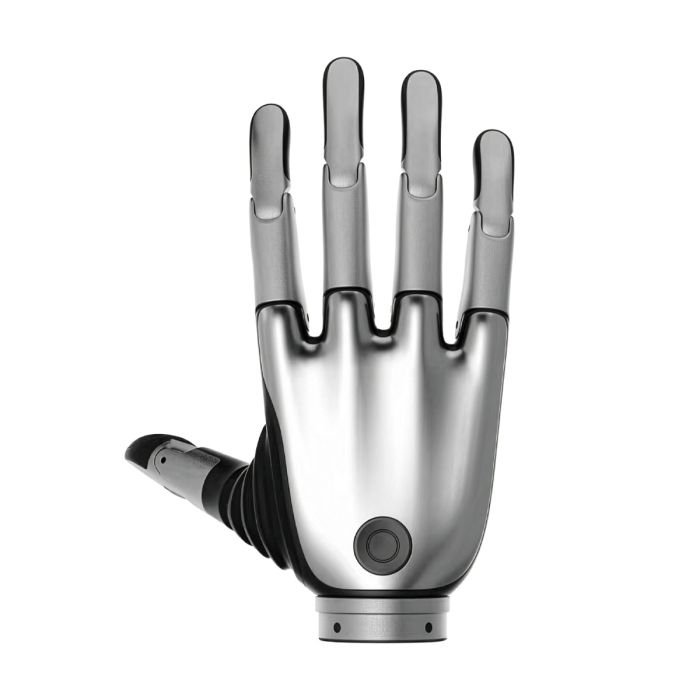
In stock
- BRAND:
- BRAINCO
- MODEL:
- REVO 2 BASIC
- PART #:
- XRL/XRR
- ORIGIN:
- China
- Warranty:
- 12 MONTHS
- AVAILABILITY:
- SUBJECT TO AVAILABILITY
- SKU:
- BrainCo-Revo-2-Basic
BrainCo Revo 2 Basic Right Dexterous Bionic Hand (XRR)
Six actuated joints, eleven degrees of freedom: that gap is the quiet idea behind the BrainCo Revo 2 Basic Right Dexterous Bionic Hand (XRR). Instead of asking a controller to manage every knuckle, the hand lets a small number of commands shape a full five-finger posture. For a robot builder, that means a hand that looks and behaves like a hand without turning the control software into a project of its own.
The product is available through this page, by quotation.
Background
BrainCo and the Revo 2 family
BrainCo is the maker of the Revo line of bionic hands. The Revo 2 is described as a bionic dexterous hand for robot integration and research, and it is offered in three versions: Basic, Pro and Touch. Each version comes in a left and a right configuration. The version codes are XRL and XRR for Basic, XEL and XER for Pro, and XTL and XTR for Touch. This page covers the Basic right hand, code XRR.
All versions can be compared side by side in the BrainCo Revo 2 category on this store. Figures belong to the version that states them, so this article keeps to what is stated for the Basic configuration and for the Revo 2 hand in general.
Where the Basic version sits
The Basic version is the configuration that communicates and is controlled over a 485 or CAN FD interface. That is the detail an integrator checks first, because it decides how the hand joins an existing bus and which controller can drive it. The interface sits under the wrist, and the connector model is BM05B-PASS-TFT(LF)(SN).
Around that interface the hand carries closed-loop servo control, custom gesture definitions, and protections for current, stall, high temperature and collision. In practical terms, the hand watches its own motors and can stop or back off when a finger meets resistance or runs hot. For a research cell where hands are handled often and objects are not always where the program expects, those protections are a sensible feature to have. The hand is also listed in our Hands category, next to other end effectors for humanoid and arm platforms.
Technical Specifications
| Specification | Value |
|---|---|
| Product type | Bionic dexterous hand for robot integration and research |
| Active joints | 6 |
| Total degrees of freedom | 11 |
| Thumb | Two active DoF (abduction/adduction), one passive DoF (flexion/extension) |
| Each of the other four fingers | One active DoF and one passive DoF, both for flexion/extension |
| Communication interface | 485 or CAN FD |
| Interface location | Under the wrist |
| Connector model | BM05B-PASS-TFT(LF)(SN) |
| Control modes | Position + Time, Position + Speed, Speed, Current, PWM |
| Protections | Current, stall, high temperature, collision |
| Control features | Closed-loop servo control, custom gesture definitions |
| SDK | Python/C; compatible with Linux, Windows and ROS systems |
| Maximum palm width | 78.5mm |
Specifications as published by the manufacturer; confirmed against the datasheet at quotation.
The manufacturer has not published the weight, the hand height, the grip force, the pinch force, the payload, the supply voltage, the operating noise, the operating temperature, the maximum current, the IP rating, the materials or the service life; they are confirmed at quotation.
How does the Revo 2 Basic move with only six active joints?
The joint layout is the heart of the design. The thumb has two active degrees of freedom, for abduction and adduction, plus one passive degree of freedom for flexion and extension. Each of the other four fingers has one active and one passive degree of freedom for flexion and extension. Add them up and you get six active joints and eleven degrees of freedom in total.
For a developer, this has a direct benefit. The control problem is about six actuated joints, not eleven, and the hand still presents a finger and thumb arrangement that suits objects made for human hands. Custom gesture definitions then let a team store the postures it uses most, such as an open hand, a closed grasp or a pointing shape, and call them by name from software.
The control modes cover the usual needs. Position + Time and Position + Speed move a joint to a target. In the speed-limited mode, a speed set to 0 means the hand runs at maximum speed. Speed, Current and PWM modes are there for teams that want to drive the hand more directly, for instance to shape a grasp through current rather than position. Closed-loop servo control keeps these commands tied to what the joints actually do.
What do the SDK and interface mean for integration?
A hand is only as useful as the effort needed to talk to it. The Revo 2 SDK supports Python and C, and it is compatible with Linux, Windows and ROS systems. That covers the main environments in which robotics labs and humanoid developers work, from quick scripts on a laptop to a ROS-based software stack on a robot.
On the hardware side, the choice of 485 or CAN FD gives the integrator a decision to make with the rest of the platform in mind. A team already running a CAN FD bus can place the hand on it, while one built around 485 can use that instead. Because the connector sits under the wrist and its model is stated, wiring can be planned before the hand arrives. This is also why the right and left hands are ordered as separate items: each is cabled for its own side of the robot.
Who is the BrainCo Revo 2 Basic Right Hand for?
The first group is humanoid robot developers who need a right hand and are fitting a matching pair. For the other side of the body, the BrainCo Revo 2 Basic Left Dexterous Bionic Hand (XRL) is the Basic left-hand partner.
The second group is university and corporate research teams working on grasping, teleoperation or manipulation learning. They benefit from the SDK, the range of control modes and the built-in protections, which make repeated experiments less risky for the hardware.
The third group is system integrators building demonstration cells or service-robot prototypes. They get a five-finger hand with a stated interface and connector, and they can start with the Basic configuration.
Buyers who want to look at other versions can review the BrainCo Revo 2 Pro Dexterous Right Hand (XER) or the Brainco Revo 2 Touch Biomimetic Dexterous Right Hand (XTR). Their features belong on their own pages and should be read there, not assumed from this one.
What is the BrainCo Revo 2 Basic Right Hand used for?
- Humanoid robot hands: the right-hand position of a two-handed platform that needs a human-like end effector.
- Manipulation research: grasping and in-hand experiments that call for a thumb with two active degrees of freedom.
- Teleoperation studies: a hand that can be commanded by position, speed, current or PWM from an operator interface.
- Robot arm upgrades: replacing a simple gripper with a five-finger hand on an existing arm.
- Gesture-based demonstrations: stored custom gestures that can be called on cue in exhibitions and teaching.
- Software development: building and testing control code with the Python/C SDK on Linux, Windows or ROS.
Pricing and Availability
We do not print prices on this page. Please request a quotation and tell us the quantity, the handedness and the controller you plan to use. Delivery, customs and support are arranged together with the quotation, so you know the full picture before you commit. The BrainCo Revo 2 Basic Right Dexterous Bionic Hand (XRR) is available on this page.
Frequently Asked Questions
Is this the left or the right hand?
This is the right hand of the Basic version, code XRR. The left-hand Basic version carries the code XRL and has its own page.
How many degrees of freedom does the hand have?
It has 6 active joints and a total of 11 degrees of freedom. The thumb has two active and one passive, and each other finger has one active and one passive.
Which communication interface does the Basic version use?
The Basic version communicates and is controlled through a 485 or CAN FD interface. The interface is located under the wrist, with connector model BM05B-PASS-TFT(LF)(SN).
Which software environments does the SDK support?
The SDK supports Python and C, and it is compatible with Linux, Windows and ROS systems.
What protections does the hand include?
It includes closed-loop servo control, custom gesture definitions, and protections for current, stall, high temperature and collision.
Are the grip force and weight listed?
Not at this time. They are among the open items named under the specification table; ask for them when you request your quotation.
Where can I buy the BrainCo Revo 2 Basic Right Hand and what does it cost?
You can buy it through this page by requesting a quotation. We do not list a price here; the quotation covers the details of your order.
Summary
The appeal of the BrainCo Revo 2 Basic Right Dexterous Bionic Hand (XRR) is the balance between a human-like hand and a manageable control task: six active joints delivering eleven degrees of freedom, a 485 or CAN FD interface, five control modes and a Python/C SDK for Linux, Windows and ROS. Built-in protections add a margin of safety for research use. If you are fitting a right hand to a humanoid or a research arm, this page is the starting point.


