
BrainCo Revo 2 Basic Left Dexterous Bionic Hand (XRL)
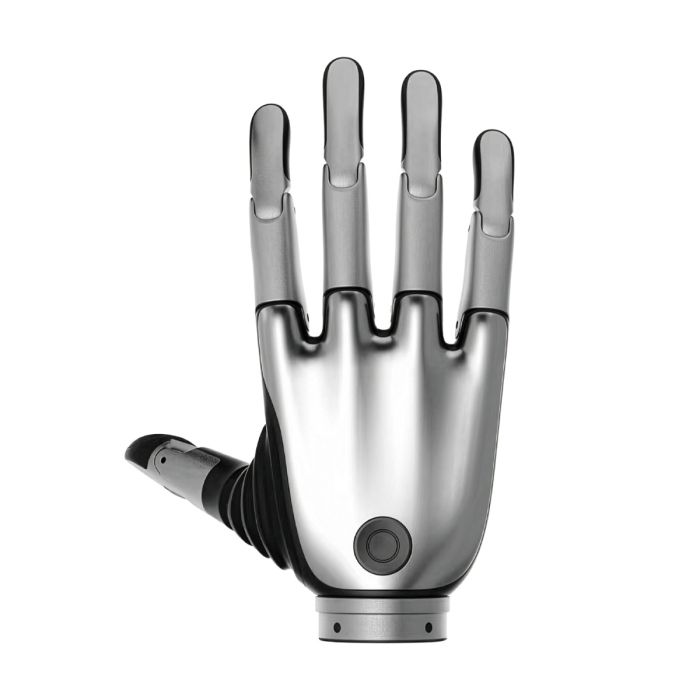
In stock
- BRAND:
- BRAINCO
- MODEL:
- REVO 2 BASIC
- PART #:
- XRL
- ORIGIN:
- China
- Warranty:
- 12 MONTHS
- AVAILABILITY:
- SUBJECT TO AVAILABILITY
- SKU:
- BrainCo-Revo-2-Basic-Left
BrainCo Revo 2 Basic Left Dexterous Bionic Hand (XRL)
A left hand is not simply a right hand turned around on the shelf. It has its own wiring, its own identity on the bus and its own place in the software. The BrainCo Revo 2 Basic Left Dexterous Bionic Hand (XRL) is built for the robot builder who has accepted that fact and wants the left side of a bimanual platform handled with the same care as the right.
The product is available through this page, by quotation.
Background
BrainCo and the Revo lineage
BrainCo is the maker of the Revo line of bionic hands. The Revo 2 is the second generation of that line, and the BrainCo Revo 1 Intelligent Dexterous Bionic Hand came before it. Within Revo 2 the manufacturer names three versions: Basic (XRL for the left hand, XRR for the right), Pro (XEL and XER) and Touch (XTL and XTR). This page covers the Basic left hand. You can browse the whole family in the BrainCo Revo 2 category.
The sources we hold do not describe the history of the company in more detail, so we leave it there rather than fill the space with guesses.
Where the Basic left hand sits
The manufacturer describes the Revo 2 as a bionic dexterous hand for robot integration and research. The Basic version is the one that talks to a controller over a 485 or CAN FD communication interface, and it is the version with the narrowest supply range of the three: 12-28V, where the Pro and Touch versions are printed at 12-64V. It has 6 active joints and a total of 11 degrees of freedom, which means that several finger joints move together rather than each having a motor of its own.
For a team that wants a capable hand to program, test and study, this is the straightforward starting point. For a team that needs a wider voltage window, the siblings are worth a look.
Technical Specifications
| Specification | Value (Basic, XRL) |
|---|---|
| Version code | XRL/XRR (Basic) |
| Degrees of freedom | 11 (6 active) |
| Weight | 383 g |
| Height (palm base to middle fingertip) | 160 mm |
| Full fist grip force | ≥50N |
| Pinch force | ≥15N |
| Max payload | ≥20kg |
| Operating noise (at 50cm) | ≤50dB |
| Flexion/extension speed | ≤0.65s |
| Communication interface | 485, CANfd |
| Supply voltage | 12-28V |
| Static current | 65 mA @24V |
| Maximum current | 4.6 A @24V |
| Repetitive control precision | 0.1° |
| Maximum opening and closing distance | 100mm (from thumb to index finger) |
| Operating temperature | -10 - 40℃ / 90%RH |
| Smart protection | Current protection, stall protection, high-temperature protection, anti-collision protection |
| SDK integration | Python/C; Linux, Windows and ROS systems |
| Online upgrade | OTA online upgrades supported |
| Default device ID (left hand) | 126 |
| Standard colors | Space Gray, Silver |
Specifications as published by the manufacturer; confirmed against the datasheet at quotation.
The manufacturer has not published the interface connector cable length, the width, the mounting interface dimensions, the IP rating, the battery or the finger-joint lifespan; they are confirmed at quotation.
How does the Basic left hand differ from the Pro and Touch versions?
The three Revo 2 versions share the same repetitive control precision of 0.1°, so the difference is not in how finely the hand can be commanded. The differences the sources print are electrical. The Basic version runs on 12-28V with a static current of 65 mA @24V and a maximum current of 4.6 A @24V. The Pro and Touch versions are printed at 12-64V, with a static current of 115 mA @24V and a maximum current of 4.65A @24V.
In practice this means the Basic hand suits a platform whose supply rail already sits comfortably inside 12-28V, and it draws little when it is simply holding still. If your robot runs a higher bus voltage, the BrainCo Revo 2 Pro Dexterous Left Hand (XEL) is the sibling to compare. If tactile sensing is part of your research question, the Touch family has its own page, such as the Brainco Revo 2 Touch Biomimetic Dexterous Left Hand (XTL).
What does the hand do to protect itself and the robot?
A dexterous hand spends much of its working life near its limits, so protection matters. The Basic version lists four protections: current protection, stall protection, high-temperature protection and anti-collision protection. Together they cover the usual ways a hand gets damaged during development, such as a finger driven against a fixture, a motor held under load or a long test run that heats the mechanism.
The hand also accepts OTA online upgrades, so firmware can be updated without taking the hand apart. On the software side, the SDK supports Python and C and works with Linux, Windows and ROS systems. The default device ID for the left hand is 126 (the right hand uses 127), which keeps a matched pair apart on the same bus from the first power-up.
Who is the BrainCo Revo 2 Basic Left Dexterous Bionic Hand (XRL) for?
The first group is humanoid and dual-arm robot builders. They need a left hand that pairs with a right one, and the BrainCo Revo 2 Basic Right Dexterous Bionic Hand (XRR) is the matching sibling in the same version.
The second group is university labs and research institutes. For them, a hand with a documented SDK, ROS compatibility and two common communication options is easier to fit into an existing experiment than a custom mechanism.
The third group is system integrators who build manipulation cells and want to test dexterous grasping before committing to a design. A weight of 383 g and a height of 160 mm give them a clear starting point for planning the arm and wrist.
Buyers who need a wider supply range, or who want tactile feedback, should look at the Pro or Touch versions rather than the Basic one. Other end-effectors can be compared in the Hands category.
What is the BrainCo Revo 2 Basic Left Dexterous Bionic Hand (XRL) used for?
- Bimanual humanoid platforms. It supplies the left hand, identified on the bus by its default ID of 126.
- Dexterous manipulation research. Labs can program grasps through the Python or C SDK and study the results.
- Robot integration trials. Integrators can connect it over 485 or CAN FD and check fit against their control architecture.
- Pinch and fist grasp testing. The published figures are at least 15N for pinch and at least 50N for a full fist.
- ROS-based development. The SDK is compatible with ROS, Linux and Windows systems.
- Teaching and demonstration. A five-finger hand with a flexion/extension speed of ≤0.65s makes robot manipulation easy to show.
Pricing and Availability
We do not print prices on this page. The call to action is a quotation request, and we respond with the details for your configuration. Delivery, customs and support are arranged together with the quotation, so you know what to expect before you commit. The BrainCo Revo 2 Basic Left Dexterous Bionic Hand (XRL) is available on this page.
Frequently Asked Questions
Is this the left or the right hand?
This is the left hand of the Basic version, with the version code XRL. The right hand is XRR, and its default device ID is 127 against 126 for the left.
How do I connect and control the hand?
The Basic version communicates and is controlled over a 485 or CAN FD interface. The SDK supports Python and C and runs on Linux, Windows and ROS systems.
What supply voltage does it need?
The Basic version is specified for 12-28V. The static current is 65 mA @24V and the maximum current is 4.6 A @24V.
What grip and load figures are published?
The full fist grip force is at least 50N, the pinch force is at least 15N and the maximum payload is at least 20kg. The hand weighs 383 g.
Which protections does it have?
It lists current protection, stall protection, high-temperature protection and anti-collision protection. It also supports OTA online upgrades.
What colors are available?
The standard colors are Space Gray and Silver. The manufacturer states that bulk color customization is supported.
Where can I buy the BrainCo Revo 2 Basic Left Dexterous Bionic Hand (XRL) and what does it cost?
You can request it through this page, by quotation. We do not print a price here; the quotation covers your configuration, delivery and support.
Summary
A bimanual robot is only as complete as its weaker hand. The Basic left hand answers that with 11 degrees of freedom, 6 active joints, a 0.1° repetitive control precision, a documented SDK and a 485 or CAN FD interface, all in a hand of 383 g. Its supply range is the narrower one of the Revo 2 family, which is a fair trade for a straightforward entry point. If that fits your platform, this page is the starting point.


