
BrainCo Revo 1 Intelligent Dexterous Bionic Hand
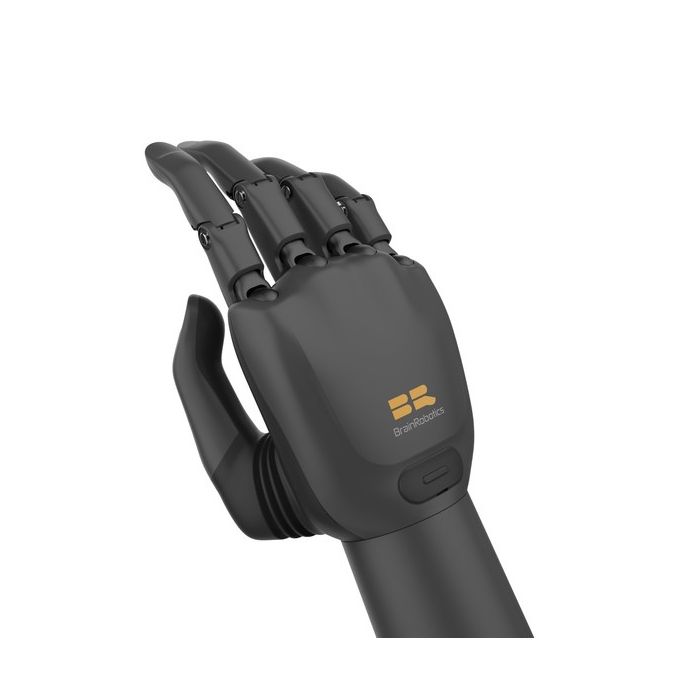
The BrainCo Revo 1 Intelligent Dexterous Bionic Hand is a robotic dexterous hand platform from BrainCo, a brain-computer-interface and human-machine-interface company that publicly lists “BrainCo Bionic Dexterous Hand Revo1” among its product lines on its official website. BrainCo positions itself as a company working across bionic hands, bionic knees, neurotechnology, and AI-oriented robotics solutions.
In stock
- BRAND:
- BRAINCO
- PART #:
- Intelligent Dexterous Bionic Hand
- ORIGIN:
- China
- Warranty:
- 12 MONTHS
- AVAILABILITY:
- SUBJECT TO AVAILABILITY
- SKU:
- BrainCo-Dexterous-Bionic-Hand
BrainCo Revo 1 Intelligent Dexterous Bionic Hand
Ask any hand therapist where the skill of a hand lives and the answer is the thumb. The BrainCo Revo 1 Intelligent Dexterous Bionic Hand takes that answer seriously: its thumb has two active degrees of freedom, and the four fingers beside it are built to follow whatever they close around. For a lab or product team that wants to study grasping on real hardware, that is a sensible place to start.
The product is available through this page, by quotation.
Background
The company and the Revo 1 line
BrainCo is the maker behind the Revo hands. The Revo 1 is the generation covered here, and the catalog groups it in the BrainCo Revo 1 category. Later generations sit beside it for buyers who want to compare, such as the BrainCo Revo 2 Basic Right Dexterous Bionic Hand (XRR) and the BrainCo Revo 3-21 Basic Robot Hand.
The sources name three versions of the Revo 1: Revo 1 Basic (MRL1/MRR1), Revo 1 Basic Touch (MTL1/MTR1) and Revo 1 Advanced (MEL2/MER2). Each pair of codes points to a left-hand and a right-hand model. Tactile sensing depends on the SKU, so the version you choose decides what the hand can feel. Please quote the model code in every enquiry.
How the hand is put together
The Revo 1 is a biomimetic dexterous hand with 6 active joints and 10 degrees of freedom. The gap between those two numbers comes from the passive joints. The thumb has two active degrees of freedom, one for abduction/adduction and one for flexion/extension. Each of the other four fingers has one active degree of freedom for flexion/extension and one passive degree of freedom for flexion/extension.
In practice, this means the motors do not have to dictate every angle of every finger. The passive joint lets a finger settle against the shape in front of it. The result is a hand that is simpler to command than a fully driven design, yet more adaptable than a two-jaw gripper.
Technical Specifications
| Specification | Value |
|---|---|
| Active joints | 6 |
| Degrees of freedom | 10 |
| Thumb | 2 active degrees of freedom (abduction/adduction, flexion/extension) |
| Each of the four fingers | 1 active and 1 passive degree of freedom (flexion/extension) |
| Maximum hand load | 30 kg |
| Five-finger grip force | 50 N |
| Supply voltage (Revo 1 Basic) | 9.5 ~ 28 V |
| Default device ID | 1, adjustable within 1 - 254 |
| Software development kits | C SDK and Python SDK |
| Versions | Revo 1 Basic (MRL1/MRR1), Revo 1 Basic Touch (MTL1/MTR1), Revo 1 Advanced (MEL2/MER2) |
Specifications as published by the manufacturer; confirmed against the datasheet at quotation.
The manufacturer has not published the weight, the dimensions, the IP rating, the contents of the box or the operating noise; they are confirmed at quotation.
What makes the Revo 1 different from a simple gripper?
A parallel gripper has one motion: open and close. It is excellent on a production line where every part is the same, and awkward almost everywhere else. The Revo 1 trades that simplicity for a thumb that can swing across the palm and four fingers that wrap. The combination lets a program approach an object from the side, close the fingers and let the passive joints take up the shape.
The manufacturer also describes a behavior it calls turbo mode. After a finger stalls against an object, it pauses for the configured stall duration, then continues gripping at 500 ms intervals. For a developer, this is a useful detail: contact does not end the grip routine, and the hand keeps working at the hold instead of simply stopping.
The figures for load and grip are worth reading together. The maximum hand load is 30 kg and the five-finger grip force is 50 N. They describe different things, so please do not treat one as a conversion of the other. Both are stated for the hand as a whole product line and are confirmed with the quotation for your version.
How does the Revo 1 behave at power-on and in a networked setup?
When the hand is powered on, it automatically runs a position calibration sweep. All fingers move during it, so keep the hand clear of obstacles, cables and people before you switch on. Build this into your cell layout and your startup procedure from day one, not after the first surprise.
On the communication side, the default device ID is 1, and you can change it within the range of 1 - 254. That matters as soon as you put more than one hand on the same setup, for instance a left and a right hand on a dual-arm platform. Give each hand its own ID before you integrate them.
For software, the manufacturer offers a C SDK and a Python SDK. Python suits quick experiments and teaching, while C suits embedded or performance-minded work. The Basic version runs on a supply voltage of 9.5 ~ 28 V. The sources do not give a supply voltage for the other versions here, so confirm it at quotation.
Who is the Revo 1 for?
Robotics research groups are the clearest fit. A hand with a two-axis thumb and mixed active and passive joints gives students and researchers real grasping problems to solve, without the cost and complexity of a fully driven hand.
Assistive-technology and rehabilitation developers are another. Anyone prototyping a device that has to hold everyday objects will benefit from a hand that is built on a human pattern. Universities and training centers around the Caribbean and beyond can use it to teach manipulation as a hands-on subject.
Integrators building service or demonstration robots will also find it a good match for an arm that needs more than a clamp. If your project needs touch feedback, look at the versions with tactile sensing, since this depends on the SKU. If you want to compare generations first, the BrainCo Revo 2 Basic Left Dexterous Bionic Hand (XRL) and the BrainCo Revo 3-21 Touch Robot Hand are on this site. Teams working in healthcare may also browse the Medical Robots category.
What is the Revo 1 used for?
- Grasping research. Study how a thumb and four adaptive fingers hold different shapes, with the stall behavior as a variable you can tune.
- Teaching manipulation. Give students a real hand with a C SDK and a Python SDK to program, in place of a simulation alone.
- Assistive-device prototyping. Test hold strategies for devices meant to help people with everyday objects.
- Rehabilitation robotics studies. Use a human-patterned hand as a reference platform in therapy and rehabilitation projects.
- Robot arm end-effector. Fit the hand to an arm that needs more than open-and-close motion.
- Demonstration and exhibition work. Show visitors a hand that calibrates itself at power-on and moves like a human one.
Pricing and Availability
We do not print prices on this page. Please ask for a quotation, telling us the version and the model code you want (left or right hand). Delivery, customs and support are arranged together with the quotation. The Revo 1 Intelligent Dexterous Bionic Hand is available on this page.
Frequently Asked Questions
How many joints and degrees of freedom does the Revo 1 have?
It has 6 active joints and 10 degrees of freedom. The difference comes from the passive joints in the four fingers.
How strong is the grip?
The five-finger grip force is 50 N and the maximum hand load is 30 kg. These are separate figures for separate purposes.
Which versions are there?
Revo 1 Basic (MRL1/MRR1), Revo 1 Basic Touch (MTL1/MTR1) and Revo 1 Advanced (MEL2/MER2). Tactile sensing depends on the SKU.
What happens when the hand is switched on?
It runs a position calibration sweep, and all fingers move during it. Keep the working area clear before you apply power.
Can I change the device ID?
Yes. The default device ID is 1, and you can set it anywhere within 1 - 254.
What software can I use?
The manufacturer provides a C SDK and a Python SDK.
Where can I buy the Revo 1 and what does it cost?
You can request it through this page, by quotation. We do not list a price here; the quotation covers the version you choose, together with delivery, customs and support.
Summary
The Revo 1 starts with the thumb and builds outward: two active degrees of freedom there, then four fingers that combine a driven joint with a passive one. The result is a hand with 6 active joints and 10 degrees of freedom, a 30 kg maximum hand load, a 50 N five-finger grip force and a stall behavior that keeps working the grip. It suits researchers, educators and developers who want to work on real grasping. If that describes your project, this page is the starting point.


