
Robotera XHAND1 Dexterous Left Hand w
In stock
- BRAND:
- ROBOTERA
- MODEL:
- LEFT XHAND1
- ORIGIN:
- China
- Warranty:
- 12 MONTHS
- AVAILABILITY:
- SUBJECT TO AVAILABILITY
- SKU:
- RobotEra-Left-XHAND1
Robotera XHAND1 Dexterous Left Hand w
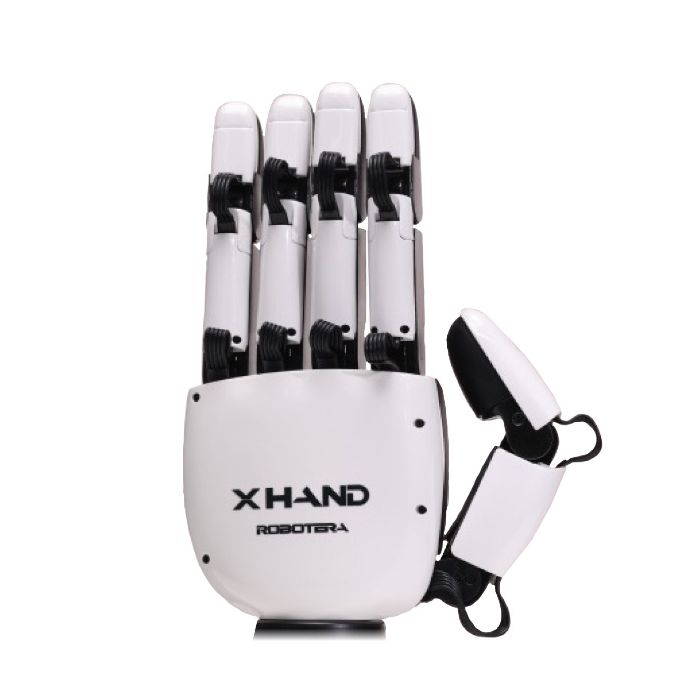
Most robot hands are built to hold things; the Robotera XHAND1 Dexterous Left Hand w is built to feel them. Where a simple gripper opens and closes, this hand moves its fingers independently and reports force and temperature back from the fingertips. That makes it a tool for teams who teach machines to handle the world the way people do.
The product is available through this page, by quotation.
Background
Robotera and the XHAND1 lineage
Robotera is a robotics company whose range runs from humanoid robots to the hands those robots use. Its catalog includes the RobotEra L7 Bipedal Humanoid Robot w and the RobotEra M7 Upper Body Wheeled Humanoid Robot. The XHAND1 is the company's dexterous hand, and it is made in two versions: Left (XHAND1-2L32) and Right (XHAND1-2R32). This page covers the left hand.
The hand has already found its way into serious laboratories and companies. The source names Skild AI, Humanoid AI and Extend Robotics among the companies that have adopted the XHAND1. It also names UC Berkeley, MIT and ByteDance Seed among the universities and research institutions. For a buyer, that is a useful signal: the hand is in daily use by teams working on manipulation and embodied AI.
Positioning and key technology
The XHAND1 is a fully direct-drive, five-fingered dexterous hand with 12 active degrees of freedom. Its joints are independently actuated, so each active joint can be commanded on its own instead of moving as part of a coupled linkage. Researchers value this because it gives the control software more freedom to shape how the hand grasps.
The second pillar is touch. The fingertips carry 270-degree (10x12x5) tactile sensors that detect 3D force and temperature, with a simulated plug-in. Motion and sensing together are what turn a mechanical hand into a platform for learning dexterous skills.
If you are comparing options within the range, the Robotera XHAND1 - Lite Elfin Hand (XHAND1-Lite) is a separate product with its own specification. You can also browse the wider Hands category.
Technical Specifications
| Specification | Value |
|---|---|
| Active degrees of freedom | 12, independently actuated joints |
| Drive type | Fully direct-drive |
| Fingertip tactile sensors | 270-degree (10x12x5), 3D force and temperature, with a simulated plug-in |
| Size (XHAND1 series) | 191 × 94 × 47 mm |
| Weight (XHAND1 series) | 1.1 kg |
| Maximum single-hand grip force (XHAND1 series) | 80 N |
| Maximum liftable object weight (XHAND1 series) | Up to 25 kg |
Specifications as published by the manufacturer; confirmed against the datasheet at quotation.
The manufacturer has not published the left-hand-specific dimensions, the left-hand-specific weight, the left-hand-specific electrical ratings, the IP rating or the contents of the box; they are confirmed at quotation.
What makes the XHAND1 Left Hand different from a basic gripper?
A basic gripper is designed for one job: close on an object and hold it. That works well on a production line where the parts never change. It works poorly when the task is to pick up a tool, turn it and place it, or to handle objects of unfamiliar shapes.
The XHAND1 takes the opposite approach. With 12 active degrees of freedom and independently actuated joints, the hand can form many different postures. It is also a five-fingered hand, so it can approach objects in the way a human hand does. Researchers who train robots from human demonstrations often prefer this form, because the hand's shape resembles the one being demonstrated.
The direct-drive design is the other difference. The XHAND1 is fully direct-drive, which is part of how the hand's joints are actuated individually.
Strength is not given up for finesse. The hand offers a maximum single-hand grip force of 80 N and can lift objects weighing up to 25 kg. Those figures belong to the XHAND1 series.
What does the fingertip sensing add?
Vision tells a robot where an object is. Touch tells it whether the object is slipping, how hard it is being squeezed and whether it is warm or cold. The XHAND1 fingertips carry 270-degree (10x12x5) tactile sensors that detect 3D force and temperature, with a simulated plug-in.
For a laboratory, this data is valuable twice over. It lets a controller adjust grip in real time, and it gives learning algorithms a richer signal than images alone. The simulated plug-in is meant for teams that want to bring the sensing into simulation work as well as the physical hand.
Who is the XHAND1 Left Hand for?
The first group is university and institute laboratories. Teams working on dexterous manipulation, imitation learning and tactile research need a hand with many controllable joints and real sensing. Institutions such as UC Berkeley, MIT and ByteDance Seed are named as adopters.
The second group is companies building humanoid robots or mobile manipulators. A humanoid needs two hands, and a bimanual setup needs both versions. If your project requires the mirrored hand, see the Robotera XHAND1 Dexterous Right Hand w. The Left version here suits the left arm of such a pair.
The third group is integrators and technology teams in the Caribbean and beyond who are exploring advanced automation and want to build local expertise in robotic manipulation. For them, the hand is a way to start prototyping real tasks. Those who would rather see more options can look through the Robot Hands category first.
What is the XHAND1 Left Hand used for?
- Dexterous manipulation research. Test grasping and in-hand movement strategies using independently actuated joints.
- Tactile learning. Collect 3D force and temperature data from the fingertips to train and evaluate control policies.
- Teleoperation and demonstration. Mirror a human operator's hand to record skills for robot learning.
- Humanoid and bimanual platforms. Fit the left hand of a two-handed robot working alongside the right-hand version.
- Simulation-to-real work. Use the simulated plug-in to connect fingertip sensing with simulated experiments.
- Teaching and training. Give students a working dexterous hand for courses in robotics and embodied AI.
Pricing and Availability
We do not print prices on this page. A quotation is the way to proceed: tell us your application and the quantity you need, and we prepare an offer. Delivery, customs and support are arranged with the quotation. The Robotera XHAND1 Dexterous Left Hand w is available on this page.
Frequently Asked Questions
How many degrees of freedom does the XHAND1 Left Hand have?
It has 12 active degrees of freedom with independently actuated joints.
What can the fingertip sensors measure?
The 270-degree (10x12x5) fingertip tactile sensors detect 3D force and temperature. A simulated plug-in is part of the sensor description.
How strong is the hand?
The XHAND1 series offers a maximum single-hand grip force of 80 N and can lift objects weighing up to 25 kg.
What are the size and weight?
The XHAND1 series is 191 × 94 × 47 mm and weighs 1.1 kg.
Is there a right-hand version?
Yes. The Right version (XHAND1-2R32) has its own page, listed as the Robotera XHAND1 Dexterous Right Hand w. The version on this page is the Left (XHAND1-2L32).
What is the IP rating, and what comes in the box?
Neither is listed on this page. Ask for both when you request a quotation.
Where can I buy the Robotera XHAND1 Dexterous Left Hand w and what does it cost?
You can request it through this page, by quotation. We do not list prices here; the offer is prepared once we know your requirements.
Summary
The XHAND1 Left Hand is for teams that want a robot to feel as well as grip. It combines 12 independently actuated joints, a fully direct-drive design and fingertip tactile sensing for 3D force and temperature, and its adopters include leading companies and universities. For a project that needs a hand which feels what it holds, this page is the starting point.
Specifications
General
Physical
Mobility
Shipping
What's included
Downloads
Related Products
Out of stock


