
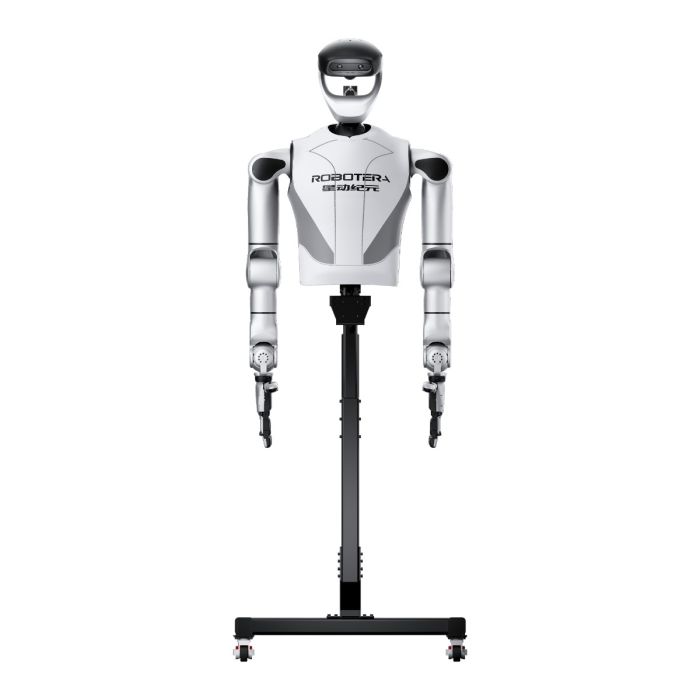
RobotEra M7 Upper Body Wheeled Humanoid Robot
In stock
- BRAND:
- ROBOTERA
- MODEL:
- M7
- ORIGIN:
- China
- Warranty:
- 12 MONTHS
- AVAILABILITY:
- SUBJECT TO AVAILABILITY
- SKU:
- RobotEra-M7
RobotEra M7 Upper Body Wheeled Humanoid Robot
Most people picture a humanoid robot walking. Yet a great deal of useful work happens at bench height, where two hands, a pair of eyes and a steady torso matter far more than a stride. The RobotEra M7 Upper Body Wheeled Humanoid Robot is built for that kind of work: embodied AI research, teleoperation and dexterous manipulation in laboratory and industrial settings.
The product is available through this page, by quotation.
Background
RobotEra and the M7 lineage
RobotEra is a humanoid robotics brand whose range spans several body forms, from full-body machines to upper-body platforms and dexterous hands. The M7 sits in the upper-body part of that range. It is described as a sibling of the full-body RobotEra L7 Bipedal Humanoid Robot, and the manufacturer states that the M7 can be easily upgraded to the full-body L7 model. For a team that wants to begin with manipulation and grow later, that upgrade path is a practical part of the story.
Other robots from the same brand can be found in the Humanoids category, which is a useful place to compare body forms before settling on one.
Positioning and key technology
The M7 is an upper body humanoid robot. Its design puts the engineering effort into the parts that touch the work: two arms, ten fingers and a stereo RGB vision system for perception. The structure uses aluminum alloy and engineering composites, and the actuation combines electric servo drives with harmonic reducers and precision robotic joints.
On the software side, the robot is built on Linux and ROS, two environments that robotics laboratories already know well. It is also compatible with Robotera embodied AI and VLA models, so a team can connect learned behaviors to a physical platform without building the whole stack from scratch. Ethernet, USB and WiFi provide connectivity.
Browse the wider Upper Body Humanoids category to see how this form factor is used across the market.
Technical Specifications
| Specification | Value |
|---|---|
| Product type | Upper body humanoid robot for embodied AI research, teleoperation and dexterous manipulation |
| Height | 119 centimeters |
| Weight | 43 kilograms |
| Degrees of freedom (total) | 43 |
| Degrees of freedom in the hands | 24 |
| Fingers | 10, for two handed work |
| Structure | Aluminum alloy and engineering composites |
| Actuation | Electric servo drives with harmonic reducers and precision robotic joints |
| Vision | Stereo RGB |
| Connectivity | Ethernet, USB and WiFi |
| Software | Linux and ROS |
| AI model compatibility | Robotera embodied AI and VLA models |
| Upgrade path | Can be easily upgraded to the full-body L7 model |
Specifications as published by the manufacturer; confirmed against the datasheet at quotation.
The manufacturer has not published the payload, the battery capacity, the battery runtime, the power supply, the IP rating, the arm reach, the arm degrees of freedom, the compute platform, the package contents, the base or stand dimensions or the mobility base; they are confirmed at quotation.
What makes the M7 different from a full-body humanoid?
A full-body humanoid has to solve balance, locomotion and manipulation all at once. That is a fine goal for some programs, but it adds cost, complexity and risk to projects that only need hands to work. The M7 removes the legged problem from the equation and keeps the part that matters for bench tasks: a torso with arms, hands and eyes at a working height of 119 centimeters.
The result is a platform whose 43 degrees of freedom are concentrated in the upper body, with 24 of them in the hands. Ten fingers allow genuine two handed work, such as holding a part with one hand while the other adjusts or inserts it. For researchers collecting demonstration data or training manipulation policies, that concentration of capability is the point.
The M7 does not close the door on the rest of the body. Because it can be upgraded to the full-body L7, a team can start with manipulation and extend the platform later, rather than replacing it. Anyone who already knows they need a complete humanoid can look directly at the L7.
Why do Linux, ROS and VLA compatibility matter?
A robot is only as useful as the software that drives it. Linux and ROS are the working language of many research groups, which means existing tools, drivers and habits carry over. Students and engineers do not need to learn a closed environment before they can run their first experiment.
Compatibility with Robotera embodied AI and VLA models adds a second layer. Vision-language-action models connect what the robot sees and what it is told to what it does with its hands. With stereo RGB vision for perception, and Ethernet, USB and WiFi for connectivity, the M7 gives those models a physical body to work with and a way to reach the rest of the laboratory network.
Who is the RobotEra M7 for?
The first group is university and corporate research laboratories working on embodied AI. They need a repeatable platform with hands, vision and an open software base, and they value being able to collect data from teleoperation sessions and then train on it.
The second group is industrial engineering teams exploring manipulation-focused workflows. The manufacturer says the M7 is best aligned with tasks such as sorting goods and assembling products, so pilot cells for those tasks are a natural fit.
The third group is integrators and training institutions in the Caribbean and beyond that want a humanoid for demonstrations, coursework or proof-of-concept projects without taking on the demands of a walking robot.
Buyers who need a complete body, with legs included, should look at the RobotEra L7 Bipedal Humanoid Robot, which the M7 can be upgraded to. Those who only need hands for their own platform can review the Robotera XHAND1 Dexterous Right Hand.
What is the RobotEra M7 used for?
- Embodied AI research. A physical platform for training and testing models that connect perception to action.
- Teleoperation. An operator guides the arms and hands remotely, which also produces demonstration data.
- Dexterous manipulation studies. Two hands with ten fingers support work on grasping and in-hand handling.
- Sorting goods. Manipulation-focused pilots that pick items and place them by category.
- Assembling products. Two handed tasks in which parts are held, aligned and joined.
- Teaching and demonstration. A humanoid on the Linux and ROS stack for courses, labs and showcases.
Pricing and Availability
Every project has its own configuration, location and support needs, so the M7 is offered by quotation rather than at a listed amount. Delivery, customs and support are arranged with the quotation. Send us your requirements and the details of your application, and the RobotEra M7 Upper Body Wheeled Humanoid Robot is available on this page.
Frequently Asked Questions
How tall is the RobotEra M7 and how much does it weigh?
The robot stands 119 centimeters tall and weighs 43 kilograms.
How many degrees of freedom does it have?
The M7 integrates 43 degrees of freedom across its body, including 24 in the hands. It has 10 fingers for two handed work.
What software does it run?
The software environment is built on Linux and ROS. It is compatible with Robotera embodied AI and VLA models.
How does the M7 connect and perceive its surroundings?
Stereo RGB vision supports perception, while Ethernet, USB and WiFi provide connectivity.
Can the M7 be upgraded to a full-body robot?
Yes. The manufacturer states that the M7 can be easily upgraded to the full-body L7 model.
What tasks suit the M7 best?
It is best aligned with manipulation-focused workflows such as sorting goods and assembling products. It is also designed for embodied AI research and teleoperation.
Where can I buy the RobotEra M7 and what does it cost?
The M7 is available through this page by quotation. Send us your requirements and we will prepare a quotation, including delivery, customs and support arrangements.
Summary
The M7 starts from a simple observation: much of the valuable work in robotics happens at the bench, not on the stairs. By concentrating 43 degrees of freedom in an upper body, with 24 in the hands, building on Linux and ROS and offering a path to the full-body L7, it gives research and industrial teams a focused tool for manipulation. For a quotation on the RobotEra M7 Upper Body Wheeled Humanoid Robot, this page is the starting point.


