
RobotEra Q5 Wheeled Humanoid Service Robot w
In stock
- BRAND:
- ROBOTERA
- MODEL:
- Q5
- ORIGIN:
- China
- Warranty:
- 12 MONTHS
- AVAILABILITY:
- SUBJECT TO AVAILABILITY
- SKU:
- RobotEra-Q5
RobotEra Q5 Wheeled Humanoid Service Robot w
Most service robots look impressive for ten minutes in a demo hall and then go quiet. The RobotEra Q5 Wheeled Humanoid Service Robot w is built around the opposite idea: a full working shift on the floor, with a runtime of over 4 hours on a 60V supply, two capable arms, and answers in more than 37 languages.
The product is available through this page, by quotation.
Background
The company and its lineage
ROBOTERA was founded in August 2023. The company has end-to-end capabilities in both software and hardware. It develops its own native embodied foundation model, ERA-42, together with a new AI-defined hardware platform. For a young company, that is a wide scope: the thinking and the machine come from the same team.
The Q5 sits inside a family of humanoid products. It shares core components with STAR1, which is meant to cut research, development and deployment costs. Buyers who want to compare approaches can look at the RobotEra Star1 Humanoid Robot, the RobotEra L7 Bipedal Humanoid Robot w and the RobotEra M7 Upper Body Wheeled Humanoid Robot.
Positioning and key technology
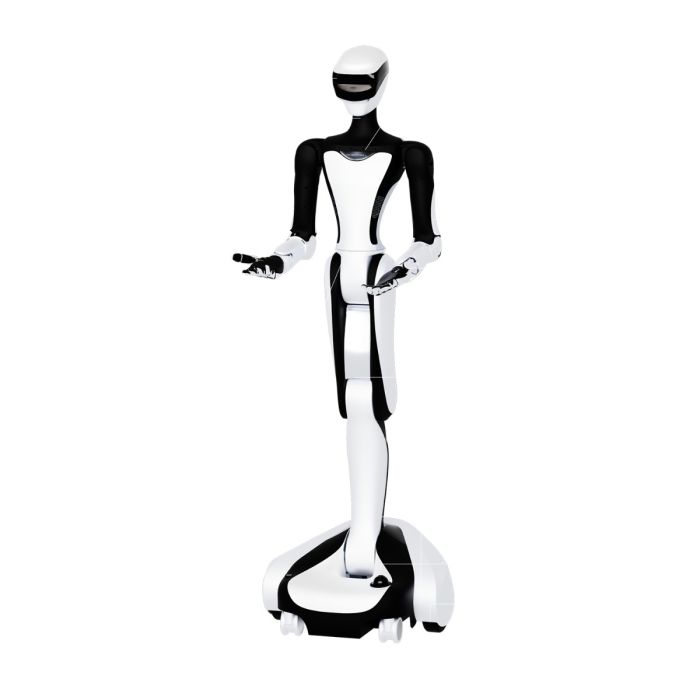
The Q5 is a super-humanoid wheeled service robot for professional service scenarios. The word wheeled matters. Instead of walking, the robot rolls on an ultra-compact base, which keeps the lower body small and suits confined workspaces. The upper body is where the humanlike work happens: bionic 7-axis high-precision robotic arms and hands with 11 degrees of freedom, known as Fairy Hands. Across the whole machine there are 44 degrees of freedom.
The robot is built on a fully self-developed modular system. This is what allows secondary development, so integrators can adapt the platform to their own task. The platform forms a closed loop of teleoperation, data collection and model iteration: an operator guides the robot, the motion data is collected, and the embodied AI model ERA-42 learns from that human-generated motion data.
Technical Specifications
| Specification | Value |
|---|---|
| Product type | Super-humanoid wheeled service robot |
| Height | 1650 mm |
| Weight | 70 kilograms |
| Degrees of freedom | 44 |
| Hand degrees of freedom | 11 |
| Arms | Bionic 7-axis high-precision robotic arms |
| Arm reach | 1380 mm |
| Single-hand lift capacity | 10 kg with one hand |
| Base dimensions | 582mm × 519mm × 225mm |
| Runtime | Over 4 hours on a 60V supply |
| Battery | High-performance lithium battery with BMS |
| Perception | Dual-modal fusion of 3D LiDAR and stereo camera |
| Communication and control | Ethernet/USB, full-body teleoperation, 2.4G wireless control |
| Teleoperation | Whole-body control via data gloves and VR devices |
| Language recognition | Over 37 languages |
| Embodied AI model | ERA-42 |
| Interaction | Status display screen and status lights; voice, vision and body language |
Specifications as published by the manufacturer; confirmed against the datasheet at quotation.
The manufacturer has not published the ingress protection rating, the battery capacity, the charging time, the operating temperature range, the processor, the maximum speed or the contents of the box; they are confirmed at quotation.
What makes the Q5 different from a typical service robot?
The first difference is the pair of hands. Many guide robots are a screen on a moving column. The Q5 has two 7-axis arms with a reach of 1380 mm, and they can extend over 2 meters to touch objects on the ground or above shoulder height. Each hand has 11 degrees of freedom, and one hand can lift 10 kg, roughly the weight of 20 bottles of water. That makes handing over items, pointing, and light physical tasks realistic, not just talking.
The second difference is the footprint. The base measures 582mm × 519mm × 225mm, and the robot navigates with LiDAR and vision fusion. For a shop with narrow aisles or a hotel with tight corners, a compact base is often the deciding point. The perception system pairs 3D LiDAR with a stereo camera. It identifies obstacles in complex environments, such as irregular objects and moving pedestrians, and it recognizes tilted or wrinkled QR codes, which helps in unstructured settings where signage is not perfect.
The third difference is how the robot is taught and controlled. It supports whole-body control through data gloves and VR devices, so an operator can step into the robot for real-time manipulation. Ethernet/USB communication and 2.4G wireless control add practical options for integration. Because the platform supports secondary development, a project team can build on it rather than accept a fixed behavior set.
How does the Q5 communicate with people?
The robot accepts commands in over 37 languages. That is a real advantage in the Caribbean, where visitors arrive from many countries and hotels, ports and attractions deal with several languages in a single day. The Q5 speaks with ease and empathy, whether it works as a shopping assistant, receptionist or tour guide.
Interaction is not voice alone. A status display screen and status lights complement the speech, and the robot combines voice, vision and body language, which increases user affinity in scenarios such as shopping guidance and interpretation. People can see what the robot is doing, and that builds trust faster than a voice from a box.
Who is the Q5 for?
Ideal settings are commercial services, cultural tourism, hotels, elderly care, education and multi-robot collaboration. In practice, that points to a few buyer groups.
Hotels and resorts can use it for reception, guidance and delivery. Museums, heritage sites and tour operators can use it for commentary in many languages. Retail operators can use it for shopping guidance. Care providers and schools can assess it for assistance and teaching roles. Universities and integrators will look at secondary development and the teleoperation and data-collection loop, because they can build their own applications on a modular platform.
If your project needs a walking machine, the RobotEra L7 Bipedal Humanoid Robot w is the sibling to review. If you mainly need hands, the Robotera XHAND1 - Lite Elfin Hand (XHAND1-Lite) is listed separately. Tell us the task and we will point you to the right model.
What is the Q5 used for?
- Guidance. Leads guests through lobbies, shops and galleries, using its navigation and multilingual speech.
- Commentary. Explains exhibits, routes and points of interest, in more than 37 languages.
- Delivery. Carries items to a destination, using its arms and mobile base.
- Shoe shining. A named service task for the Q5, showing what the dexterous hands can do.
- Reception and shopping assistance. Greets visitors and answers questions, using voice, screen, lights and body language.
- Teleoperation and data collection. An operator in data gloves and VR devices controls the robot, and the motion data feeds model iteration.
Pricing and Availability
We do not print prices on this page. A quotation is the way to proceed: tell us your site, your task and the number of units, and we respond with a written offer. Delivery, customs and support are arranged with the quotation, so you see the whole project before you commit. The RobotEra Q5 Wheeled Humanoid Service Robot w is available on this page.
Frequently Asked Questions
How tall is the Q5 and how much does it weigh?
The Q5 is 1650 mm tall and weighs 70 kilograms.
How long does it run on a charge?
The runtime is over 4 hours on a 60V supply, using a high-performance lithium battery with BMS. The battery capacity and charging time are confirmed at quotation.
Can it handle objects?
Yes. It has 7-axis arms with a reach of 1380 mm and 11-degree-of-freedom hands, and it can lift 10 kg with one hand.
Which languages does it understand?
It recognizes commands in over 37 languages.
How is the Q5 controlled?
It supports Ethernet/USB communication, 2.4G wireless control and full-body teleoperation. Whole-body control works through data gloves and VR devices.
Can we develop our own applications on it?
Yes. The modular system supports secondary development and shares core components with STAR1.
Where can I buy the Q5 and what does it cost?
You can buy it through this page, by quotation. We do not list a price here; request a quotation with your project details and we will respond with a written offer.
Summary
The Q5 aims to last through a working shift and to be useful once it arrives. It offers a compact wheeled base, two capable arms with dexterous hands, LiDAR and stereo vision, over 4 hours of runtime on a 60V supply, and speech in more than 37 languages. It also offers teleoperation and secondary development for teams that want to adapt it. For hotels, tourism, retail, care and education projects in the Caribbean, this page is the starting point.
Specifications
General
Physical
Mobility
Battery + Power
Shipping
What's included
Downloads
Related Products
Out of stock


