
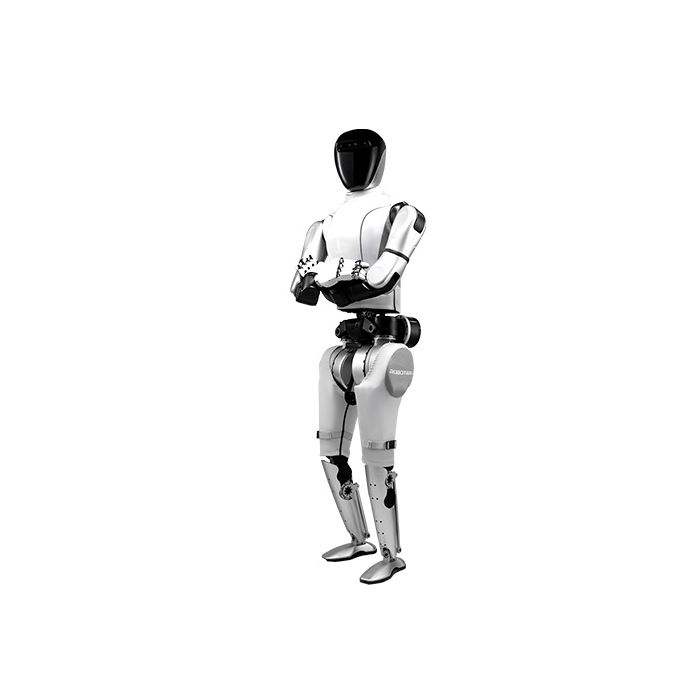
RobotEra Star1 Humanoid Robot
Out of stock
- BRAND:
- ROBOTERA
- PART #:
- Star1
- Warranty:
- 12 MONTHS
- AVAILABILITY:
- SUBJECT TO AVAILABILITY
- SKU:
- RobotEra-Star1
RobotEra Star1 Humanoid Robot
A factory built for people rarely bends to suit a machine, so the machine has to bend to suit the factory. The RobotEra Star1 Humanoid Robot takes that idea literally: a full-size biped with two arms, two hands and a human frame, meant to work at the benches, bins and aisles that already exist.
The RobotEra Star1 Humanoid Robot is available through this page, by quotation.
Background
A young company with its own AI
ROBOTERA was founded in August 2023. The company has end-to-end capabilities in both software and hardware. It develops its own native embodied foundation model, ERA-42, together with a new AI-defined hardware platform. That pairing matters for a humanoid. The body and the software that drives it are designed by the same team, rather than assembled from unrelated parts.
The Star1 is the bipedal robot in this lineage that stands out for running and jumping. Other ROBOTERA machines in our range take different forms, such as the wheeled M7 and Q5, and the XHAND1 hand is also sold on its own. The Star1 brings the walking body and the dexterous hand together in one machine.
Positioning and key technology
The Star1 stands 171 cm tall and has 55 degrees of freedom across its structure. Its legs provide 12 DOF, its waist 3 DOF and its neck 2 DOF. Each arm has 7 DOF and ends in the ROBOTERA XHAND1, a five-fingered dexterous hand with 12 active DOF and full direct drive.
The joints reach up to 400 Nm of torque and peak rotational speeds of 25 rad/s. ERA-42, ROBOTERA's proprietary end-to-end AI model, lets the robot walk, run and jump stably on challenging terrain. In real-world outdoor conditions the Star1 achieves a top running speed of 3.6 m/s, setting a world record for bipedal robots.
In practice the Star1 sits at the capable end of the humanoid class. It is aimed at buyers who need locomotion, two-handed manipulation and an embodied AI model in one platform, not at those who only need a stationary arm.
Technical Specifications
| Specification | Value |
|---|---|
| Height | 171 cm |
| Weight | 63 kg |
| Degrees of freedom (overall) | 55 |
| Leg degrees of freedom | 12 DOF |
| Waist degrees of freedom | 3 DOF |
| Neck degrees of freedom | 2 DOF |
| Arms | 7 DOF each, dual bionic arms |
| Arm lifting capacity | 20 kg in total |
| Hand | ROBOTERA XHAND1, five-fingered, 12 active DOF, full direct drive |
| Joint torque | Up to 400 Nm |
| Peak rotational speed | 25 rad/s |
| Top running speed | 3.6 m/s |
| Runtime per charge | 4 hours |
| AI model | ERA-42, proprietary end-to-end model |
Specifications as published by the manufacturer; confirmed against the datasheet at quotation.
The manufacturer has not published the payload, the IP rating, the battery capacity, the charging time, the connectivity, the sensors and cameras, the operating system, the contents of the box, the operating temperature or the onboard compute platform; they are confirmed at quotation.
What makes the Star1 different from a wheeled humanoid?
A wheeled humanoid is a sound choice on smooth, level floors. It gives up the legs in exchange for a simpler base. The Star1 keeps the legs, and with them the ability to follow a person through spaces designed for people. Its 12 leg DOF and 3 waist DOF give it room to shift weight, turn and step. ERA-42 is the model that keeps it steady on challenging terrain.
If your task happens at a single workstation and the robot never needs to travel, an upper-body wheeled model such as the RobotEra M7 Upper Body Wheeled Humanoid Robot deserves a look. If the work involves moving between stations, stepping over thresholds or working outdoors, the biped form is what you are paying for.
How does the Star1 handle delicate and heavy work together?
Two figures describe the range of the machine. Joint capability reaches up to 400 Nm of torque, which speaks to strength. The XHAND1 hand has five fingers and 12 active DOF with full direct drive, which speaks to fine manipulation. The dual 7-DOF bionic arms are capable of lifting 20 kg in total.
This combination suits precision assembly and quality checks alongside packaging and material transport. The same robot can place a small part carefully and then carry a carton to the next station.
Who is the RobotEra Star1 Humanoid Robot for?
Manufacturers are the clearest fit. Automotive assembly and 3C manufacturing are the application areas named for this robot, and plants of that kind will recognize the tasks. Integrators building pilot cells for humanoid labor will want a biped with a dexterous hand and its own AI model.
Universities and research institutes can use it as a platform for embodied AI, locomotion and manipulation work. Logistics and packaging operations with mixed floors may also find the legged form useful.
Not every buyer needs a biped. For customer-facing roles, the RobotEra Q5 Wheeled Humanoid Service Robot is the more natural choice. If you want to compare other legged models, see the RobotEra L7 Bipedal Humanoid Robot or browse the Bipedal Humanoids category. The wider Humanoids category shows the full ROBOTERA family.
What is the RobotEra Star1 Humanoid Robot used for?
- Precision assembly. Two 7-DOF arms and a five-fingered hand place and fit parts in automotive and 3C production.
- Quality checks. The robot handles inspection tasks that call for careful positioning of the head and hands.
- Packaging. Dexterous hands and a human-height reach suit boxing and packing stations.
- Material transport. The legs carry the robot, and what it holds, between workstations on the factory floor.
- Locomotion research. A biped that walks, runs and jumps gives teams a platform for gait and balance studies.
- Embodied AI development. ERA-42 and a full humanoid body make a base for training and testing intelligent behavior.
Pricing and Availability
We do not publish prices for this robot. A quotation is the way to start, and we prepare it around your application and your site. Delivery, customs and support are arranged with the quotation. The RobotEra Star1 Humanoid Robot is available on this page.
Frequently Asked Questions
How tall is the RobotEra Star1 and how much does it weigh?
The Star1 stands 171 cm tall and weighs 63 kg.
How many degrees of freedom does it have?
It has 55 degrees of freedom overall. The legs have 12, the waist 3, the neck 2 and each arm 7, and the XHAND1 hand adds 12 active DOF.
How fast can it run?
In real-world outdoor conditions it reaches a top running speed of 3.6 m/s, setting a world record for bipedal robots.
How long does it run on one charge?
The runtime per charge is 4 hours.
What AI does the Star1 use?
It uses ERA-42, ROBOTERA's proprietary end-to-end AI model. The model lets it walk, run and jump stably on challenging terrain.
How much can the arms lift?
The dual 7-DOF bionic arms are capable of lifting 20 kg in total. Joint torque reaches up to 400 Nm.
Where can I buy the RobotEra Star1 Humanoid Robot and what does it cost?
You can request it through this page, by quotation. The cost depends on your configuration and project, so we give it in the quotation and not on the page.
Summary
The idea behind the Star1 is simple: let the robot adapt to the factory instead of rebuilding the factory around the robot. Its 171 cm frame, 55 degrees of freedom, dexterous XHAND1 hands and ERA-42 AI model are all in service of that idea. If a humanoid that works at human scale fits your plans, this page is the starting point.


