
RobotEra L7 Bipedal Humanoid Robot w
In stock
- BRAND:
- ROBOTERA
- PART #:
- L7
- ORIGIN:
- China
- Warranty:
- 12 MONTHS
- AVAILABILITY:
- SUBJECT TO AVAILABILITY
- SKU:
- RobotEra-L7
RobotEra L7 Bipedal Humanoid Robot w
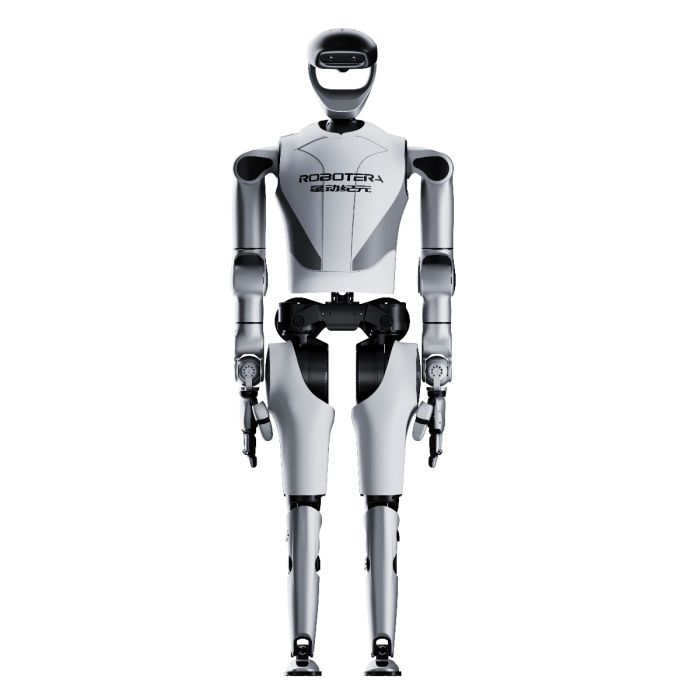
Warehouses, workshops and stages have one thing in common: people built them, and everything in them is sized for a person. A robot that must work in those spaces has to arrive at human scale, with legs, arms and hands to match. The RobotEra L7 Bipedal Humanoid Robot w is made for that job. It is a full-size, high-performance bipedal humanoid built for deployment in more than one kind of setting.
The product is available through this page, by quotation.
Background
The company and the L7 line
ROBOTERA is the brand behind the L7, and the same brand also makes wheeled humanoids, dexterous hands and other humanoid platforms. The L7 is its full-size walking machine. Wheeled siblings such as the RobotEra M7 Upper Body Wheeled Humanoid Robot serve a different purpose, so the L7 is the one to consider when legs, running and jumping matter. Buyers who want to see the wider range can browse the Humanoids category.
Within that range, the L7 stands at 171 cm. Its legs support walking, running at 4m/s and 360° rotating jumps. The robot can also perform street dancing, and it can carry out functional tasks such as sorting, barcode scanning and screw fastening in logistics and industrial settings.
Positioning and key technology
The L7 is built around a quasi-direct drive joint system with a self-developed modular skeletal structure. By eliminating conventional gear reducers, the design reduces power loss and achieves a more compact structure with improved force feedback accuracy, which allows real-time adjustment to impacts. The joints are self-developed semi-direct drive units with 400N·m peak torque and 25rad/s peak speed.
The frame is made of aerospace-grade aluminum alloy and carbon fiber, with built-in efficient heat dissipation for the high-power joints. Power comes from a high-performance lithium battery supported by a BMS. Together these choices put the L7 in the class of full-size machines meant for dynamic movement and practical work, rather than a tabletop or classroom demonstrator. Buyers comparing legged platforms can also look through the Bipedal Humanoids category.
Technical Specifications
| Specification | Value |
|---|---|
| Product type | Full-size high-performance bipedal humanoid robot |
| Height | 171 cm |
| Total weight | 65kg (excl. dexterous hands) |
| Dual-arm max payload | 20kg |
| Degrees of freedom | 55 full-body DOF |
| Locomotion | Walking, running (4m/s) and 360° rotating jumps |
| Joint peak torque | 400N·m |
| Joint peak speed | 25rad/s |
| Joint drive | Quasi-direct drive (semi-direct drive) joints, modular skeletal structure |
| Upper limb configuration | 7DOF humanoid robotic arms + 3DOF waist |
| Operation space | 2.1m diameter |
| Hand degrees of freedom | 12 independently actuated degrees of freedom |
| Hand response rate | 10 Hz |
| Perception system | Binocular vision + 3D LiDAR + microphone array |
| Frame material | Aerospace-grade aluminum alloy + carbon fiber |
| Interfaces | 1×HDMI, 1×Ethernet, 2×USB, 1×emergency stop and external power interface |
| Communication and control | Ethernet/USB communication, full-body teleoperation and 2.4G wireless control |
| Configurations | Full-body and upper-body interchangeable configuration |
Specifications as published by the manufacturer; confirmed against the datasheet at quotation.
The manufacturer has not published the battery capacity, the charging time, the IP rating, the operating system, the contents of the box, the dimensions beyond height or the onboard compute; they are confirmed at quotation.
What makes the L7 different from a wheeled humanoid?
The first difference is how it moves. A wheeled humanoid rolls on a base and concentrates on the upper body. The L7 has bipedal limbs that support walking, running at 4m/s and 360° rotating jumps. That makes it the better choice for dynamic displays and for spaces designed around a person on foot.
The second difference is the joint design. The quasi-direct drive system does without conventional gear reducers, which lowers power loss, gives a more compact structure and improves force feedback accuracy. In practice, that lets the robot adjust to impacts in real time. The joints reach 400N·m peak torque and 25rad/s peak speed, and the 55 full-body degrees of freedom give the machine a wide range of postures.
The third difference is the working envelope. The 7DOF arms and 3DOF waist build an operation space with a diameter of 2.1m. The dual-arm maximum payload is 20kg, and single-arm use is intended for dexterous tasks. Where the work is mostly at a bench or a conveyor and travel is not needed, the wheeled RobotEra M7 Upper Body Wheeled Humanoid Robot is worth comparing.
How do the full-body and upper-body configurations differ?
The L7 comes as an interchangeable configuration, in a full-body version and an upper-body-only version. The full-body version is the one for dynamic displays such as 360° spinning jumps and street dance performances, because it carries the legs. The upper-body-only version suits tasks in which the work happens within reach of the arms and hands and no walking is needed.
The 2.1m operation space, the 7DOF arms and the 3DOF waist describe the upper-limb system. Figures such as running speed and rotating jumps belong to the full-body version only. Please state which configuration you need when you request a quotation, so the figures you receive match it.
Who is the RobotEra L7 for?
Logistics and industrial teams are the first group. The robot is described as able to sort goods, scan barcodes and fasten screws. Its perception system supports obstacle avoidance in complex environments, such as irregular goods in logistics warehouses, and QR code recognition even when the code is tilted or wrinkled.
Commercial and exhibition operators are the second group. They can use the full-body version for dynamic displays, including spinning jumps and street dance performances, where a standing, moving robot draws attention.
Research and development groups are the third. Full-body teleoperation, Ethernet and USB communication and 2.4G wireless control give several ways to command the machine, and the interface panel adds HDMI and an emergency stop. Teams that want to explore bipedal platforms further can start from the Bipedal Humanoids category linked above. Buyers whose focus is the hand itself may also look at the Robotera XHAND1 Dexterous Right Hand w.
What is the RobotEra L7 used for?
- Sorting in logistics: the hands and perception system handle goods, including irregular items in a warehouse.
- Barcode and QR code scanning: the robot reads codes even when they are tilted or wrinkled.
- Screw fastening: the fingers are independently controlled, so it can press buttons on tools such as screw guns.
- Dynamic displays: the full-body version performs running, 360° spinning jumps and street dance.
- Teleoperated work: full-body teleoperation lets an operator guide the robot through tasks.
- Handling mixed objects: the 12-DOF hands move from gripping mechanical parts to handling soft packages.
Pricing and Availability
No price is printed on this page, because every L7 is quoted to the configuration and the project. Use the quotation request as your next step. Delivery, customs and support are arranged together with the quotation. The RobotEra L7 Bipedal Humanoid Robot w is available on this page.
Frequently Asked Questions
How tall is the L7 and how much does it weigh?
The L7 stands 171 cm tall. Its total weight is 65kg, excluding the dexterous hands.
How many degrees of freedom does it have?
The robot has 55 full-body DOF. The arms are 7DOF, with a 3DOF waist, and each hand has 12 independently actuated degrees of freedom.
How fast can it move?
Its bipedal limbs support walking, running at 4m/s and 360° rotating jumps. The joints reach 400N·m peak torque and 25rad/s peak speed.
What can it lift?
The dual-arm maximum payload is 20kg. Single-arm use is meant for dexterous tasks.
How is the L7 connected and controlled?
It has 1×HDMI, 1×Ethernet, 2×USB, 1×emergency stop and an external power interface. It supports Ethernet/USB communication, full-body teleoperation and 2.4G wireless control.
Which sensors does it use?
The perception system combines binocular vision, 3D LiDAR and a microphone array. It supports obstacle avoidance in complex environments.
Where can I buy the RobotEra L7 and what does it cost?
You can buy it through this page by requesting a quotation. The cost depends on the configuration and the project, so no price is shown here.
Summary
Spaces built for people call for machines that match them, and the L7 does so with a 171 cm frame, 55 degrees of freedom, strong joints and two hands ready for real tasks. It can run, jump and dance on stage, and it can sort, scan and fasten screws at work. For a quotation on the RobotEra L7 Bipedal Humanoid Robot w, this page is the starting point.
Specifications
General
Physical
Mobility
Performance
What's included
Downloads
Related Products
Out of stock


