
Robotera XHAND1 Dexterous Right Hand w
In stock
- BRAND:
- ROBOTERA
- MODEL:
- RIGHT XHAND1
- ORIGIN:
- China
- Warranty:
- 12 MONTHS
- AVAILABILITY:
- SUBJECT TO AVAILABILITY
- SKU:
- RobotEra-XHAND1
Robotera XHAND1 Dexterous Right Hand w
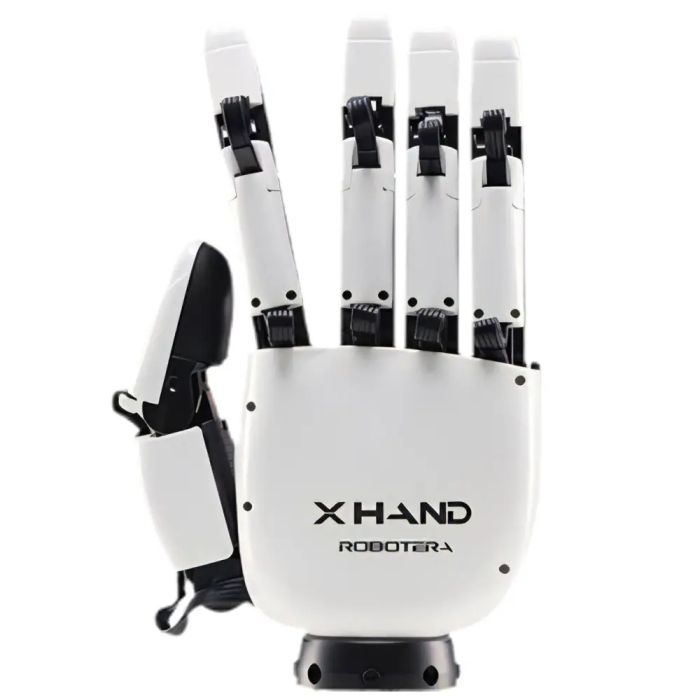
A robot is only as capable as the point where it touches the world, and that point is usually the hand. The Robotera XHAND1 Dexterous Right Hand w is built around that idea: a five-fingered right hand whose joints are driven by force-controlled gear modules, made for teams that want to study and build real manipulation rather than settle for a simple gripper.
The product is available through this page, by quotation.
Background
Robotera and the XHAND1 line
Robotera is a robotics company whose range on our network covers humanoid platforms as well as hands. Alongside the XHAND1 you will find the RobotEra Q5 wheeled service robot, the L7 bipedal humanoid, the M7 upper-body humanoid and the Star1 humanoid. A dexterous hand fits naturally into that family, because a humanoid body is of limited use until its hands can do real work.
The XHAND1 itself comes in a right-hand and a left-hand version, so a two-handed setup can be assembled from matching parts. The right hand described on this page is a separate listing from the Robotera XHAND1 Dexterous Left Hand w, and there is also a Robotera XHAND1 - Lite Elfin Hand (XHAND1-Lite) listed on its own page for buyers who want to compare the options.
The hand has already found its way into serious research settings. It has been adopted by Skild AI, Humanoid AI and Extend Robotics, as well as by universities and research institutions including UC Berkeley, MIT and ByteDance Seed. For a buyer in the Caribbean who is weighing a purchase from a distance, that is a useful signal about the kind of work the hand is meant for.
How the hand is driven and controlled
The core of the design is its actuation. The thumb is driven by 3 gear-driven, force-controlled joint modules, and the four fingers share 9 gear-driven, force-controlled joint modules. Because every module is force-controlled, the hand can be commanded by how hard it should press and not only by where a joint should be. That distinction matters when the task involves a fragile object, a slippery one, or a surface that should not be marked.
Three control modes are available: position control, current-loop force control, and force-position control. Position control suits repeatable, scripted motions. Current-loop force control lets you work directly with the motor effort. Force-position control blends the two, so a finger can move to a place and still behave gently when it arrives.
On the software side, the hand supports Linux, offers an SDK for C++ and Python, and works with ROS. Teams that already run their robots on ROS can therefore bring the hand into their existing setup without rebuilding their toolchain.
Technical Specifications
| Specification | Value |
|---|---|
| Version | Right hand |
| Weight | 1100 g |
| Thumb actuation | 3 gear-driven, force-controlled joint modules |
| Four-finger actuation | 9 gear-driven, force-controlled joint modules |
| Maximum grip force (whole hand) | 80 N |
| Lifting capacity | Objects weighing up to 25 kg |
| Working voltage | 24 V to 72 V |
| Control modes | Position control, current-loop force control, force-position control |
| Software support | Linux compatibility, SDK (C++/Python), ROS support |
Specifications as published by the manufacturer; confirmed against the datasheet at quotation.
The manufacturer has not published what is in the box, the IP rating, the operating temperature, the fingertip material or the mounting interface for the right hand; they are confirmed at quotation.
What makes the XHAND1 different from a simple gripper?
A parallel gripper opens and closes along one axis. It is fast, cheap to reason about and perfectly adequate for a great many pick-and-place jobs. It cannot, however, hold a tool the way a person does, roll an object between the fingertips or adapt its shape to something irregular.
The XHAND1 is aimed at exactly those gaps. Its thumb has its own set of three modules, and the four fingers share nine more, so the hand can form many different grasps instead of one. With a maximum whole-hand grip force of 80 N and the ability to lift objects weighing up to 25 kg, it is not a delicate laboratory toy either. The force-controlled modules let that strength be applied with care.
The trade-off is complexity. A multi-fingered hand asks more of the people who program it, and it asks for a proper control stack. That is why the software support matters: an SDK in both C++ and Python, along with ROS, gives researchers and integrators more than one way in. A team that only needs to open and close around a box will likely be better served by something simpler; a team that wants to learn how to manipulate will find that the hand rewards the effort.
Why does the working voltage range matter?
The hand accepts a working voltage of 24 V to 72 V. A wide window like this gives the integrator room when choosing a power source. A lab bench supply, a mobile platform with its own battery bus and a larger robot arm cell may all sit at different voltages, and a hand that tolerates a broad range is easier to move from one to another.
Power planning belongs to your own platform, so choose a supply that sits inside that window.
Who is the Robotera XHAND1 Dexterous Right Hand w for?
The most obvious buyers are university labs and corporate research groups working on robot learning and manipulation. The list of adopters, from UC Berkeley and MIT to Skild AI and ByteDance Seed, points that way. For these teams, a force-controlled hand with a clean software interface is a platform for experiments, not just a part.
Humanoid developers form a second group. If you are building or extending a humanoid with two hands, you will want both sides. This listing covers the right hand; the matching left hand has its own page. Buyers who would like to compare another option can also look at the XHAND1-Lite before deciding.
Integrators and automation engineers make up a third segment. They may be exploring tasks that are too varied for a gripper but still repeatable enough to teach. Technical colleges and training centers in the region may find the hand useful as well, because it is programmable in Python and runs under Linux, two things students are likely to know already.
What is the Robotera XHAND1 Dexterous Right Hand w used for?
- Robot learning research: collecting manipulation data and testing learned policies on a real multi-fingered hand.
- Humanoid platforms: giving a humanoid robot a capable right hand for handling everyday objects.
- Teleoperation experiments: studying how operators can guide a dexterous hand from a distance with position and force commands.
- Delicate handling trials: using force-controlled joints to test gentle grasps on fragile or irregular items.
- Tool-use studies: exploring how a robot can hold and operate hand tools with a firm grip.
- Teaching and training: showing students how an actuated hand is programmed through its C++ and Python SDK and ROS.
Pricing and Availability
We do not print prices on this page. Please request a quotation, and tell us how many hands you need, whether you want the right hand, the left hand or both, and what you plan to build with them. Delivery, customs and support are arranged together with the quotation, so you will know the full picture before you commit. The Robotera XHAND1 Dexterous Right Hand w is available on this page.
Frequently Asked Questions
Is this the right hand or the left hand?
This listing is the right hand. A separate listing covers the left hand, so you can order a matching pair if your project calls for two.
How strong is the grip?
The maximum single-hand grip force is 80 N, and the hand can lift objects weighing up to 25 kg. The joints are force-controlled, so that strength can be applied with care.
What does the hand weigh?
The right hand weighs 1100 g. Keep this in mind when you plan the payload of the arm or platform that will carry it.
What control modes does it offer?
It offers position control, current-loop force control and force-position control. You can choose the mode that suits each task.
What software can I use with it?
The hand supports Linux, provides an SDK for C++ and Python, and works with ROS. This lets most research teams connect it to their existing tools.
What power supply does it need?
The working voltage is 24 V to 72 V.
Where can I buy the Robotera XHAND1 Dexterous Right Hand w and what does it cost?
You can buy it through this page, by quotation. We do not publish a price here; send us your request and we will reply with the terms for your project.
Summary
The hand is where a robot either succeeds or fails at touching the world, and the XHAND1 right hand is built to give that moment more control. Its thumb and finger modules are gear-driven and force-controlled, it offers three control modes, and it connects through Linux, a C++ and Python SDK, and ROS. Its adopters in research and industry show where it is already at work. If you are planning a project that needs real dexterity, this page is the starting point.


